This article is for general education and does not replace an in-person assessment, examination, or imaging. Everyone's injury pattern, medical history, and goals differ; use what you read here to prepare better questions for your doctor.
Dr. Nitin N Sunku is a consultant orthopedic and sports medicine surgeon. He sees patients at Raghava Multispeciality Hospital, Attibele, on Sarjapura–Attibele Road, and at Health Nest Hospital, HSR Layout, Bengaluru. If pain is rapidly worsening, you cannot bear weight, you develop numbness or weakness in a limb, or you have fever after an injury, seek urgent medical care. For non-emergency evaluation and individualised treatment options, book through the contact page.
Topics across this blog include knee ligament and meniscus problems, shoulder pain and instability, hip and knee arthritis, fracture recovery principles, spine symptoms when urgent causes have been excluded, running and tendon overuse issues, and what to expect from arthroscopy or joint replacement discussions. If you are comparing sources online, cross-check dates and always confirm advice with an in-person clinician.
Early knee arthritis is the moment when regenerative care is most worth the conversation. A practical guide to PRP, GFC, hyaluronic acid, and lifestyle care for Grade 1–2 knee OA in Bengaluru.
The frustrating thing about early knee arthritis is that it doesn't look dramatic on a scan, but it can quietly start changing how you walk, exercise, and sleep. The good news: this is the stage where non-surgical and regenerative care can do the most useful work. The window is open. The biology still has something to work with.
This guide is for people who have been told they have Grade 1 or Grade 2 osteoarthritis of the knee — or who suspect it from symptoms like morning stiffness, ache after a long walk, or a knee that feels "tired" by evening. If you are not sure whether what you are feeling is early arthritis at all, Early Signs of Knee Osteoarthritis is the right place to start.
What does Grade 1–2 knee arthritis actually mean?
Knee arthritis is graded by what the X-ray shows and how the joint behaves clinically. A simplified version:
- Grade 1 — minor changes, slight joint space narrowing, possible small osteophytes. Often symptomatic only with overuse.
- Grade 2 — clearer joint space narrowing, more defined osteophytes, regular pain with activity, stiffness after rest.
- Grade 3 — moderate narrowing, multiple osteophytes, some deformity, more constant pain.
- Grade 4 — severe loss of joint space, bone-on-bone, deformity, pain at rest.
Grade 1–2 is where a careful, layered plan can change your trajectory for years. Beyond Grade 3, the conversation increasingly shifts toward when, not whether, surgery is the right answer. (For deeper context on how cartilage wears, see Cartilage Degeneration Explained.)
The five-layer plan for early knee arthritis
Layer 1 — Load management
The single most powerful (and most underused) tool. Every kilogram of body weight translates into several kilograms of force across the knee with each step. For overweight patients with early OA, losing 5–10% of body weight is often more impactful than any injection.
- Dietary review focused on calorie quality, protein intake, and inflammation-friendly eating
- Reducing high-impact activity in favour of cycling, swimming, and incline walking
- Sensible footwear and avoiding flip-flops for long walks
Layer 2 — Strength and movement
An early arthritic knee is rarely just a cartilage problem. It is also a strength, alignment, and movement-pattern problem. A structured plan addresses:
- Quadriceps strength (especially VMO)
- Glute and hip strength — a strong hip protects the knee
- Calf and ankle mobility
- Walking and squat mechanics
This is where physiotherapy earns its keep — and where many patients are surprised at how much pain reduction is possible without any injection.
Layer 3 — Targeted regenerative injections
If pain is still limiting rehab or quality of life, this is the layer where regenerative therapy is most useful. The options:
- GFC (Growth Factor Concentrate) — a refined, autologous growth-factor-rich injection that is often the first-line regenerative choice for mild-to-moderate knee OA in our practice.
- PRP (Platelet-Rich Plasma) — the older sibling of GFC. Both come from your own blood; see PRP vs GFC for the side-by-side.
- Hyaluronic acid (HA) — joint-lubrication style support, useful as a standalone or in combination with PRP/GFC.
- BMAC — generally reserved for selected Grade 2 to early Grade 3 patients, or those who responded only partially to PRP/GFC.
All injections are best delivered with ultrasound guidance for accuracy. A "blind" injection into a swollen knee in a heavier patient is not the standard of care we offer.
Layer 4 — Lifestyle and biomechanics
Often overlooked, this layer is what makes the result stick:
- Sleep — chronic poor sleep amplifies pain perception.
- Smoking cessation — affects tissue healing and inflammation.
- Sensible activity scheduling — long walking holidays after months of inactivity is a classic flare trigger.
- Supportive footwear, and orthoses where indicated.
Layer 5 — Honest review and follow-up
Every plan needs a checkpoint. Most patients are reviewed at 6 weeks and 3 months to assess pain, function, and any imaging changes. If something is not working, we change it. If something is working, we protect it.
What to realistically expect
For a typical patient with Grade 1–2 knee OA who commits to all five layers:
- Meaningful reduction in pain over 2–3 months
- Improved walking distance and ability to climb stairs
- Less reliance on painkillers
- A clearer sense of which activities they can return to
- For many, surgery delayed by years — sometimes indefinitely, sometimes until later in life when it is more straightforward
What we will not promise:
- A cure for arthritis
- Cartilage regrowth to a healthy joint
- Permanent freedom from any future flare
That honesty is what makes the rest of the plan trustworthy.
When the plan needs to escalate
If a Grade 2 knee crosses into Grade 3 with significant pain at rest, instability, or mechanical locking, the conversation may need to widen to include arthroscopy or, in time, partial or total knee replacement. The goal is not to force surgery — and not to avoid it dogmatically — but to time it well. The broader trade-offs are explored in Knee Replacement Alternatives — Non-Surgical Options and Best Treatments for Knee Pain After 40.
Your next step
If you have been told you have early knee arthritis, or you suspect it, the most useful thing you can do is get a clear baseline:
- A focused clinical examination
- A weight-bearing X-ray (this matters — non-weight-bearing X-rays underestimate severity)
- An honest discussion of your goals — daily walking, gym, running, sport
- A written, layered plan you can actually follow
From there, regenerative therapy becomes a deliberate tool — not a hopeful guess.
Get assessed in Bengaluru
If you would like a structured, honest evaluation, you can book a consultation with Dr. Nitin N Sunku at Raghava Multispeciality Hospital, Attibele (Sarjapura–Attibele Road) or Health Nest Hospital, HSR Layout. The clinics serve patients from Attibele, Anekal, Bommasandra, Chandapura, Hosur Road, Electronic City, HSR Layout, Koramangala, BTM Layout, Sarjapur Road, and Bellandur. Bring any prior X-ray or MRI; the imaging is reviewed and explained in plain language during your visit.
This article is educational and does not replace a clinical examination. Treatment outcomes vary based on the severity of your condition, age, weight, lifestyle, and other medical factors. Severe joint degeneration may still require surgical management.
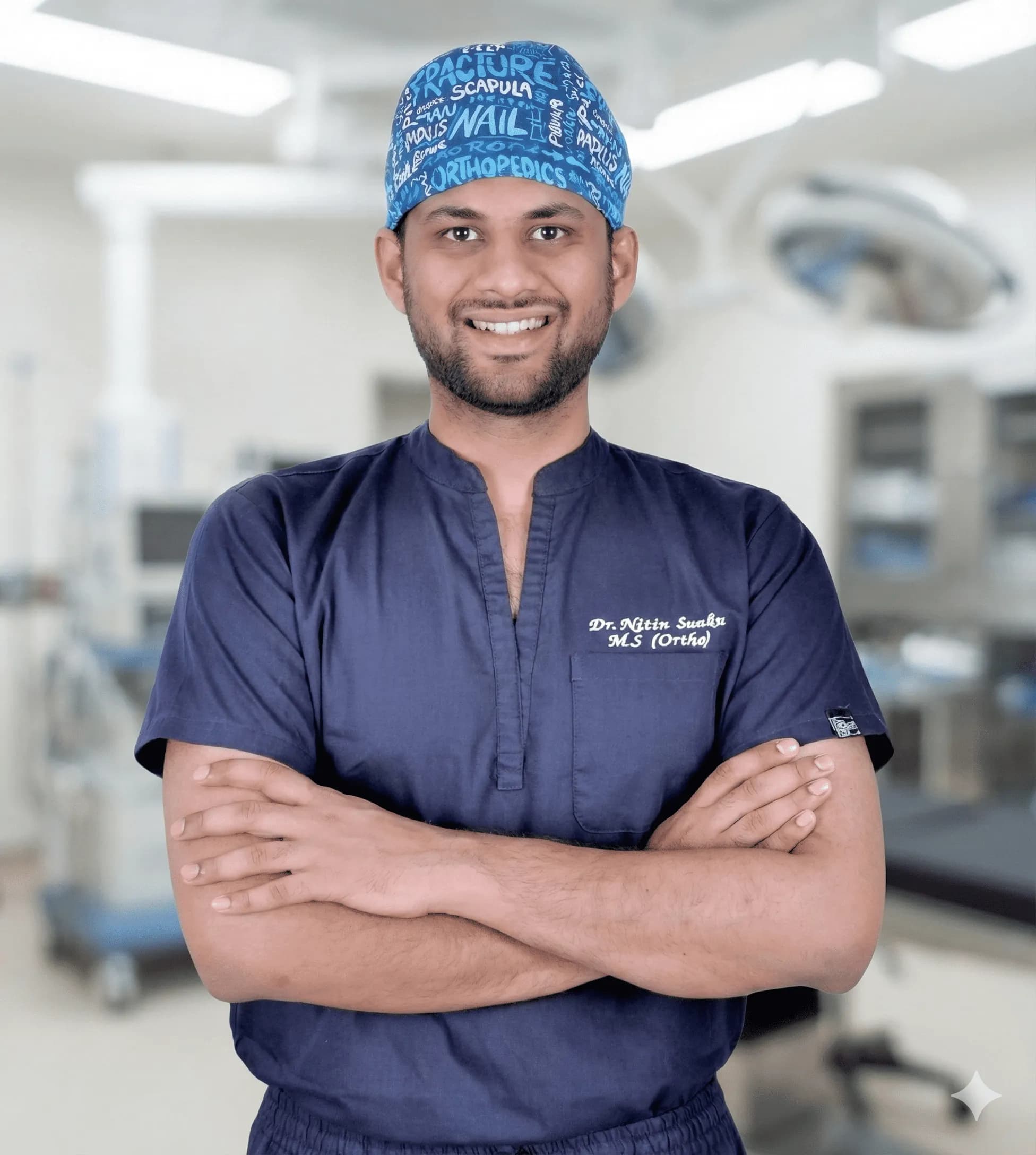
About the Author
Dr. Nitin N Sunku
MBBS, MS (Orthopedics), Fellowship in Arthroscopy & Sports Medicine
Dr. Nitin N Sunku is a Consultant Orthopedic & Sports Medicine Surgeon with over 10 years of focused practice in Bengaluru. He serves as the Team Doctor for Bengaluru FC and consults at Raghava Multispeciality Hospital (Attibele) and Health Nest Hospital (HSR Layout). His clinical interests include arthroscopy, ligament & meniscus care, regenerative orthopedic medicine, ultrasound-guided injections, and joint replacement.
Experiencing symptoms?
Don't let pain hold you back. Schedule a comprehensive evaluation with Dr. Nitin today.
Book Appointment

