This article is for general education and does not replace an in-person assessment, examination, or imaging. Everyone's injury pattern, medical history, and goals differ; use what you read here to prepare better questions for your doctor.
Dr. Nitin N Sunku is a consultant orthopedic and sports medicine surgeon. He sees patients at Raghava Multispeciality Hospital, Attibele, on Sarjapura–Attibele Road, and at Health Nest Hospital, HSR Layout, Bengaluru. If pain is rapidly worsening, you cannot bear weight, you develop numbness or weakness in a limb, or you have fever after an injury, seek urgent medical care. For non-emergency evaluation and individualised treatment options, book through the contact page.
Topics across this blog include knee ligament and meniscus problems, shoulder pain and instability, hip and knee arthritis, fracture recovery principles, spine symptoms when urgent causes have been excluded, running and tendon overuse issues, and what to expect from arthroscopy or joint replacement discussions. If you are comparing sources online, cross-check dates and always confirm advice with an in-person clinician.
Cartilage degeneration in your knee, explained simply. What causes it, how it progresses, and what modern non-surgical treatments can — and cannot — do.
What is cartilage?
Articular cartilage is the smooth, white, slippery covering at the ends of bones inside a joint. Healthy cartilage:
- Allows bones to glide smoothly
- Distributes load
- Absorbs shock
- Protects underlying bone
It does not have its own blood supply, which is why cartilage heals very slowly — and incompletely — once damaged.
What is cartilage degeneration?
It is a gradual process where cartilage:
- Thins
- Becomes less elastic
- Develops small surface fissures
- Loses its protective qualities
- Eventually wears through to bone in advanced cases
This process is part of osteoarthritis but can also occur from injury, alignment issues, repetitive overuse, or systemic factors.
What drives degeneration?
- Age
- Genetics
- Body weight and joint load
- Old injuries (meniscal tears, ligament injuries, fractures)
- Alignment (bow legs, knock-knees)
- Muscle weakness
- Repetitive overuse / impact
- Inflammation (systemic and local)
Stages of cartilage damage
Doctors often talk about cartilage damage in stages:
- Stage 0 — Normal, smooth cartilage
- Stage 1 — Cartilage softening (chondromalacia)
- Stage 2 — Surface fissures, partial thickness damage
- Stage 3 — Deeper fissures down to bone surface
- Stage 4 — Full thickness loss; bone exposed
Stages roughly correlate with — but are not identical to — Kellgren–Lawrence OA grades on X-ray.
Important truths
- Cartilage damage cannot be fully reversed by current widely available therapies.
- However, pain and function are not entirely about how the cartilage looks — many people with imaging changes feel fine, and some with mild changes have severe pain.
- Modern care focuses on reducing pain, supporting the joint environment, slowing progression, and preserving function — not on "regrowing" cartilage.
What modern non-surgical care can do
1. Reduce mechanical load
Weight management and movement education protect remaining cartilage. See weight loss and knee pain.
2. Strengthen the protective envelope
Strong muscles act as shock absorbers. See exercises for knee OA.
3. Improve the joint environment
- HA injections improve lubrication and cushioning.
- GFC therapy delivers concentrated growth factors to support the local biological environment.
- Ultrasound guidance ensures injections reach the right place.
4. Selective surgical interventions when truly needed
Cartilage repair / restoration procedures (microfracture, OAT, MACI) are considered for specific defects, usually in younger patients with focal damage. Total knee replacement is reserved for end-stage OA.
What about supplements and "cartilage-regrowing" claims?
Be cautious. Many products claim to "regrow" cartilage — most without robust evidence. Some patients find supplements helpful as part of a broader plan. They are not a substitute for the core care.
Get assessed in Bengaluru
If you would like a structured, honest evaluation, you can book a consultation with Dr. Nitin N Sunku at Raghava Multispeciality Hospital, Attibele (Sarjapura–Attibele Road) or Health Nest Hospital, HSR Layout. The clinics serve patients from Attibele, Anekal, Bommasandra, Chandapura, Hosur Road, Electronic City, HSR Layout, Koramangala, BTM Layout, Sarjapur Road, and Bellandur. Bring any prior X-ray or MRI; the imaging is reviewed and explained in plain language during your visit.
This article is educational and does not replace a clinical examination. Treatment outcomes vary based on the severity of your condition, age, weight, lifestyle, and other medical factors. Severe joint degeneration may still require surgical management.
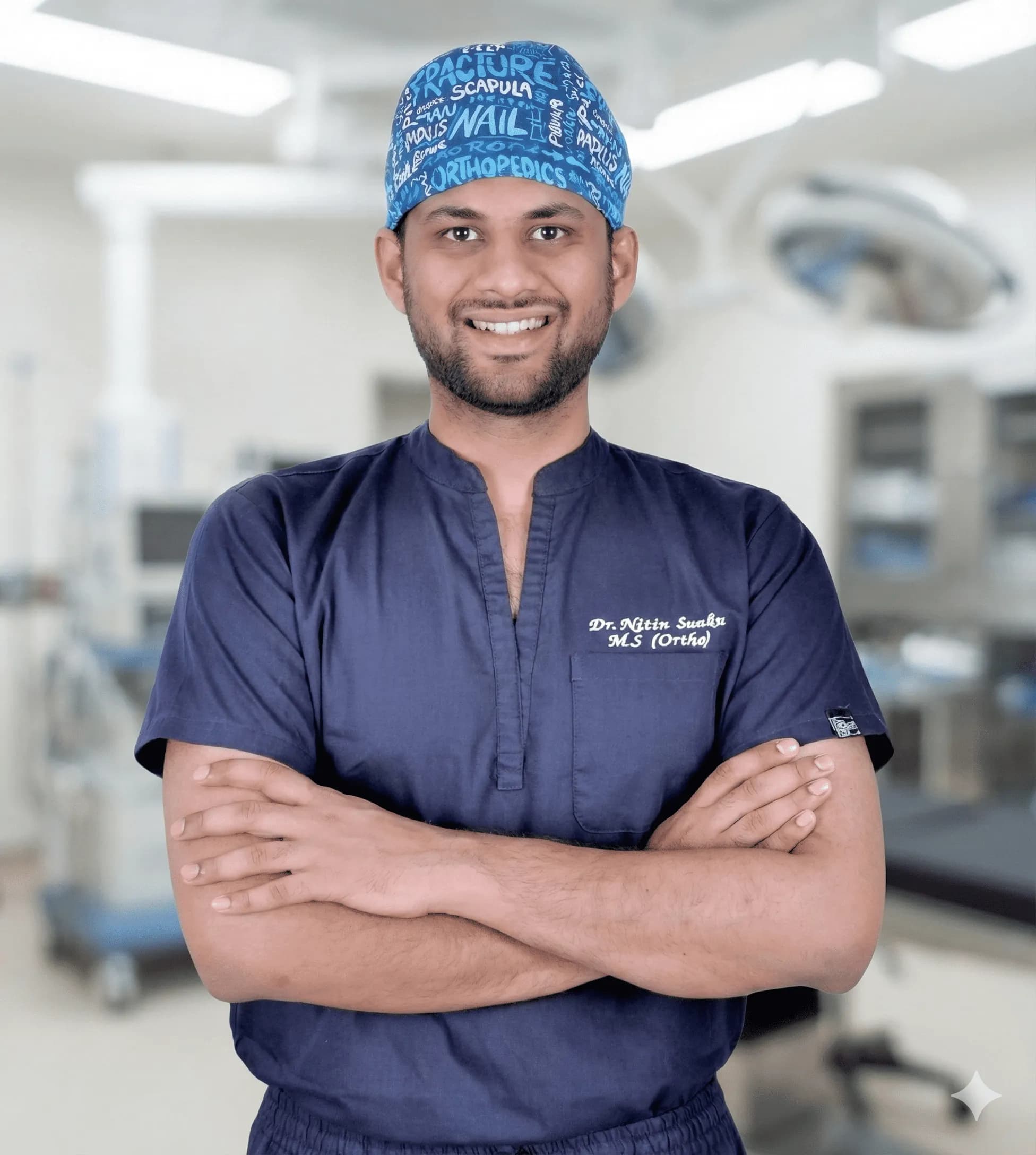
About the Author
Dr. Nitin N Sunku
MBBS, MS (Orthopedics), Fellowship in Arthroscopy & Sports Medicine
Dr. Nitin N Sunku is a Consultant Orthopedic & Sports Medicine Surgeon with over 10 years of focused practice in Bengaluru. He serves as the Team Doctor for Bengaluru FC and consults at Raghava Multispeciality Hospital (Attibele) and Health Nest Hospital (HSR Layout). His clinical interests include arthroscopy, ligament & meniscus care, regenerative orthopedic medicine, ultrasound-guided injections, and joint replacement.
Experiencing symptoms?
Don't let pain hold you back. Schedule a comprehensive evaluation with Dr. Nitin today.
Book Appointment

