This article is for general education and does not replace an in-person assessment, examination, or imaging. Everyone's injury pattern, medical history, and goals differ; use what you read here to prepare better questions for your doctor.
Dr. Nitin N Sunku is a consultant orthopedic and sports medicine surgeon. He sees patients at Raghava Multispeciality Hospital, Attibele, on Sarjapura–Attibele Road, and at Health Nest Hospital, HSR Layout, Bengaluru. If pain is rapidly worsening, you cannot bear weight, you develop numbness or weakness in a limb, or you have fever after an injury, seek urgent medical care. For non-emergency evaluation and individualised treatment options, book through the contact page.
Topics across this blog include knee ligament and meniscus problems, shoulder pain and instability, hip and knee arthritis, fracture recovery principles, spine symptoms when urgent causes have been excluded, running and tendon overuse issues, and what to expect from arthroscopy or joint replacement discussions. If you are comparing sources online, cross-check dates and always confirm advice with an in-person clinician.
Should you choose knee surgery or injections like PRP and GFC? A clear decision guide comparing cost, recovery, suitability and results — to help you choose with Dr. Nitin N Sunku.
If your knee has been hurting for months, you have probably reached the point where two very different paths are on the table: injections — including regenerative options like PRP and GFC — or surgery. They sit at opposite ends of the spectrum in cost, recovery and how aggressively they treat the problem, and choosing wrongly wastes either money or time. This guide compares them honestly so you can have a focused conversation with your orthopedic surgeon and pick the option that genuinely fits your knee.
First, the key idea: it is not all-or-nothing
Knee treatment is best thought of as a ladder, not a coin toss. Most people should climb it one rung at a time: activity modification and physiotherapy, then injections, then surgery — moving up only when the rung below has been given a fair trial and is not enough. Injections and surgery are not rivals; they are different rungs for different stages of joint damage. The right question is not "which is better?" but "which rung am I actually on?"
When injections are the smarter choice
Injection therapy — particularly regenerative injections like Platelet-Rich Plasma (PRP) and Growth Factor Concentrate (GFC), or hyaluronic acid — tends to suit patients who:
- Have early to moderate knee osteoarthritis or a tendon/soft-tissue problem, not bone-on-bone end-stage arthritis.
- Still have reasonable cartilage left on imaging.
- Want to avoid or delay surgery, or are not yet ready for the recovery time it needs.
- Are not suitable surgical candidates right now (for example, due to other health issues).
What to expect: injections are an outpatient procedure done in minutes, with little to no downtime — most people walk out and resume light activity quickly. Regenerative injections aim to reduce inflammation and support the joint environment. They do not regrow a worn-out joint, and results vary; some patients get months of meaningful relief, others less. A short course is often planned rather than a single shot.
Indicative cost: PRP for the knee in Bengaluru typically runs in the region of ₹10,000–₹25,000 per session (sometimes higher at premium centres), and GFC, a more concentrated next-generation option, is usually a little more per session. Costs vary and change over time — confirm with the clinic.
When surgery is the better answer
Surgery moves from managing symptoms to fixing or replacing structure. It is usually the right choice when:
- Arthritis is advanced (bone-on-bone), and pain limits walking, sleep and daily life despite conservative care.
- There is a mechanical problem injections cannot fix — a significant meniscus tear causing locking, or a torn ACL causing the knee to give way.
- Injections and physiotherapy have been tried and have stopped helping.
- Imaging shows structural damage that will only progress.
Depending on the problem, surgery may be keyhole (arthroscopy) for a meniscus or ligament, or a partial or total knee replacement for arthritis. Recovery is longer — weeks to months — but for the right patient it delivers a definitive, durable result that no injection can match.
Side-by-side comparison
For a typical patient weighing regenerative injections against knee replacement:
- Best stage: Injections — early/moderate. Surgery — advanced or mechanically unstable.
- Goal: Injections relieve symptoms and buy time. Surgery corrects or replaces the structure.
- Downtime: Injections — minimal, back to routine quickly. Surgery — weeks to months of staged recovery and physiotherapy.
- Cost: Injections — lower per session but may need repeating. Surgery — far higher one-time cost (knee replacement typically ₹2.5–3.5 lakh per knee), but definitive.
- Durability: Injections — months, variable. Surgery — years to decades.
- Risk profile: Injections — low. Surgery — higher, as with any operation, but very well established.
How the decision is actually made
A good orthopedic consultation settles this quickly. Dr. Nitin reviews your symptoms, examines the knee, and looks at your X-rays or MRI to grade the damage. From there:
- If you have early or moderate disease and cartilage to work with, a conservative plan with physiotherapy and, where appropriate, regenerative injections is usually tried first.
- If the joint is end-stage, or there is a mechanical block injections cannot solve, surgery is discussed honestly with timelines and cost.
- Often the answer is sequential: injections now to manage pain and stay active, with surgery kept as a clear option for later if and when it is needed.
The aim is always the least invasive treatment that will genuinely work for your knee — not the most expensive, and not a delay that lets a fixable problem get worse.
Talk it through in Attibele
The fastest way to know which path fits is a single, honest assessment. Dr. Nitin N Sunku offers both regenerative injection therapy and surgical care, so the recommendation is unbiased — he is not limited to one tool. Consult at Raghava Multispeciality Hospital, Attibele. Call +91-9980031006 or book online.
Frequently Asked Questions
Q1: Are PRP or GFC injections better than knee replacement?A: They are not better or worse — they treat different stages. PRP and GFC suit early to moderate arthritis and soft-tissue problems and aim to relieve pain and delay surgery. Knee replacement is for advanced, bone-on-bone arthritis where injections will not help. The right choice depends entirely on the state of your joint, which imaging and examination reveal.
Q2: Can injections help me avoid knee surgery completely?A: In some patients with early or moderate disease, a structured plan of weight management, physiotherapy and regenerative injections can delay surgery for years, and occasionally avoid it. But injections cannot reverse end-stage arthritis or fix a mechanical tear, so they are not a substitute for surgery when surgery is genuinely indicated.
Q3: Which is cheaper overall?A: Per session, injections are far cheaper (roughly ₹10,000–₹25,000 for PRP). Knee replacement is a much larger one-time cost (commonly ₹2.5–3.5 lakh per knee). However, injections may need repeating, while surgery is usually a once-in-decades fix — so the cheaper option depends on your stage and how long relief lasts.
Q4: How long do injection results last?A: It varies widely. Some patients get several months to longer of meaningful relief from a course of regenerative injections; others respond less. Results depend on how much cartilage remains and the underlying diagnosis, which is why proper patient selection matters so much.
Q5: How do I know which option I need?A: Through an orthopedic assessment — symptoms, a physical exam, and imaging to grade the joint. A surgeon who offers both injections and surgery can give you an unbiased recommendation rather than defaulting to the only tool they have.
This article is educational and not a substitute for personalised medical advice. Treatment decisions should follow examination and imaging by a qualified orthopedic surgeon.
Author: Dr. Nitin N Sunku, MS Orthopedics (Gold Medalist), Fellowship in Arthroscopy & Sports Medicine.
Consulting at Raghava Multispeciality Hospital, Attibele and Health Nest Hospital, HSR Layout, Bengaluru.
Find out which option fits — call +91-9980031006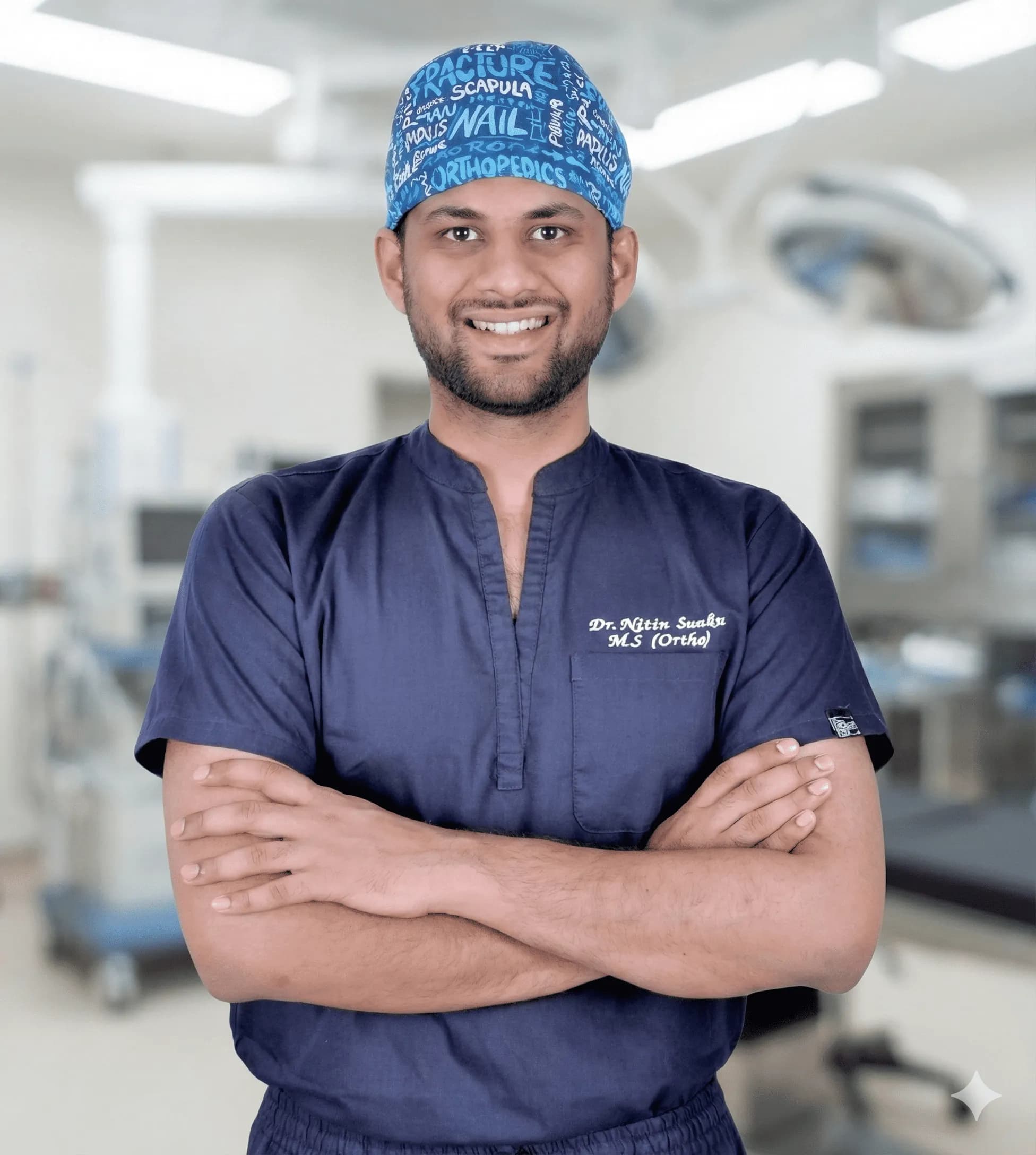
About the Author
Dr. Nitin N Sunku
MBBS, MS (Orthopedics), Fellowship in Arthroscopy & Sports Medicine
Dr. Nitin N Sunku is a Consultant Orthopedic & Sports Medicine Surgeon with over 10 years of focused practice in Bengaluru. He serves as the Team Doctor for Bengaluru FC and consults at Raghava Multispeciality Hospital (Attibele) and Health Nest Hospital (HSR Layout). His clinical interests include arthroscopy, ligament & meniscus care, regenerative orthopedic medicine, ultrasound-guided injections, and joint replacement.
Experiencing symptoms?
Don't let pain hold you back. Schedule a comprehensive evaluation with Dr. Nitin today.
Book Appointment

