This article is for general education and does not replace an in-person assessment, examination, or imaging. Everyone's injury pattern, medical history, and goals differ; use what you read here to prepare better questions for your doctor.
Dr. Nitin N Sunku is a consultant orthopedic and sports medicine surgeon. He sees patients at Raghava Multispeciality Hospital, Attibele, on Sarjapura–Attibele Road, and at Health Nest Hospital, HSR Layout, Bengaluru. If pain is rapidly worsening, you cannot bear weight, you develop numbness or weakness in a limb, or you have fever after an injury, seek urgent medical care. For non-emergency evaluation and individualised treatment options, book through the contact page.
Topics across this blog include knee ligament and meniscus problems, shoulder pain and instability, hip and knee arthritis, fracture recovery principles, spine symptoms when urgent causes have been excluded, running and tendon overuse issues, and what to expect from arthroscopy or joint replacement discussions. If you are comparing sources online, cross-check dates and always confirm advice with an in-person clinician.
Stem cell therapy for knee pain in India explained — BMAC (Bone Marrow Aspirate Concentrate) for knee arthritis and cartilage injuries, what the science supports, who it suits, and how it compares to PRP and GFC.
If you have been reading about non-surgical options for knee pain, you have almost certainly come across the term stem cell therapy. In clinical orthopedic practice, the version that is most often discussed and used responsibly is called BMAC — Bone Marrow Aspirate Concentrate. This guide explains what BMAC actually is, how it differs from PRP and GFC, who it is suitable for, and what realistic outcomes look like.
The aim here is honesty over hype. BMAC is a useful tool — but it is not a guaranteed cure, and it is not the right choice for every knee. As with all non-surgical knee pain treatments, the value lies in matching the right therapy to the right patient.
What exactly is BMAC?
BMAC stands for Bone Marrow Aspirate Concentrate. A small volume of bone marrow is drawn — usually from the back of the pelvis (iliac crest) — under local anaesthesia. The aspirate is then spun in a centrifuge to concentrate the cellular and growth-factor-rich fraction, which is injected into the affected knee, often under ultrasound guidance for accuracy.
What's inside the concentrate? A mix of:
- Mesenchymal signalling cells (sometimes loosely called "stem cells")
- Growth factors
- Cytokines that help modulate inflammation
- Platelets
This is why BMAC is described as a biological injection — it brings the body's own repair signalling machinery directly to the joint.
How is BMAC different from PRP and GFC?
The simplest way to think of it:
- PRP — concentrated platelets from your blood, rich in growth factors.
- GFC — a more refined preparation that isolates growth factors with less cellular debris.
- BMAC — taken from bone marrow rather than blood, and adds signalling cells to the mix.
If you would like a deeper side-by-side comparison of the blood-based options, the PRP vs GFC explainer is a good place to start. For the broader picture of how these therapies fit together, see What is Regenerative Orthopedic Medicine?.
Stem cell therapy for knee pain in India: what to know
Stem cell therapy for knee pain in India sits inside a specific regulatory framework that patients should understand before choosing a clinic. Autologous BMAC — where the patient's own bone marrow is aspirated, concentrated and re-injected in a single sitting — is generally permitted as part of orthopedic practice, because it uses minimally manipulated cells from the same patient. In contrast, expanded or cultured mesenchymal stem cell (MSC) therapies are tightly regulated by the CDSCO (Central Drugs Standard Control Organisation) and the ICMR's National Guidelines for Stem Cell Research, and are largely restricted to approved clinical trials. Patients should be cautious of unlicensed clinics offering “stem cell” injections that claim to regrow cartilage or cure end-stage arthritis — ask whether the procedure is autologous BMAC, who performs it, and how the cells are processed.
What conditions can BMAC help with?
In a carefully selected patient, BMAC may be considered for:
- Mild to moderate knee osteoarthritis (typically Grade 2 to early Grade 3)
- Focal cartilage defects after sports injury
- Knees that responded only partially to PRP/GFC or hyaluronic acid injections
- Patients who want to delay knee replacement for as long as reasonably possible
- Selected cases of avascular necrosis around the knee
BMAC is generally not the right answer when:
- The joint is end-stage with bone-on-bone changes and severe deformity
- There is significant mechanical instability needing surgical reconstruction
- The patient has active infection, certain cancers, or untreated bleeding disorders
This is why a clinical examination and recent imaging (X-ray and often MRI) are essential before BMAC is recommended. The goal is honest matching — not selling the procedure.
What happens on the day of the procedure?
BMAC is a daycare procedure. A typical visit looks like this:
- Pre-procedure check and consent.
- The skin over the iliac crest (back of the pelvis) is cleaned and numbed with local anaesthesia.
- A small volume of bone marrow is aspirated through a needle.
- The aspirate is processed in a centrifuge to produce BMAC.
- The concentrate is then injected into the knee — most commonly under ultrasound guidance to ensure precise placement.
- You rest for a short period and walk out the same day.
Most patients describe the aspiration as a deep pressure rather than sharp pain. You can usually return to light desk work the next day. High-impact activity is restricted for a few weeks based on the post-procedure protocol shared with you.
What outcomes are realistic?
Here is the honest version. BMAC, when used in suitable cases, can:
- Reduce knee pain
- Improve function and walking distance
- Help you tolerate physiotherapy and strengthening better
- Delay the need for surgery in many eligible patients
What BMAC will not do:
- Regrow a worn-out joint back to a brand-new knee
- Reverse advanced bone deformity
- Eliminate the need for weight management, exercise, and rehab
Onset is usually gradual — early benefit may appear over 4–6 weeks, with peak effect at around 3 months. Some patients are advised a planned combination with HA injections or a follow-up biologic dose for the best response.
BMAC vs knee replacement — how to think about the choice
Patients often ask if BMAC is an alternative to knee replacement. The right way to think about it:
- If your arthritis is mild to moderate, BMAC and other regenerative options can be a meaningful part of buying time and improving quality of life.
- If your knee is end-stage with severe pain at rest, deformity, and bone-on-bone changes, no injection is going to match what a well-done knee replacement does. We will be honest with you about that.
- Many patients sit in between, and that's where careful staging — physiotherapy, weight management, regenerative injections, eventual surgery if needed — works best.
For broader context, the post Knee replacement alternatives walks through the full ladder of non-surgical care.
Safety and side effects
Because BMAC uses your own tissue (autologous), the risk of allergic reaction or rejection is very low. Possible side effects include:
- Soreness at the aspiration site for a few days
- Mild swelling or stiffness in the knee for 48–72 hours
- Rare risk of infection, as with any injection
Procedures are performed under sterile conditions, and where helpful, with ultrasound guidance for accuracy. You will receive clear, written aftercare instructions.
How Dr. Nitin N Sunku decides if BMAC is right for you
The decision is based on:
- The grade and pattern of arthritis on imaging
- Your age, weight, activity level, and goals
- What you've already tried — physiotherapy, PRP, GFC, HA
- Whether mechanical issues (loose bodies, meniscus tears, malalignment) need to be addressed first
- Your readiness for a structured rehabilitation plan after the injection
BMAC is not offered in isolation. It is always paired with a rehab plan, weight and lifestyle advice, and clear follow-up — because that is what gives the biology its best chance to do its job.
Get assessed in Bengaluru
If you would like a structured, honest evaluation, you can book a consultation with Dr. Nitin N Sunku at Raghava Multispeciality Hospital, Attibele (Sarjapura–Attibele Road) or Health Nest Hospital, HSR Layout. The clinics serve patients from Attibele, Anekal, Bommasandra, Chandapura, Hosur Road, Electronic City, HSR Layout, Koramangala, BTM Layout, Sarjapur Road, and Bellandur. Bring any prior X-ray or MRI; the imaging is reviewed and explained in plain language during your visit.
This article is educational and does not replace a clinical examination. Treatment outcomes vary based on the severity of your condition, age, weight, lifestyle, and other medical factors. Severe joint degeneration may still require surgical management.
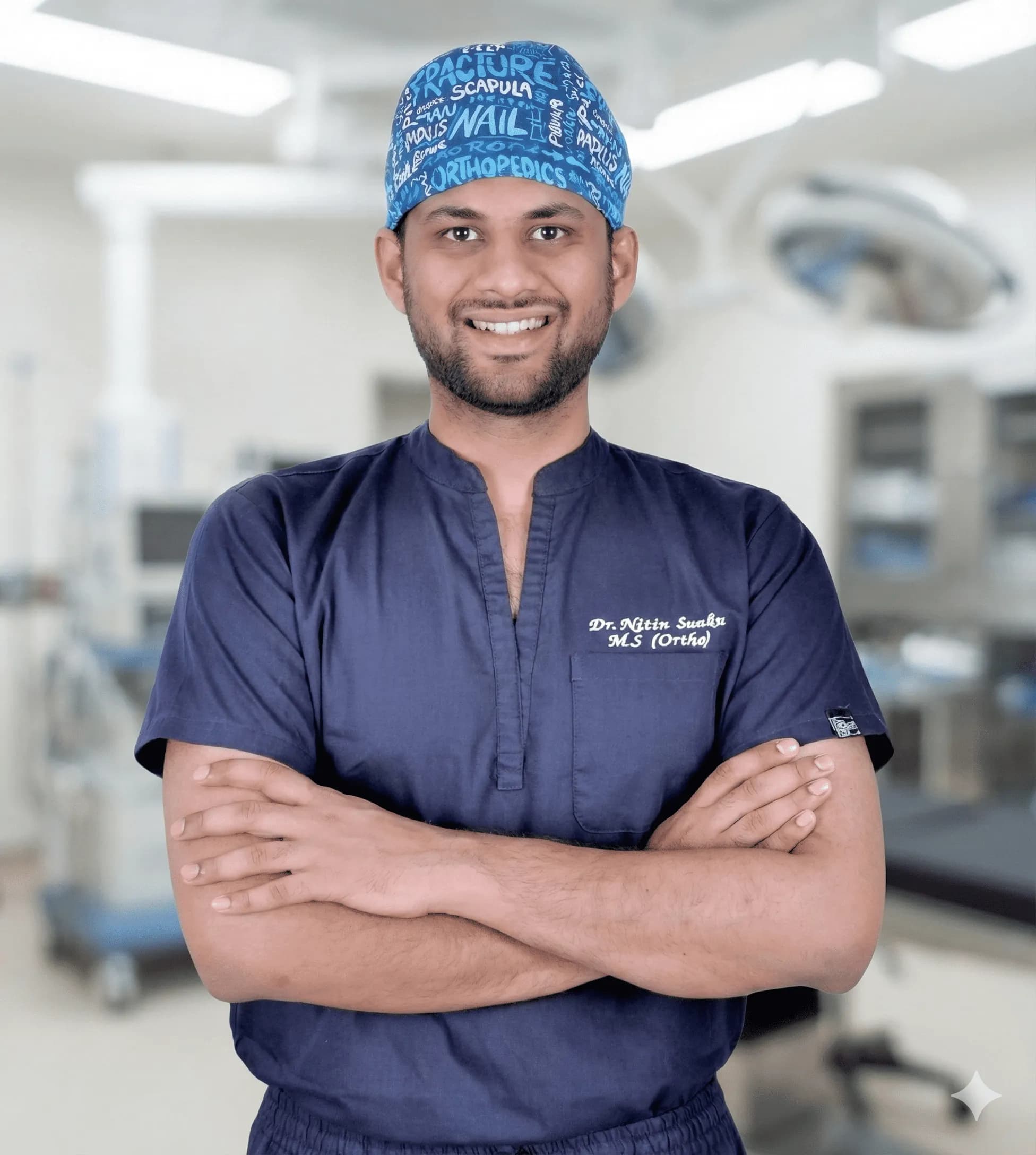
About the Author
Dr. Nitin N Sunku
MBBS, MS (Orthopedics), Fellowship in Arthroscopy & Sports Medicine
Dr. Nitin N Sunku is a Consultant Orthopedic & Sports Medicine Surgeon with over 10 years of focused practice in Bengaluru. He serves as the Team Doctor for Bengaluru FC and consults at Raghava Multispeciality Hospital (Attibele) and Health Nest Hospital (HSR Layout). His clinical interests include arthroscopy, ligament & meniscus care, regenerative orthopedic medicine, ultrasound-guided injections, and joint replacement.
Experiencing symptoms?
Don't let pain hold you back. Schedule a comprehensive evaluation with Dr. Nitin today.
Book Appointment

