This article is for general education and does not replace an in-person assessment, examination, or imaging. Everyone's injury pattern, medical history, and goals differ; use what you read here to prepare better questions for your doctor.
Dr. Nitin N Sunku is a consultant orthopedic and sports medicine surgeon. He sees patients at Raghava Multispeciality Hospital, Attibele, on Sarjapura–Attibele Road, and at Health Nest Hospital, HSR Layout, Bengaluru. If pain is rapidly worsening, you cannot bear weight, you develop numbness or weakness in a limb, or you have fever after an injury, seek urgent medical care. For non-emergency evaluation and individualised treatment options, book through the contact page.
Topics across this blog include knee ligament and meniscus problems, shoulder pain and instability, hip and knee arthritis, fracture recovery principles, spine symptoms when urgent causes have been excluded, running and tendon overuse issues, and what to expect from arthroscopy or joint replacement discussions. If you are comparing sources online, cross-check dates and always confirm advice with an in-person clinician.
Regenerative orthopedic medicine in plain language — what it is, how it works, who benefits, and what it can and cannot do for joint and tendon pain.
A simple definition
Regenerative medicine is a branch of modern healthcare that uses the body's own biological signals — cells, growth factors, and supportive proteins — to help reduce pain, modulate inflammation, and support the health of damaged tissues.
In orthopedics, this typically means non-surgical injections aimed at:
- Mild-to-moderate joint osteoarthritis (knee, shoulder, hip)
- Tendinopathies (tennis elbow, jumper's knee, Achilles, plantar fascia)
- Sports injuries
- Chronic soft-tissue pain that hasn't responded to conventional care
Regenerative medicine is not magic. It does not regrow lost cartilage to a healthy joint or guarantee surgery avoidance. It is a powerful, biologically grounded tool — most useful when combined with rehab, weight management, and image-guided precision.
Why your body matters in this story
Your body is constantly repairing itself. Every minor strain, every micro-injury, every inflammatory flare is met by an internal response involving:
- Platelets — the first responders that release healing signals
- Growth factors — molecules that direct repair (PDGF, TGF-β, VEGF, IGF, EGF)
- Cytokines — coordinators of inflammation and resolution
- Resident tissue cells — that maintain cartilage, tendon, and ligament
In chronic OA or persistent tendinopathy, this response becomes less efficient. The local environment turns persistently inflammatory, and repair signals get muted by ongoing wear and lifestyle factors. Regenerative therapies aim to re-supply concentrated repair signals to that environment.
Common regenerative options used today
- PRP (Platelet-Rich Plasma) — your own platelets concentrated and re-injected
- GFC (Growth Factor Concentrate) — a refined, growth-factor-focused upgrade of PRP. See the GFC treatment for knee pain page.
- Hyaluronic acid (HA) — although strictly a viscosupplement (lubricant), it is often used alongside regenerative options. See the HA injection treatment page.
- Selected stem-cell-based therapies — used in carefully chosen scenarios, with regulatory and ethical considerations
- Combination protocols — HA + GFC; injection + structured rehab; etc.
For a clear comparison of the two most common options, read PRP vs GFC.
What regenerative medicine can do
- Reduce pain in many patients with mild-to-moderate OA and chronic tendinopathy
- Improve joint and tendon comfort
- Help delay or avoid surgery in eligible patients
- Support the local biological environment of the joint
- Pair beautifully with physiotherapy and lifestyle care
- Use your own biology — limiting allergic and rejection risks
What regenerative medicine cannot do
- It cannot regrow a fully damaged joint to "new"
- It cannot reverse end-stage OA with bone-on-bone changes and deformity
- It cannot replace the role of physiotherapy, weight management, and load modification
- It cannot guarantee outcomes for every patient
- It cannot substitute for surgery when surgery is genuinely needed
This honesty matters. Beware any clinic that promises permanent cures or guaranteed cartilage regrowth.
Who benefits the most?
Patients who often respond well include:
- Mild-to-moderate knee OA (KL grade 1–3)
- Patellar/quadriceps tendinopathy
- Tennis elbow / golfer's elbow
- Mild rotator cuff tendinopathy
- Plantar fasciitis
- Selected sports injuries
- Patients committed to physiotherapy and lifestyle changes
- Patients seeking an alternative to surgery, where medically reasonable
Why image guidance matters
Regenerative injections are most effective when delivered exactly where they are needed. Ultrasound guidance allows the doctor to see the joint or tendon and track the needle in real time, improving accuracy and safety. See ultrasound-guided orthopedic injections.
What to expect from a regenerative care plan
- Honest assessment — diagnosis, OA/tendinopathy grade, expected benefit
- Personalised regimen — type, number, and timing of injections
- Layered care — physiotherapy, weight management, footwear and load advice
- Realistic timelines — onset of relief, peak benefit, follow-up
- Re-evaluation — adjust the plan based on your response
Get assessed in Bengaluru
If you would like a structured, honest evaluation, you can book a consultation with Dr. Nitin N Sunku at Raghava Multispeciality Hospital, Attibele (Sarjapura–Attibele Road) or Health Nest Hospital, HSR Layout. The clinics serve patients from Attibele, Anekal, Bommasandra, Chandapura, Hosur Road, Electronic City, HSR Layout, Koramangala, BTM Layout, Sarjapur Road, and Bellandur. Bring any prior X-ray or MRI; the imaging is reviewed and explained in plain language during your visit.
This article is educational and does not replace a clinical examination. Treatment outcomes vary based on the severity of your condition, age, weight, lifestyle, and other medical factors. Severe joint degeneration may still require surgical management.
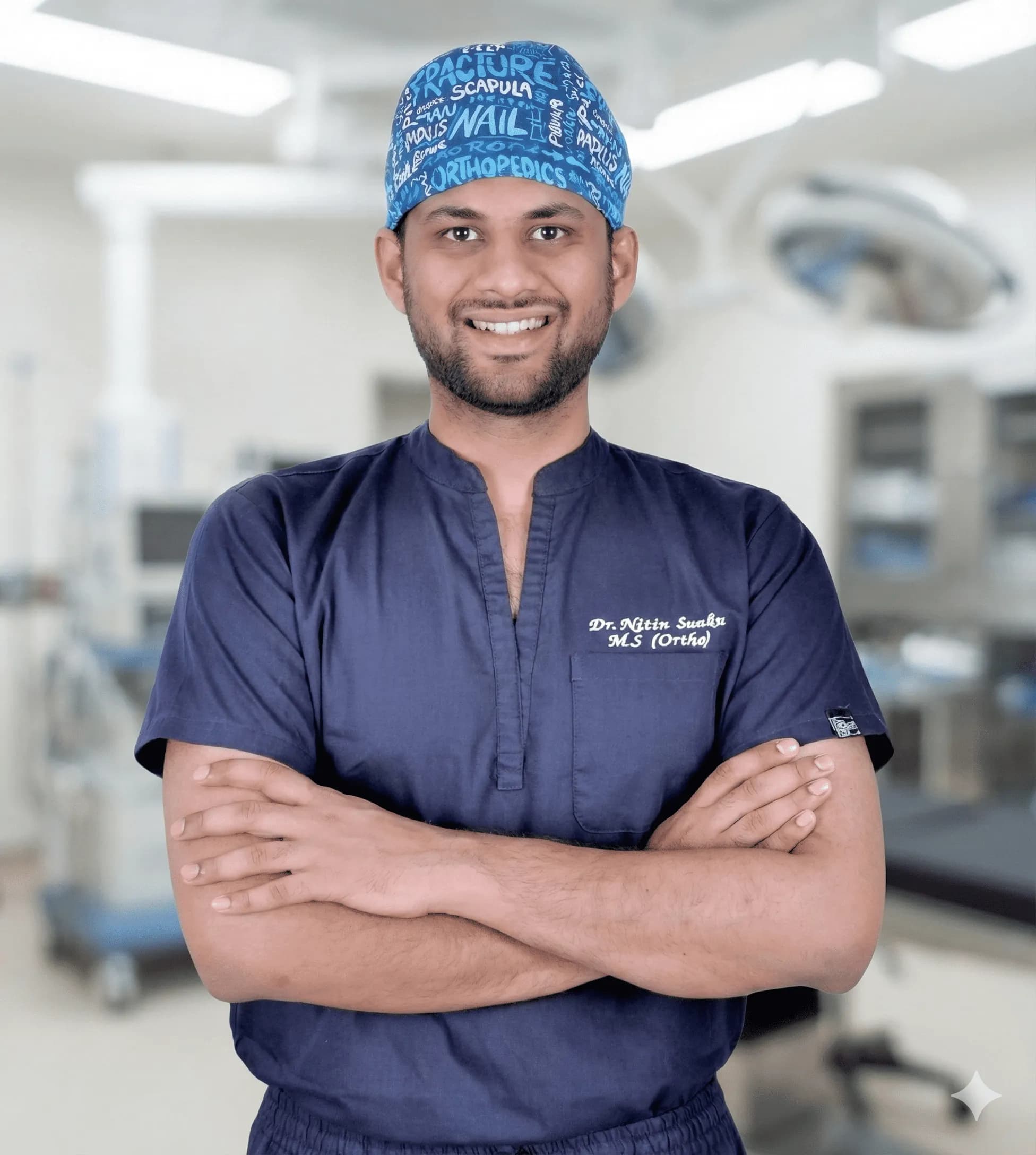
About the Author
Dr. Nitin N Sunku
MBBS, MS (Orthopedics), Fellowship in Arthroscopy & Sports Medicine
Dr. Nitin N Sunku is a Consultant Orthopedic & Sports Medicine Surgeon with over 10 years of focused practice in Bengaluru. He serves as the Team Doctor for Bengaluru FC and consults at Raghava Multispeciality Hospital (Attibele) and Health Nest Hospital (HSR Layout). His clinical interests include arthroscopy, ligament & meniscus care, regenerative orthopedic medicine, ultrasound-guided injections, and joint replacement.
Experiencing symptoms?
Don't let pain hold you back. Schedule a comprehensive evaluation with Dr. Nitin today.
Book Appointment

