This article is for general education and does not replace an in-person assessment, examination, or imaging. Everyone's injury pattern, medical history, and goals differ; use what you read here to prepare better questions for your doctor.
Dr. Nitin N Sunku is a consultant orthopedic and sports medicine surgeon. He sees patients at Raghava Multispeciality Hospital, Attibele, on Sarjapura–Attibele Road, and at Health Nest Hospital, HSR Layout, Bengaluru. If pain is rapidly worsening, you cannot bear weight, you develop numbness or weakness in a limb, or you have fever after an injury, seek urgent medical care. For non-emergency evaluation and individualised treatment options, book through the contact page.
Topics across this blog include knee ligament and meniscus problems, shoulder pain and instability, hip and knee arthritis, fracture recovery principles, spine symptoms when urgent causes have been excluded, running and tendon overuse issues, and what to expect from arthroscopy or joint replacement discussions. If you are comparing sources online, cross-check dates and always confirm advice with an in-person clinician.
Knee pain means different things at 25, 45 and 65. Here is how an orthopedic surgeon in Attibele sorts the likely cause by age and by where the knee hurts, what you can safely try at home first, and the signs that mean you should be examined rather than wait.
Short answer: in people under 30, knee pain is usually a sports or twisting injury to a ligament, meniscus or the kneecap. Between 30 and 45 it is most often pain behind the kneecap from weak thigh muscles, or an early meniscus tear. After 45, and especially in women after menopause, osteoarthritis becomes the leading cause. Knee pain that has lasted more than three or four weeks, or that comes with swelling, locking, giving way or fever, should be examined by an orthopedic doctor. For families in Chandapura, Anekal, Hennagara and Jigani, Dr. Nitin N Sunku sees knee patients at Raghava Multispeciality Hospital, Attibele, about 4 km and eight minutes from Chandapura circle.
Why knee pain is so common on the Chandapura–Anekal belt
The pattern in this part of Bengaluru is a little different from the IT corridors closer to the city. Many homes here are independent houses with steep internal staircases climbed twenty or thirty times a day. A lot of daily life still happens at floor level, from cooking to prayer to sitting with family, which means repeated deep knee bending. Many residents work standing shifts in the industrial units of Bommasandra, Jigani and Attibele. And almost everyone rides a two-wheeler, putting a foot down at every signal on Chandapura–Anekal Road and Hosur Road. None of this damages a healthy knee by itself, but it loads a knee that is already weak, overweight or arthritic every single day, which is why pain that starts small tends to keep growing.
Knee pain by age: the most likely causes
| Age | Most likely cause | Typical clue | Sensible first step |
|---|---|---|---|
| 15–30 | ACL or meniscus tear, kneecap instability, patellar tendon pain | Started with a twist, pop or fall during sport; swelling within hours | Examination; MRI only if instability or locking |
| 30–45 | Pain behind the kneecap (patellofemoral pain), early degenerative meniscus tear | Worse on stairs, squatting and after long sitting; no clear injury | Quadriceps and hip strengthening for six to eight weeks |
| 45–60 | Early osteoarthritis, degenerative meniscus tear | Morning stiffness under 30 minutes, pain after standing, inner-knee ache | Standing X-ray, weight and strength programme |
| 60+ | Osteoarthritis, occasionally gout or calcium crystal arthritis | Bow-leg deformity, grinding, reduced walking distance | Staged treatment; replacement only when daily life is limited |
| Any age | Joint infection | Hot, red, very swollen knee with fever | Emergency — same day |
Where on the knee does it hurt?
Location narrows the cause quickly. Pain at the front of the knee, around or behind the kneecap, points to patellofemoral pain or patellar tendon trouble. Pain along the inner side is the classic site of medial knee osteoarthritis and of degenerative meniscus tears, both very common in people over 45. Pain on the outer side in runners and cyclists is often the iliotibial band rubbing over the bone. Pain and fullness at the back of the knee is frequently a Baker's cyst, which is a sign of something else inside the joint rather than a problem on its own. Pain that is everywhere, with stiffness in both knees and other joints, makes an inflammatory or post-viral cause more likely.
What you can safely try at home first
For knee pain without injury, swelling or red flags, two to three weeks of sensible self-care is reasonable before seeing a doctor:
- Reduce, do not stop, the aggravating activity. Fewer trips up the stairs, a chair instead of the floor for a few weeks, and shorter standing spells where possible.
- Start straight-leg raises and wall sits within comfort, ten repetitions twice a day. Weak quadriceps are behind a large share of knee pain at every age.
- Use a cold pack for 15 minutes after activity if the knee is warm or puffy; heat helps stiffness.
- Paracetamol is the safest short-term painkiller for most people. Avoid buying strong anti-inflammatory tablets or steroid courses over the counter.
- Skip the knee caps and copper bands as a treatment; a soft support is fine for comfort but builds no strength.
Signs you should be examined, not wait
- The knee swelled up within hours of a twist or fall.
- It locks, catches or gives way under you.
- You cannot straighten it fully or cannot bear weight.
- It is hot and red, or you have a fever.
- Pain wakes you at night, or has lasted more than three or four weeks despite rest.
- Walking distance has shrunk to the point that it changes your day.
What happens at the first orthopedic visit
Most knee problems are diagnosed by history and examination, with a standing X-ray when arthritis is suspected. An MRI is not routine. It is ordered when the examination suggests a ligament or meniscus tear that would change treatment, because MRI scans over 40 commonly show tears that are not the cause of the pain. The large majority of knee pain is treated without surgery, with a structured strengthening programme, weight management, and in selected cases an injection. The non-surgical knee pain treatment page explains these options, and surgery vs injections for knee pain covers when each is appropriate. Knee replacement is reserved for advanced arthritis that has not responded and is limiting daily life; the joint replacement hospital in Attibele page covers that pathway.
Getting seen from Chandapura, Anekal and nearby
Dr. Nitin N Sunku, a fellowship-trained orthopedic and sports medicine surgeon, runs his outpatient clinic at Raghava Multispeciality Hospital on Sarjapura–Attibele Road, Monday to Saturday, 10 am to 6 pm. From Chandapura circle it is roughly 4 km, about eight minutes by road; Anekal, Hennagara and Jigani are a short drive further. The hospital has in-house X-ray, so the examination and imaging usually happen in one visit. Directions and booking are on the orthopedic doctor for Chandapura and Anekal page.
This article is general information and does not replace an examination. A knee that is hot, red and swollen with fever, or one that cannot bear weight after an injury, needs urgent assessment.
Frequently asked questions
Which doctor should I see for knee pain in Chandapura?
An orthopedic doctor is the right first specialist for knee pain from injury, arthritis or long-standing pain. Families in Chandapura and Anekal can see Dr. Nitin N Sunku, orthopedic and sports medicine surgeon, at Raghava Multispeciality Hospital, Attibele, about eight minutes from Chandapura circle. A physician or rheumatologist is more appropriate if several joints are swollen together with fever or a rash.
Do I need an MRI for knee pain?
Usually not at the first visit. Most knee pain is diagnosed by examination and, after 45, a standing X-ray. An MRI is useful when the examination suggests a ligament or meniscus tear that would change the treatment plan, such as a knee that locks or gives way.
Is knee pain after 40 always arthritis?
No. Between 30 and 50 the commonest causes are pain behind the kneecap from weak thigh muscles and degenerative meniscus tears. Osteoarthritis becomes the leading cause after about 45 to 50, and earlier in people who are overweight or had a previous knee injury.
Can knee pain be treated without surgery?
Yes, in most cases. Structured quadriceps and hip strengthening, weight reduction, activity changes, and in selected cases an injection relieve most knee pain. Surgery is considered for mechanical problems such as a locked knee or an unstable ligament, and replacement for advanced arthritis that has failed other treatment.
When is knee pain an emergency?
Seek same-day care if the knee is hot, red and swollen with fever, if you cannot bear weight after an injury, if the knee is locked and cannot straighten, or if the leg below the knee is cold, pale or numb.
How far is the Attibele clinic from Chandapura?
Raghava Multispeciality Hospital on Sarjapura–Attibele Road is about 4 km from Chandapura circle, roughly an eight-minute drive. The outpatient clinic runs Monday to Saturday, 10 am to 6 pm, and the hospital has in-house X-ray.
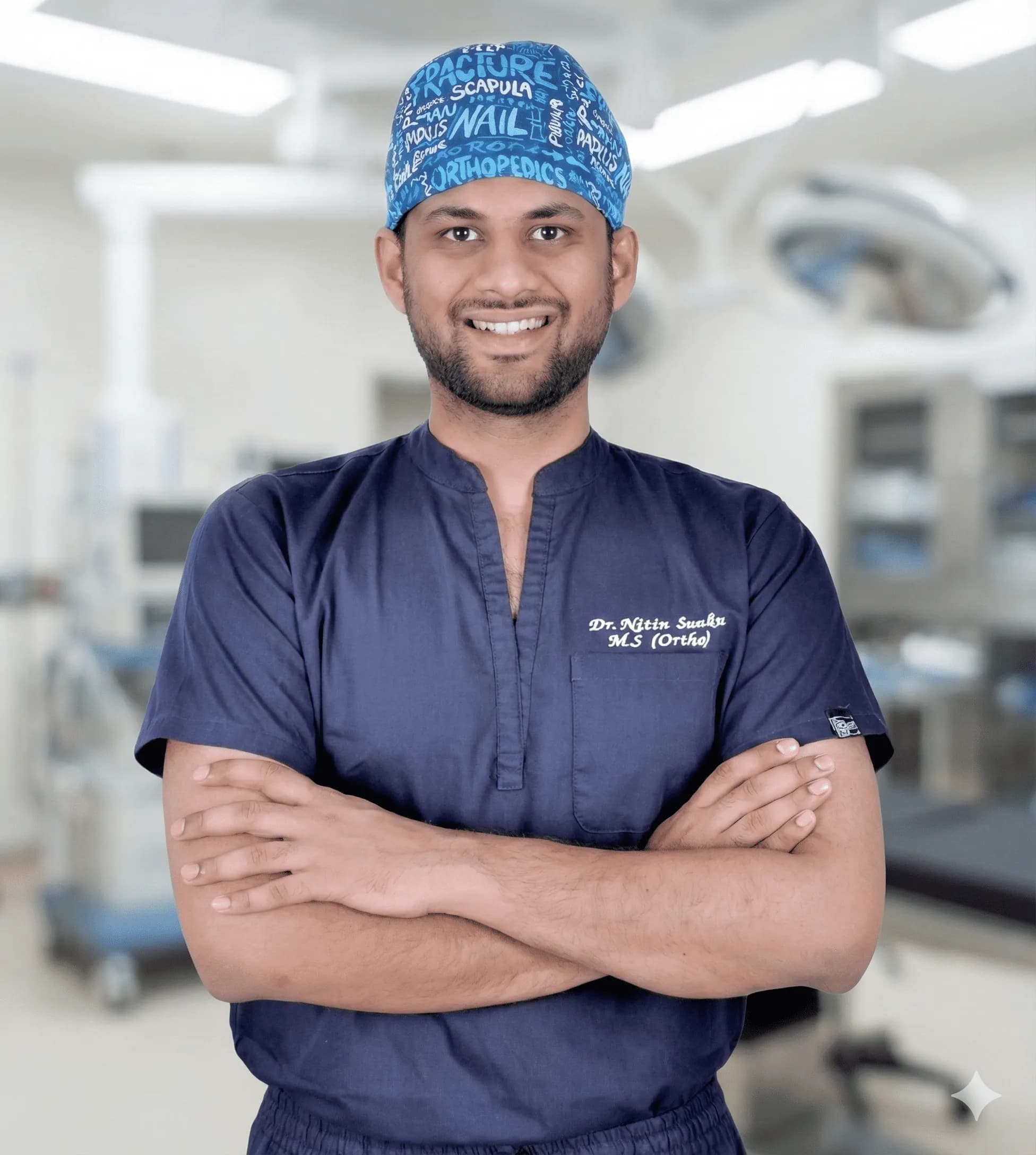
About the Author
Dr. Nitin N Sunku
MBBS, MS (Orthopedics), Fellowship in Arthroscopy & Sports Medicine
Dr. Nitin N Sunku is a Consultant Orthopedic & Sports Medicine Surgeon with over 10 years of focused practice in Bengaluru. He serves as the Team Doctor for Bengaluru FC and consults at Raghava Multispeciality Hospital (Attibele) and Health Nest Hospital (HSR Layout). His clinical interests include arthroscopy, ligament & meniscus care, regenerative orthopedic medicine, ultrasound-guided injections, and joint replacement.
Experiencing symptoms?
Don't let pain hold you back. Schedule a comprehensive evaluation with Dr. Nitin today.
Book Appointment

