This article is for general education and does not replace an in-person assessment, examination, or imaging. Everyone's injury pattern, medical history, and goals differ; use what you read here to prepare better questions for your doctor.
Dr. Nitin N Sunku is a consultant orthopedic and sports medicine surgeon. He sees patients at Raghava Multispeciality Hospital, Attibele, on Sarjapura–Attibele Road, and at Health Nest Hospital, HSR Layout, Bengaluru. If pain is rapidly worsening, you cannot bear weight, you develop numbness or weakness in a limb, or you have fever after an injury, seek urgent medical care. For non-emergency evaluation and individualised treatment options, book through the contact page.
Topics across this blog include knee ligament and meniscus problems, shoulder pain and instability, hip and knee arthritis, fracture recovery principles, spine symptoms when urgent causes have been excluded, running and tendon overuse issues, and what to expect from arthroscopy or joint replacement discussions. If you are comparing sources online, cross-check dates and always confirm advice with an in-person clinician.
If a herniated disc, sciatica, or spinal stenosis has left you searching for a way out of chronic back pain without the fear of a "big open surgery," you have probably come across the term endoscopic spine surgery. It is one of the most searched spine treatments in India today, and for good reason: smaller cuts, faster walking, and a quicker return to normal life.
Medically reviewed by Dr. Nitin N Sunku, Orthopedic & Sports Medicine Specialist, Bengaluru
If a herniated disc, sciatica, or spinal stenosis has left you searching for a way out of chronic back pain without the fear of a "big open surgery," you have probably come across the term endoscopic spine surgery. It is one of the most searched spine treatments in India today, and for good reason: smaller cuts, faster walking, and a quicker return to normal life.
This guide breaks down what endoscopic spine surgery actually involves, who it genuinely helps, what it costs across India in 2026, and the honest limitations most marketing pages will not tell you. It is written for patients trying to make a real decision, not just read a sales pitch.
What Is Endoscopic Spine Surgery?
Endoscopic spine surgery is a keyhole (minimally invasive) technique used to treat problems in the spine, such as a slipped disc or a pinched nerve, through an incision that is often smaller than a centimetre. A thin tube carrying a high-definition camera, called an endoscope, is guided to the exact site of the problem using live X-ray imaging. Through the same working channel, the surgeon passes tiny instruments to remove the disc fragment or bone spur pressing on the nerve, all while watching a magnified view on a monitor.
Unlike traditional open spine surgery, there is no cutting through large sections of back muscle to reach the spine. This muscle-sparing approach is the main reason endoscopic techniques are associated with less post-operative pain, less blood loss, and a shorter hospital stay compared to conventional discectomy or laminectomy.
It is important to be clear about terminology, since patients often mix these up:
- Endoscopic spine surgery uses a single working channel with continuous saline irrigation and a dedicated endoscope.
- Microdiscectomy uses a surgical microscope and a slightly larger incision, without the endoscope's tube-and-irrigation system.
- Open spine surgery involves a larger incision with direct-vision muscle retraction, generally reserved for more complex or multi-level disease.
Conditions Treated With Endoscopic Spine Surgery
Endoscopic techniques are most useful for well-localised, single-level problems rather than widespread degeneration. Commonly treated conditions include:
- Lumbar disc herniation (slipped disc) causing sciatica or leg pain
- Cervical disc herniation causing arm pain or numbness
- Foraminal stenosis (narrowing of the nerve exit canal)
- Recurrent disc herniation after a previous surgery
- Selected cases of lumbar canal stenosis, when the compression is localized
- Facet joint–related nerve impingement
If you are still unsure whether your back pain fits this category, it is worth reading a broader explainer on sciatica treatment without surgery in India, since many patients resolve their symptoms with rehabilitation alone before any procedure is even discussed.
Types of Endoscopic Spine Surgery
There are three broad approaches used in India, and the choice depends on where the disc herniation sits relative to the nerve root.
1. Transforaminal Endoscopic Discectomy (TFED)
The endoscope enters from the side of the spine through the natural foramen (nerve exit window). This approach is often done under local anaesthesia with sedation, allowing the surgeon to get real-time feedback from the patient during the procedure — a genuine safety advantage for avoiding nerve injury.
2. Interlaminar Endoscopic Discectomy
The endoscope enters from the back, between two vertebral laminae. This route suits herniations that sit closer to the midline or lower down at the L5–S1 level, where the transforaminal window can be narrow.
3. Unilateral Biportal Endoscopy (UBE)
A newer technique using two small separate incisions — one for the endoscope, one for instruments — rather than a single working channel. UBE gives surgeons more freedom of movement and is increasingly used for spinal stenosis and some fusion-adjacent procedures in Indian centres with advanced endoscopic training.
Am I a Good Candidate for Endoscopic Spine Surgery?
You are generally a reasonable candidate if:
- You have leg or arm pain (radiculopathy) matching a specific nerve level on MRI, not just isolated back pain
- Symptoms have not improved after 6–12 weeks of structured physiotherapy, medication, and activity modification
- The herniation or stenosis is at a single, clearly identified level
- You do not have significant spinal instability or multi-level collapse requiring fusion
You are usually not an ideal candidate if you have:
- Progressive weakness, loss of bladder or bowel control (cauda equina syndrome) — this needs emergency surgery, not elective endoscopic planning
- Severe spinal instability, scoliosis, or multi-level stenosis needing decompression and fusion
- Active spinal infection or tumour
- Very high body weight combined with distorted anatomy that limits endoscopic visualization safely
An honest surgeon will tell you when endoscopic surgery is not the right fit rather than fitting every patient into one technique. If your pain has followed you from a fall or sudden collapse rather than gradual disc degeneration, it is worth reading about compression fracture spine treatment in India as the management pathway is different.
What Happens During the Procedure: Step by Step
- Pre-operative workup — MRI, sometimes CT, blood tests, and anaesthesia fitness clearance.
- Positioning and anaesthesia — local anaesthesia with sedation for transforaminal approaches, or general/spinal anaesthesia for interlaminar and UBE techniques.
- Needle localization — a guide needle is placed under live X-ray (fluoroscopy) to confirm the exact level and trajectory.
- Dilation and endoscope insertion — the tract is gently dilated, and the endoscope with a working sheath is introduced.
- Visualization and decompression — using saline irrigation for a clear field, the surgeon removes the herniated disc fragment or bony overgrowth compressing the nerve.
- Confirmation — the nerve root is checked for free, pulsating movement, which is the intraoperative marker of adequate decompression.
- Closure — a single stitch or adhesive strip closes the tiny incision; no drains are usually needed.
The entire procedure typically takes 45 minutes to 90 minutes depending on complexity, and most patients walk within a few hours.
Endoscopic Spine Surgery Cost in India (2026)
Cost is one of the most searched aspects of this procedure, and transparency matters more than a single headline number. Here is a realistic 2026 range based on procedure complexity and hospital tier:
| Procedure Type | Approximate Cost Range (INR) |
|---|---|
| Single-level transforaminal endoscopic discectomy | ₹1,20,000 – ₹2,20,000 |
| Interlaminar endoscopic discectomy | ₹1,30,000 – ₹2,40,000 |
| UBE (Unilateral Biportal Endoscopy) for stenosis | ₹1,80,000 – ₹3,20,000 |
| Revision endoscopic surgery (recurrent disc) | ₹1,80,000 – ₹3,00,000 |
Factors that move the price within this range include the hospital's city tier, implant or disposable device costs (the endoscope kits are largely single-use), the surgeon's experience with the specific technique, ICU or ward category chosen, and whether insurance pre-authorization applies. For a wider comparison across all spine procedures — not just endoscopic ones — see this detailed breakdown of spine surgery cost in India.
Compared to open discectomy or laminectomy, endoscopic surgery is often priced similarly or slightly higher per procedure because of the disposable instrumentation, but this is frequently offset by a shorter hospital stay (often a single day versus 3–4 days for open surgery) and faster return to work.
Recovery Timeline After Endoscopic Spine Surgery
| Phase | What to Expect |
|---|---|
| Day 0–1 | Walking with assistance within 2–6 hours; discharge same day or next morning |
| Week 1 | Light walking, avoiding bending and lifting; wound care; oral pain medication tapering off |
| Week 2–4 | Gradual return to desk work; structured physiotherapy begins; no heavy lifting |
| Week 4–8 | Core strengthening exercises; most patients resume driving and normal daily activity |
| Week 8–12 | Return to gym, sport, or physically demanding work with surgeon clearance |
Recovery is generally faster than open surgery, but "minimally invasive" does not mean "no rehabilitation needed." Patients who skip structured physiotherapy have a higher chance of recurrent symptoms. If your job or recovery plan depends on a clear phase-by-phase home programme, this 4-phase lower back pain physiotherapy protocol for India is a useful companion resource regardless of which spine procedure you undergo.
Benefits of Endoscopic Spine Surgery
- Incision size of 7–10 mm versus 4–6 cm for open surgery
- Minimal muscle and ligament disruption, preserving spinal stability
- Reduced blood loss, typically under 20 ml
- Same-day or next-day discharge in most cases
- Local anaesthesia option for transforaminal approaches, reducing anaesthesia-related risk in older patients
- Faster return to sitting, walking, and light work
- Lower risk of surgical site infection due to the smaller wound
Honest Limitations and Risks
No responsible guide should only list benefits. Endoscopic spine surgery carries real limitations that patients deserve to know before committing:
- Steep learning curve for surgeons. Outcomes are strongly operator-dependent; a surgeon early in their endoscopic learning curve may have longer operating times and higher revision rates than an experienced open spine surgeon.
- Not suitable for every anatomy. Very lateral or extremely migrated disc fragments, severe central stenosis, or unstable spines often still need open or fusion surgery.
- Risk of incomplete decompression. Because the working corridor is narrow, a small fragment can occasionally be missed, requiring a second procedure.
- Standard surgical risks still apply, including nerve irritation, dural tear, infection, and, rarely, recurrence of disc herniation at the same level (5–10% reported in literature, similar to microdiscectomy).
- Cost is not always lower. Disposable endoscopic kits can make the procedure cost comparable to, or occasionally more than, conventional microdiscectomy despite the smaller incision.
A trustworthy surgeon will discuss these limitations openly during your consultation rather than presenting endoscopic surgery as risk-free.
Endoscopic Surgery vs Microdiscectomy vs Open Spine Surgery
| Factor | Endoscopic Surgery | Microdiscectomy | Open Surgery |
|---|---|---|---|
| Incision size | 7–10 mm | 2–3 cm | 4–6 cm+ |
| Anaesthesia | Local/sedation or general | General or spinal | General or spinal |
| Hospital stay | Same day–1 day | 1–2 days | 3–5 days |
| Muscle disruption | Minimal | Moderate | Significant |
| Best suited for | Single-level, well-localized disc/foraminal disease | Most standard disc herniations | Multi-level disease, instability, fusion cases |
| Surgeon expertise required | High (specialized training) | Standard spine training | Standard spine training |
Choosing the Right Endoscopic Spine Surgeon in India
Because outcomes depend so heavily on surgeon experience, ask these questions before booking:
- How many endoscopic spine procedures has the surgeon personally performed, and at which levels (lumbar, cervical, or both)?
- What is their approach if the endoscopic view is inadequate during surgery — do they have the training to convert to open surgery safely if needed?
- Can they show you comparable pre- and post-operative imaging from prior cases?
- What physiotherapy and follow-up structure is built into the recovery plan?
- Is a second opinion or non-surgical pathway discussed before recommending surgery?
If your MRI shows disc-related neck or arm symptoms rather than lower back involvement, the surgical decision-making is different and it is worth reading about cervical disc replacement in India to understand how ACDF and disc replacement compare to decompression-only approaches.
Why Patients Choose India for Endoscopic Spine Surgery
India has become a significant destination for endoscopic and minimally invasive spine care, both for domestic patients and medical tourists, due to a combination of experienced fellowship-trained spine surgeons, modern endoscopic and navigation equipment in most metro and tier-2 city hospitals, treatment costs that are a fraction of the US, UK, or Gulf equivalent, and shorter waiting times for elective spine procedures. For international patients, most centres also assist with visa documentation, accommodation, and coordinated post-operative follow-up before travel home.
When Should You See a Spine Specialist?
Book a consultation promptly, rather than waiting, if you notice:
- Leg or arm pain that is worse than your back pain
- Numbness, tingling, or weakness in a specific pattern down one limb
- Pain that disturbs sleep or does not respond to 2–3 weeks of rest and basic pain relief
- Any change in bladder or bowel control — this needs same-day evaluation
For a broader look at deciding whether your symptoms need specialist review at all, this guide on when you should see an orthopedic surgeon for joint or back pain walks through the red-flag checklist in plain language.
Frequently Asked Questions
Is endoscopic spine surgery safe?
Yes, in experienced hands it is considered a safe, well-established technique with a strong safety record for single-level disc herniation and foraminal stenosis. Risks such as nerve irritation, infection, or incomplete decompression exist but are comparable to, or lower than, conventional microdiscectomy.
How long does it take to recover from endoscopic spine surgery?
Most patients walk within hours and return to desk work in 2–4 weeks. Full recovery, including return to sport or heavy physical work, typically takes 8–12 weeks with structured physiotherapy.
What is the cost of endoscopic spine surgery in India?
As of 2026, a single-level lumbar endoscopic discectomy typically costs between ₹1,20,000 and ₹2,40,000 in India, depending on the technique used, hospital tier, and city.
Is endoscopic spine surgery better than open surgery?
It is not universally "better" — it is better suited to specific, well-localized problems. For single-level disc herniation, it generally offers less pain, a smaller scar, and faster recovery. For complex, multi-level, or unstable spine conditions, open or fusion surgery may still be the safer and more durable option.
Does endoscopic spine surgery require general anaesthesia?
Not always. Transforaminal endoscopic discectomy can often be done under local anaesthesia with sedation, which is particularly useful for older patients or those with anaesthesia-related risk factors. Interlaminar and UBE approaches more commonly use general or spinal anaesthesia.
Can a herniated disc come back after endoscopic surgery?
Recurrence at the same level occurs in roughly 5–10% of cases, a rate similar to microdiscectomy. This is one reason post-operative core strengthening and activity modification matter as much as the surgery itself.
How do I know if I need endoscopic spine surgery or if physiotherapy is enough?
Most disc-related back and leg pain improves with 6–12 weeks of structured physiotherapy, medication, and activity changes. Surgery, including endoscopic techniques, is usually reserved for patients who do not improve with this conservative approach, or who have progressive neurological symptoms.
Is endoscopic spine surgery covered by insurance in India?
Many Indian health insurance policies cover endoscopic spine surgery when it is medically indicated and pre-authorized, similar to coverage for microdiscectomy or laminectomy. Coverage details vary by insurer and policy, so it is worth confirming pre-authorization requirements with your hospital's insurance desk before scheduling.
What is the difference between endoscopic discectomy and UBE?
Endoscopic discectomy (transforaminal or interlaminar) uses a single working channel with continuous saline irrigation. UBE (Unilateral Biportal Endoscopy) uses two separate small incisions — one for the endoscope, one for instruments — giving the surgeon more freedom of movement, often used for spinal stenosis or slightly more complex decompressions.
The Bottom Line
Endoscopic spine surgery has genuinely changed how single-level disc herniations and localized nerve compression are treated in India — smaller incisions, faster walking, and a quicker return to normal life for the right candidate. But "minimally invasive" is not the same as "minimal decision-making." The technique's success depends heavily on accurate patient selection and surgeon experience, not the marketing around the word "endoscopic" itself.
If you are dealing with persistent back or leg pain and want a clear, honest assessment of whether endoscopic surgery, a different surgical approach, or continued non-surgical care is right for you, review the Spine Care services offered by Dr. Nitin N Sunku, or book a consultation to bring your MRI and history for a structured, evidence-based opinion.
This article is for general educational purposes and does not replace an in-person clinical evaluation. For further reading on endoscopic spine techniques, see the peer-reviewed overview from the National Center for Biotechnology Information (NCBI).
About the Author
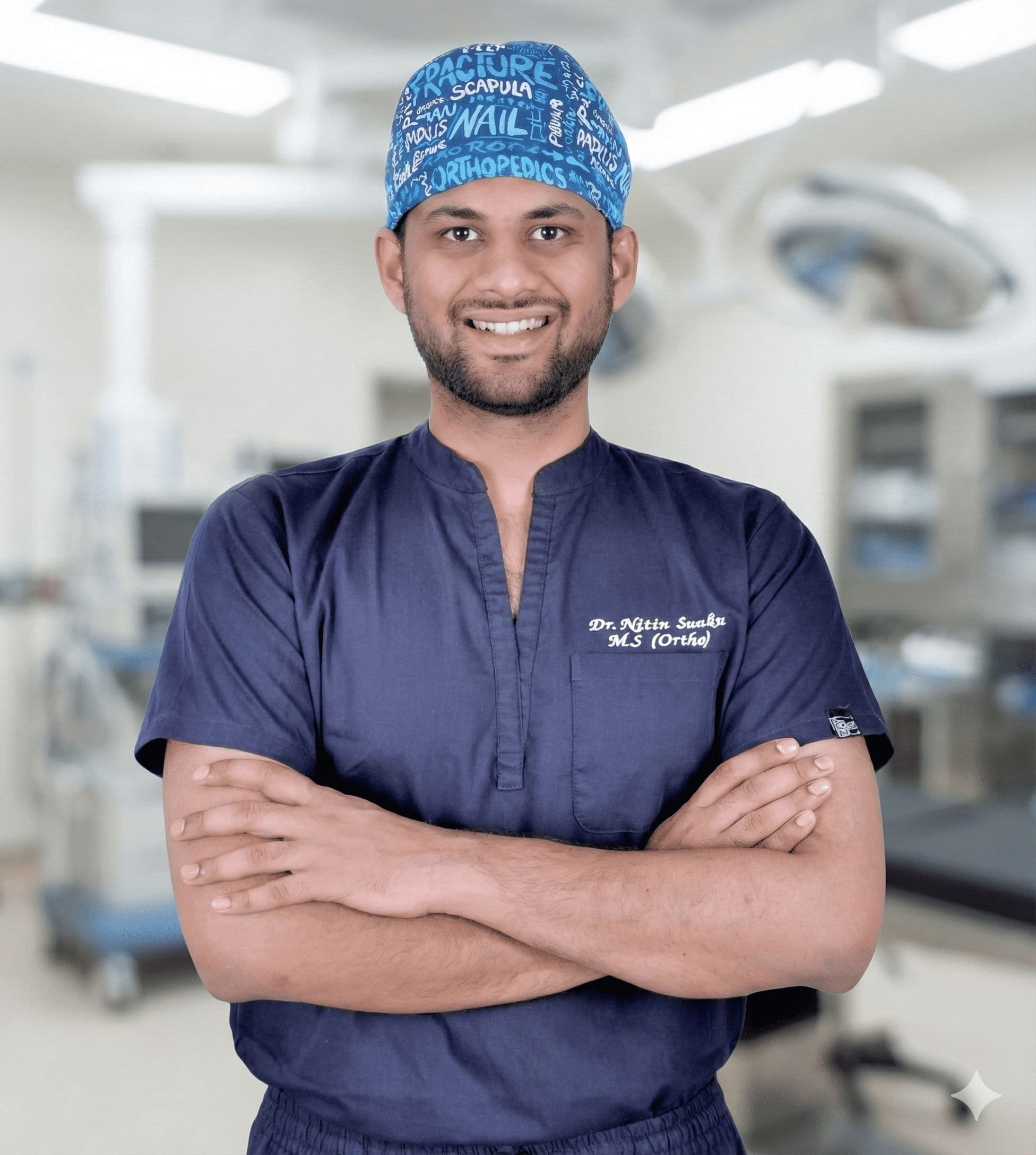
Dr. Nitin N Sunku
MBBS, MS (Orthopedics), Fellowship in Arthroscopy & Sports Medicine
Dr. Nitin N Sunku is a Consultant Orthopedic & Sports Medicine Surgeon with over 10 years of focused practice in Bengaluru. He serves as the Team Doctor for Bengaluru FC and consults at Raghava Multispeciality Hospital (Attibele) and Health Nest Hospital (HSR Layout). His clinical interests include arthroscopy, ligament & meniscus care, regenerative orthopedic medicine, ultrasound-guided injections, and joint replacement.
Experiencing symptoms?
Don't let pain hold you back. Schedule a comprehensive evaluation with Dr. Nitin today.
Book Appointment

