This article is for general education and does not replace an in-person assessment, examination, or imaging. Everyone's injury pattern, medical history, and goals differ; use what you read here to prepare better questions for your doctor.
Dr. Nitin N Sunku is a consultant orthopedic and sports medicine surgeon. He sees patients at Raghava Multispeciality Hospital, Attibele, on Sarjapura–Attibele Road, and at Health Nest Hospital, HSR Layout, Bengaluru. If pain is rapidly worsening, you cannot bear weight, you develop numbness or weakness in a limb, or you have fever after an injury, seek urgent medical care. For non-emergency evaluation and individualised treatment options, book through the contact page.
Topics across this blog include knee ligament and meniscus problems, shoulder pain and instability, hip and knee arthritis, fracture recovery principles, spine symptoms when urgent causes have been excluded, running and tendon overuse issues, and what to expect from arthroscopy or joint replacement discussions. If you are comparing sources online, cross-check dates and always confirm advice with an in-person clinician.
A surgeon's plain-English guide to spine surgery cost in India in 2026 — real rupee ranges by procedure, what drives the bill, and when surgery can be avoided.
If you have been told you may need spine surgery, the very next question is almost always the same: how much will this actually cost? Patients searching for the spine surgery cost in india usually find either vague brochures or aggregator pages quoting suspiciously low numbers. Neither helps you plan. This guide is written to give you a straight, surgeon's-eye view of what spine procedures realistically cost in India in 2026, what those numbers include, and where the variation comes from.
Dr. Nitin N Sunku is an orthopedic and sports-medicine surgeon practicing in Bengaluru, with consultations at Raghava Multispeciality Hospital in Attibele and Health Nest Hospital in HSR Layout. A meaningful share of patients who walk in worried about disc pain, sciatica or stenosis end up not needing surgery at all. For those who do, the cost question deserves a clear answer rather than a sales pitch — so let us go through it the way we would in clinic.
Spine surgery cost in India: the realistic range
Costs in 2026 vary widely by city, hospital category, implant brand and the exact procedure. The numbers below are indicative private-hospital ranges in major Indian metros for a single admission, including surgeon, anaesthesia, OT, implants and a standard hospital stay. They are not a quote — please confirm a written estimate from the hospital before deciding.
- Microdiscectomy (single level, open/microscopic): ₹1,50,000 — ₹3,00,000
- Endoscopic spine surgery (single-level disc): ₹2,50,000 — ₹4,50,000
- Lumbar laminectomy / decompression: ₹1,75,000 — ₹3,50,000
- Lumbar fusion, single level (TLIF/PLIF with cage and screws): ₹3,50,000 — ₹6,50,000
- Lumbar fusion, multi-level: ₹6,00,000 — ₹12,00,000+
- Cervical discectomy and fusion (ACDF, single level): ₹2,50,000 — ₹5,00,000
- Cervical disc replacement (artificial disc): ₹4,00,000 — ₹8,00,000
- Scoliosis correction (deformity, instrumented): ₹6,00,000 — ₹15,00,000+
- Minimally invasive spine surgery cost (MIS TLIF, single level): ₹4,00,000 — ₹7,50,000
For most working-age patients with one painful disc or a single-level problem, the bill lands somewhere between ₹2,00,000 and ₹5,00,000 in a good mid-sized private hospital. Premium corporate hospitals and multi-level cases push higher. Government and trust hospitals can be substantially lower for those who qualify.
What drives the cost up or down
Two patients with "the same" spine problem can receive very different estimates. The honest reasons are:
- Type of procedure: a discectomy cost India range is far below a fusion, because a fusion adds implants, longer OT time and longer stay.
- Implant choice: pedicle screws, cages and artificial discs come in Indian, Korean, European and American brands. The implant alone can swing the bill by ₹1—3 lakh.
- Surgical technique: open vs tubular MIS vs full-endoscopic vs robotic/navigation-assisted. Newer tech often means smaller incisions and shorter stay, but a higher headline price.
- Hospital category: a NABH-accredited mid-sized hospital is usually 25—40% cheaper than a flagship corporate chain for the same surgeon and same implant.
- Room category: shared, twin-sharing, single deluxe and suite rooms cascade into nursing charges, doctor visit fees and even pharmacy markup.
- Single vs multi-level: every additional level fused adds implants, OT time and blood loss management.
- Your health profile: diabetes, obesity, smoking, osteoporosis or cardiac issues can mean extra pre-op work-up, longer ICU stay and higher costs.
What is usually included — and what is extra
A typical hospital "package" for spine surgery usually covers the core admission. Be careful to ask, in writing, what sits outside the package.
- Usually included: surgeon's fee, anaesthetist, OT charges, standard implants for the quoted level, hospital stay (typically 3—5 days), routine ward medication, basic post-op imaging.
- Often extra: pre-op tests (MRI, CT, blood work, cardiac clearance), advanced implants beyond the package tier, intra-operative neuro-monitoring, ICU days beyond what is bundled.
- Almost always extra: post-discharge physiotherapy, lumbar/cervical brace, take-home medication, follow-up consultations beyond the first one or two, and imaging at 6 weeks/3 months.
- Hidden but real: time off work, a family member's travel, and home modifications (firmer mattress, raised toilet seat) for the first month.
Does insurance cover spine surgery in India?
Most Indian health insurance policies, CGHS, ECHS and ESI do cover medically indicated spine surgery, provided the procedure is not deemed cosmetic or experimental. Standard decompressions and fusions are routinely approved; newer technologies like artificial disc replacement and full-endoscopic surgery sometimes need additional justification, and insurers may cap the implant component. Pre-authorization is normally required — the hospital's TPA desk will submit the MRI, clinical notes and proposed plan, and approval usually comes through in 24—72 hours.
A practical tip: ask the hospital billing team upfront for the difference between the "cashless approved" amount and the "total expected bill". That gap — co-pay, non-medical items, room-rent capping — is what you will actually pay out of pocket.
Is the cheapest option the right option?
Spine surgery is one area where the lowest quote can become the most expensive decision. A poorly chosen implant, an inexperienced surgical team, or a hospital without 24-hour neurosurgical/orthopedic cover and proper intra-operative imaging can turn a routine case into a complication. When you are evaluating a Bangalore spine surgeon or any other city's team, weigh experience with your specific problem, volume of similar cases per year, access to neuro-monitoring, and what happens at 2 AM if something goes wrong. A ₹50,000 saving is not a saving if it costs you a revision surgery two years later.
Conservative first: when surgery can be avoided
A large fraction of patients sent for "surgery opinion" do not actually need an operation. Most acute disc herniations and sciatica episodes settle over 6—12 weeks with structured physiotherapy, activity modification, short courses of medication and, in selected cases, a targeted epidural or nerve-root injection. Mild to moderate canal stenosis often responds to a graded exercise program. If you have been advised surgery for a herniated disc or early stenosis, it is reasonable — in fact, sensible — to ask for a second opinion focused on whether you can be managed non-surgically first. The earlier posts on this site about herniated discs and on non-surgical alternatives for joint pain explain that approach in more detail.
How to plan your spine surgery in Bangalore
- Get an accurate diagnosis first. A recent MRI alone is not a diagnosis — it has to match your symptoms and examination.
- Ask for a written, itemized estimate. Surgeon's fee, implant brand and tier, OT charges, expected days of stay, ICU contingency.
- Clarify the implant tier. Indian, Korean or premium imported — understand what you are paying for and whether your insurer caps it.
- Plan the recovery time. Most single-level decompressions need 2—4 weeks off desk work; fusions need 6—12 weeks before heavier activity.
- Arrange post-op physiotherapy in advance. Recovery is 50% the surgery and 50% the rehab that follows.
- Confirm follow-up schedule and costs. Typically at 2 weeks, 6 weeks, 3 months and 6 months.
Book a consultation in Attibele
If you would like an unhurried second opinion on whether spine surgery is the right answer for you — and what it would realistically cost — Dr. Nitin N Sunku consults at Raghava Multispeciality Hospital, Attibele (call +91-9980031006) and at Health Nest Hospital, HSR Layout (call +91-9449031003). Please bring your most recent MRI, any prior X-rays, and a list of treatments already tried.
Frequently Asked Questions
What is the average spine surgery cost in india in 2026?
For a single-level procedure in a good private hospital, most patients pay between ₹2,00,000 and ₹5,00,000 all-in. Multi-level fusions, deformity correction or premium imported implants can push the total above ₹10,00,000.
How much does a lumbar disc surgery cost in India?
A standard single-level microdiscectomy typically falls in the ₹1,50,000—₹3,00,000 range, while an endoscopic version is usually ₹2,50,000—₹4,50,000. The endoscopic option costs more but often means a shorter hospital stay.
What is the minimally invasive spine surgery cost compared to open surgery?
MIS techniques generally run 20—40% higher than the equivalent open procedure because of specialised instruments and longer OT time. For many patients the trade-off is worth it: smaller incision, less blood loss and faster return to work.
Will my health insurance cover the full spine surgery price?
Most policies cover medically indicated spine surgery, subject to your sum insured, room-rent limit and implant sub-limits. Expect to pay out of pocket for non-medical items, brace, home medication and rehabilitation.
How long is the recovery after spine surgery?
A simple discectomy typically allows return to desk work in 2—4 weeks. A single-level fusion needs 6—12 weeks before heavier activity, and multi-level or deformity surgery can take 3—6 months for full recovery, depending on the rehab program.
Can spine surgery be avoided?
Often, yes. Most acute disc and nerve-root problems settle with 6—12 weeks of structured physiotherapy and medication. Surgery is reserved for progressive weakness, bladder/bowel involvement, severe stenosis with disabling symptoms, or pain that fails proper non-surgical care.
How do I choose a Bangalore spine surgeon?
Look for someone who does a high volume of the specific procedure you need, who is willing to discuss non-surgical options honestly, and who operates in a hospital with proper intra-operative imaging and round-the-clock cover. A clear, itemized estimate is also a good sign of a transparent practice.
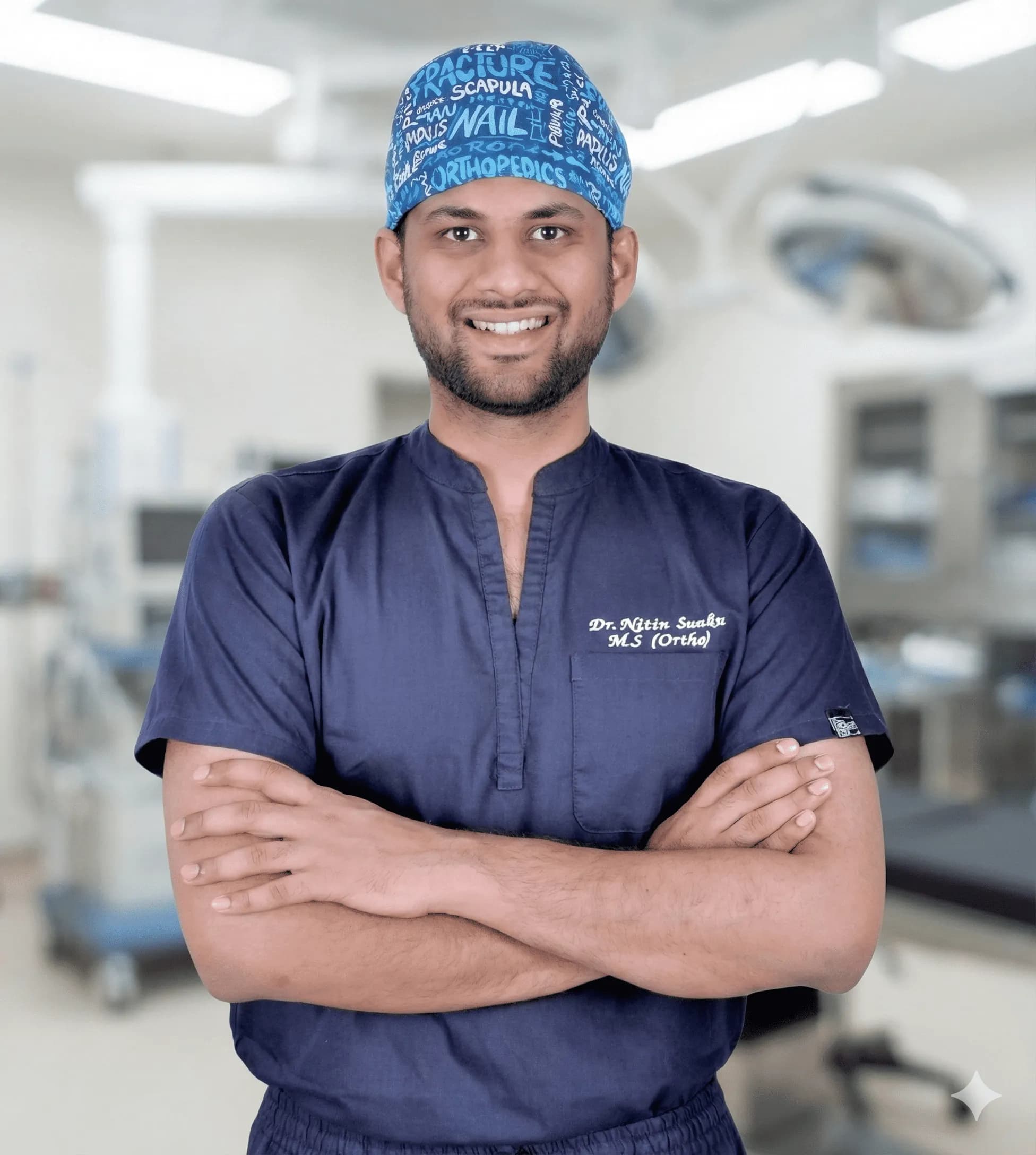
About the Author
Dr. Nitin N Sunku
MBBS, MS (Orthopedics), Fellowship in Arthroscopy & Sports Medicine
Dr. Nitin N Sunku is a Consultant Orthopedic & Sports Medicine Surgeon with over 10 years of focused practice in Bengaluru. He serves as the Team Doctor for Bengaluru FC and consults at Raghava Multispeciality Hospital (Attibele) and Health Nest Hospital (HSR Layout). His clinical interests include arthroscopy, ligament & meniscus care, regenerative orthopedic medicine, ultrasound-guided injections, and joint replacement.
Experiencing symptoms?
Don't let pain hold you back. Schedule a comprehensive evaluation with Dr. Nitin today.
Book Appointment

