This article is for general education and does not replace an in-person assessment, examination, or imaging. Everyone's injury pattern, medical history, and goals differ; use what you read here to prepare better questions for your doctor.
Dr. Nitin N Sunku is a consultant orthopedic and sports medicine surgeon. He sees patients at Raghava Multispeciality Hospital, Attibele, on Sarjapura–Attibele Road, and at Health Nest Hospital, HSR Layout, Bengaluru. If pain is rapidly worsening, you cannot bear weight, you develop numbness or weakness in a limb, or you have fever after an injury, seek urgent medical care. For non-emergency evaluation and individualised treatment options, book through the contact page.
Topics across this blog include knee ligament and meniscus problems, shoulder pain and instability, hip and knee arthritis, fracture recovery principles, spine symptoms when urgent causes have been excluded, running and tendon overuse issues, and what to expect from arthroscopy or joint replacement discussions. If you are comparing sources online, cross-check dates and always confirm advice with an in-person clinician.
Hip arthritis doesn't always have to lead straight to replacement. A clear look at how regenerative injections, ultrasound-guided care, and lifestyle changes can help eligible patients manage hip pain in Bengaluru.
Most online content about regenerative orthopedic care focuses on the knee. But many patients walking into the clinic are equally worried about the hip — early-morning stiffness, groin pain that radiates into the thigh, difficulty putting on socks, and the lingering question: "Do I really need a hip replacement?"
The honest answer is: not always, and not always immediately. This guide explains how regenerative options fit into the management of hip arthritis, when they help, and when surgery is the better path. It is a companion piece to Natural Alternatives to Hip Replacement and the broader overview of regenerative orthopedic medicine.
Why the hip is a different conversation from the knee
The hip is a deep, ball-and-socket joint. That has two practical implications for regenerative care:
- Access matters. Injections into the hip joint are blind-and-hope only when done badly. They should be performed with image guidance — most commonly ultrasound or fluoroscopy — so the medication or biologic reaches the joint, not the surrounding soft tissue.
- Load matters. The hip carries a significant amount of body weight with every step. A stiff, arthritic hip rarely improves without addressing strength, weight, and movement habits alongside any injection.
Which hip patients are candidates for regenerative therapy?
Regenerative injections — PRP, GFC, and in selected cases BMAC — may be considered for:
- Mild to moderate hip osteoarthritis
- Persistent groin and lateral hip pain with preserved joint space on X-ray
- Greater trochanteric pain syndrome and gluteal tendinopathy (outside the joint)
- Hip labral irritation in the right clinical setting
- Patients who want to delay or defer hip replacement and are willing to commit to rehab
And — equally important — when regenerative therapy is generally not the answer:
- End-stage hip arthritis with bone-on-bone changes, severe deformity, and night pain
- Avascular necrosis at an advanced stage with collapse of the femoral head
- Severe functional limitation where surgery would clearly restore far more quality of life
This filtering is not a sales decision. It is what makes the difference between honest care and chasing a procedure.
The non-surgical ladder for hip arthritis
For eligible patients, the approach is staged — not "injection or nothing":
Step 1 — Foundation care
- Weight optimisation (each kilogram matters more at the hip than people realise)
- Hip-specific strengthening: glutes, deep stabilisers, and core
- Movement modification — how you sit, drive, climb stairs, and sleep
- Simple aids when needed (a cane in the opposite hand can offload the hip dramatically)
Step 2 — Targeted medications
Short-course anti-inflammatory medications or paracetamol, used carefully, can give breathing room for rehab to take effect. Long-term reliance on painkillers is not the goal.
Step 3 — Image-guided injections
If pain is limiting rehab, ultrasound- or fluoroscopy-guided injections into the joint or peri-articular structures are considered:
- Corticosteroid + local anaesthetic — for short-term flare control
- Hyaluronic acid — for lubrication-style support in some hip cases
- PRP / GFC — for tendon-based hip pain and selected intra-articular cases (see PRP vs GFC)
- BMAC — in selected mild-to-moderate hip OA cases, often planned alongside structured rehab (more in our guide to BMAC)
Step 4 — Surgical options when justified
If conservative care has been tried fully and life is still limited, hip replacement is one of the most successful operations in modern orthopedics. The point of regenerative care is not to avoid surgery at all costs — it's to ensure surgery happens at the right time, for the right reasons. You can read more about that in our hip replacement service overview.
How long can regenerative care reasonably delay hip replacement?
There is no fixed number that applies to everyone, and any clinic that promises one should be viewed with caution. Realistic patterns in clinical practice include:
- Patients with early arthritis who lose weight, strengthen well, and use injections wisely can sometimes go years without surgery.
- Patients with moderate arthritis often gain meaningful symptom relief and functional improvement for many months at a time.
- Patients with advanced changes typically gain less from biologics, and earlier surgical planning is often the kinder option.
The decision is reviewed at each visit with imaging and your own functional report. Treatment is a partnership, not a one-off transaction.
What about "stem cell" claims for the hip?
You will see a lot of online marketing around stem cell injections for hip arthritis. A few honest points:
- Most legitimate "stem cell" procedures done in India today are BMAC-based — using your own bone marrow, not culture-expanded or imported cells.
- Claims of regrowing cartilage or completely curing arthritis are not supported by current evidence and should be treated with caution.
- Where BMAC is offered, it should be performed under sterile conditions, with image guidance, and as part of a wider plan that includes rehab.
What to bring to your hip consultation
If you are coming in for a hip pain consultation, please bring:
- Any prior X-rays of the pelvis or hip (paper or digital)
- An MRI of the hip if one has been done
- A list of medications you are taking
- Notes on what activities aggravate the pain and what relieves it
- Your honest goals — pain reduction, walking longer, sleeping better, returning to a specific activity
The first consultation focuses on examination, imaging review, and discussion. You will leave with a written plan — and a clear understanding of where regenerative therapy fits in your case, if at all.
Get assessed in Bengaluru
If you would like a structured, honest evaluation, you can book a consultation with Dr. Nitin N Sunku at Raghava Multispeciality Hospital, Attibele (Sarjapura–Attibele Road) or Health Nest Hospital, HSR Layout. The clinics serve patients from Attibele, Anekal, Bommasandra, Chandapura, Hosur Road, Electronic City, HSR Layout, Koramangala, BTM Layout, Sarjapur Road, and Bellandur. Bring any prior X-ray or MRI; the imaging is reviewed and explained in plain language during your visit.
This article is educational and does not replace a clinical examination. Treatment outcomes vary based on the severity of your condition, age, weight, lifestyle, and other medical factors. Severe joint degeneration may still require surgical management.
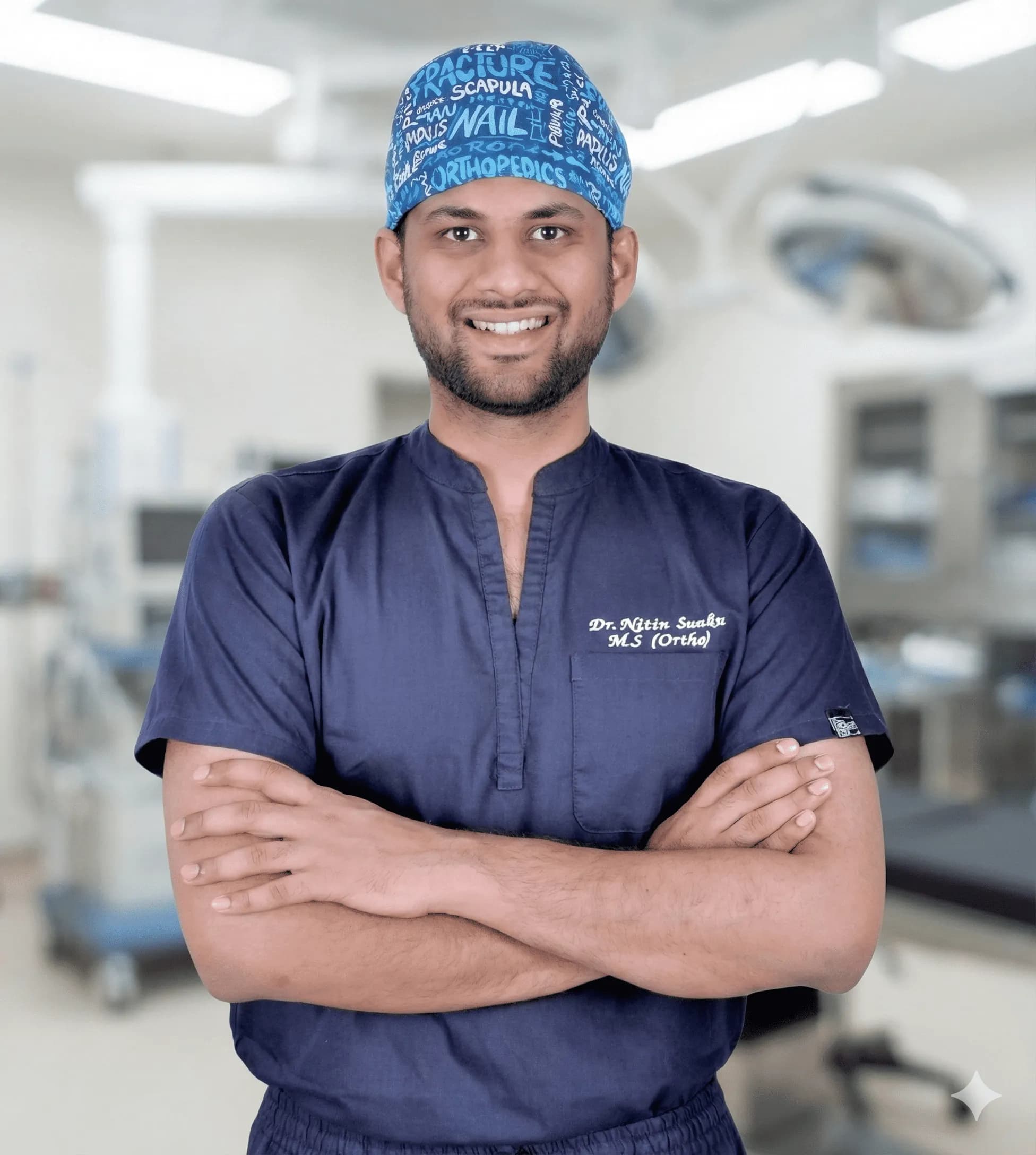
About the Author
Dr. Nitin N Sunku
MBBS, MS (Orthopedics), Fellowship in Arthroscopy & Sports Medicine
Dr. Nitin N Sunku is a Consultant Orthopedic & Sports Medicine Surgeon with over 10 years of focused practice in Bengaluru. He serves as the Team Doctor for Bengaluru FC and consults at Raghava Multispeciality Hospital (Attibele) and Health Nest Hospital (HSR Layout). His clinical interests include arthroscopy, ligament & meniscus care, regenerative orthopedic medicine, ultrasound-guided injections, and joint replacement.
Experiencing symptoms?
Don't let pain hold you back. Schedule a comprehensive evaluation with Dr. Nitin today.
Book Appointment

