This article is for general education and does not replace an in-person assessment, examination, or imaging. Everyone's injury pattern, medical history, and goals differ; use what you read here to prepare better questions for your doctor.
Dr. Nitin N Sunku is a consultant orthopedic and sports medicine surgeon. He sees patients at Raghava Multispeciality Hospital, Attibele, on Sarjapura–Attibele Road, and at Health Nest Hospital, HSR Layout, Bengaluru. If pain is rapidly worsening, you cannot bear weight, you develop numbness or weakness in a limb, or you have fever after an injury, seek urgent medical care. For non-emergency evaluation and individualised treatment options, book through the contact page.
Topics across this blog include knee ligament and meniscus problems, shoulder pain and instability, hip and knee arthritis, fracture recovery principles, spine symptoms when urgent causes have been excluded, running and tendon overuse issues, and what to expect from arthroscopy or joint replacement discussions. If you are comparing sources online, cross-check dates and always confirm advice with an in-person clinician.
Frozen shoulder is several times more common in people with diabetes, tends to be stiffer, more often affects both shoulders and takes longer to settle. Here is why that happens, why a new frozen shoulder is worth a blood sugar test, and what changes about injections, physiotherapy and surgical release.
Frozen shoulder (adhesive capsulitis) is substantially more common in people with diabetes than in people without it. Published series vary a great deal, but most report that somewhere between one in ten and one in four people with long-standing diabetes will develop a frozen shoulder at some point, against roughly two to five per cent of the general population. In people with diabetes it also tends to be stiffer, to involve both shoulders more often, to last longer, and to be more likely to come back on the other side later.
The practical takeaways are simple. If you have diabetes and your shoulder has stiffened, start treatment early and expect a longer road than the textbook timeline. If you have a frozen shoulder and have never been tested for diabetes, get a fasting glucose and HbA1c done, because for a minority of patients the shoulder is what brings the diabetes to light. And if a steroid injection is being considered, plan for a few days of higher blood sugar readings afterwards.
What a frozen shoulder actually is
The shoulder sits inside a soft-tissue sleeve called the capsule. In adhesive capsulitis that capsule becomes inflamed and then fibrotic. It thickens, contracts and loses its normal folds, particularly at the front where the rotator interval and coracohumeral ligament sit. The result is a shoulder that hurts and, more tellingly, cannot be moved through full range even by someone else. That is the clinical signature: in a true frozen shoulder, passive external rotation is restricted, not just active movement. A painful shoulder someone else can still rotate freely is usually something else, most often a rotator cuff problem.
It runs through three overlapping stages: a painful freezing phase, a frozen phase where pain settles but movement is at its worst, and a thawing phase where range gradually returns. More detail is in frozen shoulder treatment without surgery and on our frozen shoulder treatment page.
Why diabetes makes the capsule stiffer
The mechanism most widely accepted is non-enzymatic glycation. When blood glucose runs high over long periods, glucose molecules attach themselves to collagen without any enzyme directing the process. Over time these attachments mature into advanced glycation end-products, which form cross-links between adjacent collagen fibres. Cross-linked collagen is stiffer, turns over more slowly and is more resistant to the normal remodelling that keeps soft tissue supple. In a joint capsule that is already inflamed, this shifts the balance towards dense fibrosis rather than resolution.
A pro-fibrotic tissue environment and changes in small blood vessels probably contribute as well. But glycation explains the pattern, and it explains something patients often notice: this is not a shoulder-only phenomenon.
The wider hand and shoulder cluster
Frozen shoulder belongs to a group of connective-tissue conditions that all occur more often in people with diabetes. Recognising the cluster is genuinely useful, because a patient who has had two of these already is at higher risk of the others, and because the pattern sometimes prompts the diabetes diagnosis itself.
- Trigger finger (stenosing tenosynovitis), where a finger catches or locks as it bends. Multiple digits are more often involved in diabetes.
- Dupuytren’s disease, in which fascia in the palm thickens into cords that pull the fingers inwards. In diabetes it often affects the middle and ring fingers and tends to be less aggressive than the hereditary form.
- Carpal tunnel syndrome, with numbness and tingling in the thumb, index and middle fingers, typically worse at night.
- Limited joint mobility of the hand (diabetic cheiroarthropathy), where the small joints stiffen and the palms cannot be pressed flat together.
None of these is dangerous in itself, but together they say something about how your connective tissue is behaving. If you have a frozen shoulder and one or more of these, mention it at your appointment.
Hypothyroidism, and the other associations
Diabetes is the strongest association but not the only one. Frozen shoulder occurs more often in people with hypothyroidism, so thyroid function is worth checking in bilateral or otherwise unexplained cases. It is also more common after prolonged immobilisation of the arm, after shoulder or breast surgery, and after a stroke affecting that side. Most cases occur between the ages of 40 and 60, and it is somewhat more common in women.
If you have a frozen shoulder and no diabetes diagnosis
Our practical position is that anyone presenting with a genuine frozen shoulder who has not been screened recently should have a fasting glucose and an HbA1c done. It is inexpensive and low-risk. In a proportion of patients it comes back showing prediabetes or undiagnosed type 2 diabetes, and finding that early is worth far more over a lifetime than anything we do for the shoulder.
Two caveats. A frozen shoulder does not diagnose diabetes; it only raises suspicion enough to justify a test. And if the test is abnormal, management of your diabetes belongs with your physician or endocrinologist, not with an orthopedic surgeon. We treat the shoulder and coordinate; decisions about medication, diet and monitoring are theirs.
How the course differs
The table reflects broad patterns reported in published series and seen in clinic. Individual patients vary widely in both groups.
| Feature | Typical non-diabetic patient | Typical patient with diabetes |
|---|---|---|
| Overall duration | Often 12 to 24 months to near-normal | Frequently longer, sometimes 2 to 3 years or more |
| Both shoulders involved | Uncommon, though the other side can follow years later | Considerably more common, sometimes at the same time |
| Severity of stiffness | Moderate; external rotation most affected | Often more severe and more resistant to stretching |
| Response to steroid injection | Usually good pain relief, especially if given early | Still helpful but the benefit may be smaller and shorter |
| Need for surgical release | A minority of cases | A higher proportion, particularly with type 1 diabetes |
| Residual restriction at the end | Small and usually not troublesome | More likely to retain some loss of end-range rotation |
| Recurrence or the other side | Uncommon in the same shoulder | Higher risk on the opposite side over following years |
What changes about treatment
Steroid injections raise blood sugar
An intra-articular corticosteroid injection is one of the more effective things we can offer in the painful phase. But the steroid is absorbed systemically to some degree, and in people with diabetes it commonly pushes blood glucose up. The rise starts within hours, peaks in the first day or two, and settles over roughly three to seven days. With well-controlled diabetes the rise may be modest; where control is already poor it can be substantial.
This does not make injections off-limits; it means we plan for them. If you are diabetic and we are injecting your shoulder, monitor your sugars more frequently for about a week, tell your physician in advance so any dose adjustment can be discussed, and let us know if readings go very high or you feel unwell. If your HbA1c is very poor, it is often sensible to improve control first and inject after.
Accuracy matters too, because a well-placed injection into the joint or rotator interval does more with the same dose. We use imaging guidance for many shoulder injections; the reasoning is in ultrasound-guided orthopedic injections and in shoulder injections and precision care. If you are weighing an injection against biological options, steroid injection versus PRP explains where each fits, and it is worth saying plainly that PRP is not an established treatment for adhesive capsulitis.
Physiotherapy still does the heavy lifting
Structured physiotherapy, done consistently, remains the core of treatment. The important detail is intensity. Aggressive stretching into sharp pain during the inflamed freezing phase tends to make things worse; gentle, frequent, range-focused work respecting pain limits does better. As the shoulder moves into the stiff phase, the emphasis shifts towards sustained end-range stretching. A physiotherapist who understands the staging will get more out of you than one applying a generic protocol.
Glycaemic control affects the recovery
The association between better glycaemic control and better shoulder outcomes is consistent but not proven to be causal. We cannot promise that lowering your HbA1c will unfreeze your shoulder faster. It is biologically plausible, it is what the mechanism predicts, and it is worth doing for a dozen other reasons anyway. So we raise it, and leave the how to your physician.
Why we usually prefer arthroscopic release over manipulation
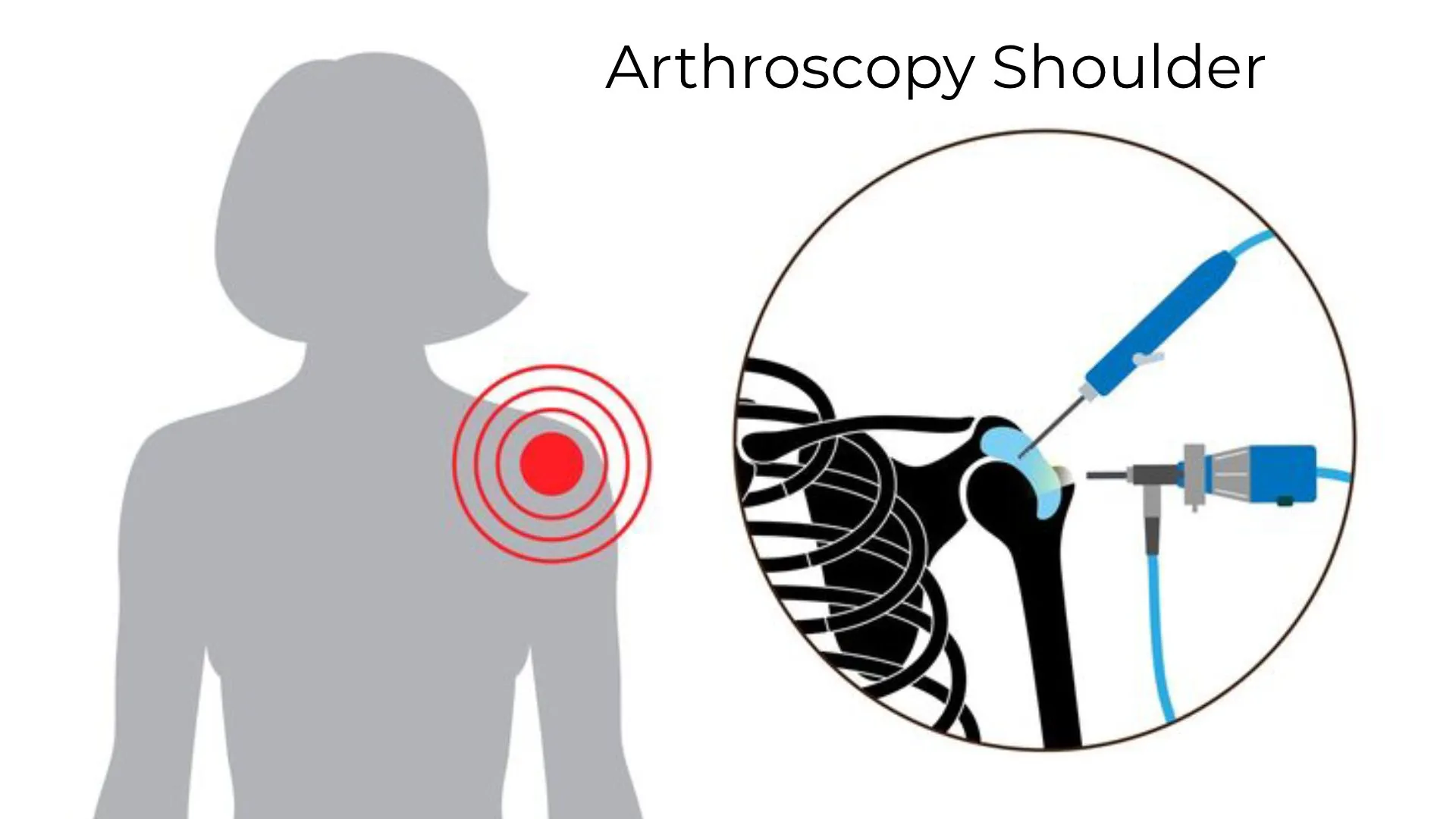
When a shoulder has failed to improve after several months of proper conservative treatment, two options exist. Manipulation under anaesthesia means forcibly moving the anaesthetised shoulder to tear the contracted capsule. Arthroscopic capsular release means dividing the tight capsule and coracohumeral ligament through keyhole incisions, under direct vision, in a controlled sequence.
Manipulation is quicker and cheaper, but it is uncontrolled by definition: the tearing goes where the tissue is weakest, not where you want it. Reported complications include fracture of the proximal humerus or humeral shaft, rotator cuff tears, labral injury and dislocation. In diabetes the capsule is often unusually dense while the bone may be relatively osteopenic, exactly the combination that shifts risk towards the bone giving way before the capsule does. So in diabetic patients with a severely stiff shoulder we generally prefer a controlled arthroscopic release, sometimes followed by a gentle manipulation once the tight structures are already divided. Our wider approach is outlined under shoulder care.
Setting expectations honestly
Frozen shoulder is often described as self-limiting. That is true in the sense that most shoulders improve substantially with time, and misleading in the sense that "time" can mean two or three years, and that a meaningful minority of patients are left with some permanent loss of end-range rotation. In diabetes both statements sit further towards the pessimistic end. Expect months, not weeks. Expect pain to improve well before stiffness does, and progress to be uneven. Do the physiotherapy on the days you do not feel like it, because that is where the outcome is decided.
What does not work
Rest and avoidance make a frozen shoulder worse. Oral steroids give short-term benefit that fades and are rarely justified in a diabetic patient given the effect on blood sugar. Repeated injections at short intervals are not a strategy; more than two or three into the same shoulder within a year rarely adds value and carries its own risks. Hydrodilatation has reasonable evidence for short-term gain but is not a shortcut past rehabilitation. And no supplement, oil, belt or device has been shown to change the natural course of this condition.
When to see a doctor, and the red flags
Book an assessment if your shoulder has been stiffening for more than three or four weeks, if you cannot reach behind your back or across your body, if pain is waking you at night, or if you have diabetes and have noticed any loss of shoulder movement at all. Early treatment during the painful phase is when we have the most leverage. Our general shoulder pain assessment page explains what a first consultation involves.
Seek medical attention urgently, rather than assuming it is a frozen shoulder, if any of the following apply:
- The stiffness followed a fall, a dislocation or a direct injury, raising the possibility of a fracture or unreduced dislocation.
- Fever, redness, warmth or rapidly increasing pain, which can indicate infection. This matters more in diabetes, where infection risk is higher and presentation can be blunted.
- Sudden weakness of the arm rather than stiffness, or an inability to lift it against gravity.
- Numbness, pins and needles or weakness extending into the hand, which points to the neck or a nerve problem rather than the capsule.
- Unexplained weight loss, night sweats, or a history of cancer with new shoulder pain.
- Very high blood sugar readings after a steroid injection, or excessive thirst, frequent urination, drowsiness or vomiting. Contact your physician the same day.
This article is general information, not a substitute for an individual consultation. Decisions about diabetes medication and monitoring belong with the doctor who manages your diabetes.

About the Author
Dr. Nitin N Sunku
MBBS, MS (Orthopedics), Fellowship in Arthroscopy & Sports Medicine
Dr. Nitin N Sunku is a Consultant Orthopedic & Sports Medicine Surgeon with over 10 years of focused practice in Bengaluru. He serves as the Team Doctor for Bengaluru FC and consults at Raghava Multispeciality Hospital (Attibele) and Health Nest Hospital (HSR Layout). His clinical interests include arthroscopy, ligament & meniscus care, regenerative orthopedic medicine, ultrasound-guided injections, and joint replacement.
Experiencing symptoms?
Don't let pain hold you back. Schedule a comprehensive evaluation with Dr. Nitin today.
Book Appointment