This article is for general education and does not replace an in-person assessment, examination, or imaging. Everyone's injury pattern, medical history, and goals differ; use what you read here to prepare better questions for your doctor.
Dr. Nitin N Sunku is a consultant orthopedic and sports medicine surgeon. He sees patients at Raghava Multispeciality Hospital, Attibele, on Sarjapura–Attibele Road, and at Health Nest Hospital, HSR Layout, Bengaluru. If pain is rapidly worsening, you cannot bear weight, you develop numbness or weakness in a limb, or you have fever after an injury, seek urgent medical care. For non-emergency evaluation and individualised treatment options, book through the contact page.
Topics across this blog include knee ligament and meniscus problems, shoulder pain and instability, hip and knee arthritis, fracture recovery principles, spine symptoms when urgent causes have been excluded, running and tendon overuse issues, and what to expect from arthroscopy or joint replacement discussions. If you are comparing sources online, cross-check dates and always confirm advice with an in-person clinician.
The first six weeks after a PRP, GFC or BMAC injection are when most patients either get the best out of their treatment — or accidentally undo it. A clear, week-by-week guide.
Patients often spend weeks deciding whether to have a regenerative injection, and then surprisingly little time understanding what happens after one. That's a missed opportunity, because the post-procedure period is when the biology you've paid for is either supported — or quietly sabotaged.
This guide is a practical, plain-language playbook for the days and weeks after a PRP, GFC, or BMAC injection. It is a companion to What is Regenerative Orthopedic Medicine? and PRP vs GFC for Knee Pain, and it applies broadly to non-surgical knee pain treatments, tendon injections, and hip injections.
Why the recovery window matters so much
Regenerative injections do not "switch on" pain relief like a steroid shot. They work by inviting the body's repair signalling into the target tissue. That biological process unfolds over weeks, not minutes. Three things meaningfully change the outcome:
- What you do (or don't do) in the first 72 hours
- Whether you rehab progressively over weeks 2–6
- Whether you respect the joint enough after you start feeling better
The day of the procedure
- The injection itself usually takes only a few minutes once the area is prepared.
- Most injections are delivered with ultrasound guidance, especially for tendons and the hip.
- You will be observed for a short period and then discharged.
- Plan for someone to drive you home if a large joint has been injected.
- Mild soreness, fullness or warmth in the area for 24–72 hours is normal — that is part of the inflammatory healing signal.
Days 0–3 — protect the area, control the inflammation
Do:
- Rest the joint relatively, but keep moving gently — no immobilisation.
- Walk short distances at home if a leg joint was treated.
- Use a cold pack over the dressing for 10–15 minutes a few times a day if there is soreness.
- Take paracetamol if you need pain relief.
- Keep the dressing dry until advised otherwise.
Don't:
- No NSAIDs (e.g., ibuprofen, diclofenac, naproxen) for at least 1–2 weeks. They blunt the inflammatory cascade we are trying to encourage. This is one of the most common mistakes patients make.
- No alcohol on day 1.
- No running, jumping, heavy lifting, or sport.
- No hot tubs, swimming pools, or saunas for at least 48 hours (infection risk and heat-driven inflammation).
Week 1 — gentle reintroduction
- Walking distance can be gradually increased on flat ground.
- Desk work is fine. Long sitting in cramped positions is not.
- Light range-of-motion exercises as advised — no resistance training yet.
- Mild discomfort comes and goes — this is expected.
- Driving is usually fine by the end of week 1 if the right leg/knee is comfortable and pain-free for emergency braking.
Weeks 2–4 — progressive loading
This is the phase where structured rehab begins. The exact protocol depends on the joint and condition treated, but the principles are:
- Begin physiotherapy-guided strengthening — isometric first, then light dynamic work.
- Reintroduce stationary cycling, cross-trainer, or pool walking before running.
- Use pain as a guide: a 3/10 ache during activity is acceptable; sharp pain or 24-hour worsening is not.
- Continue avoiding NSAIDs unless explicitly cleared.
If you have come in for a sports-related issue, the rehab principles in Sports Injury Regenerative Treatments apply here too.
Weeks 4–6 — return to function
- Most patients begin to notice clear improvements in pain and movement around this window.
- Strengthening is progressed under physiotherapy supervision.
- Low-impact aerobic activity can be increased.
- Return to running, court sports, or heavy lifting is staged — usually from week 6 onwards, and only if function and strength milestones are met.
Weeks 6–12 — peak biological effect
For many patients, the peak effect of a PRP, GFC or BMAC injection appears between week 6 and week 12. This is also when the temptation to "test the joint hard" returns — and where many people undo their own progress by:
- Going back to long runs or hill work too quickly
- Skipping strengthening because "the pain is gone"
- Regaining lost weight
- Returning to the same biomechanics that produced the problem in the first place
This is why follow-up matters. A planned review at 6–8 weeks (and again at 3 months) allows the plan to be adjusted before small issues become recurrences.
What about a second injection?
Some patients are planned for a series of 2–3 sessions at intervals of 4–6 weeks. The decision depends on:
- The diagnosis (tendons sometimes respond better to a planned series)
- The grade of arthritis (more advanced joints sometimes need a combination strategy with hyaluronic acid)
- Your response to the first injection — gauged at the 6-week review
When to call the clinic
You should contact us if you experience:
- Rapidly increasing pain or swelling after 72 hours (not the usual mild soreness)
- Fever, chills, or redness spreading from the injection site
- New numbness or weakness in the limb
- Any reaction that feels different from what was discussed at consent
True infections after sterile, image-guided injections are rare, but they need to be caught early. We would rather see you for a quick check than miss something.
The mindset that gets the best result
The patients who do best after regenerative injections share a few habits:
- They treat the injection as one tool, not the whole plan.
- They show up for their physiotherapy sessions.
- They are patient enough to let biology work — they don't expect Day 3 miracles.
- They protect their progress by adjusting weight, footwear, and training load.
If you would like to understand where regenerative options fit within the larger ladder of non-surgical knee care or treatments for knee pain after 40, those articles are good next reads.
Get assessed in Bengaluru
If you would like a structured, honest evaluation, you can book a consultation with Dr. Nitin N Sunku at Raghava Multispeciality Hospital, Attibele (Sarjapura–Attibele Road) or Health Nest Hospital, HSR Layout. The clinics serve patients from Attibele, Anekal, Bommasandra, Chandapura, Hosur Road, Electronic City, HSR Layout, Koramangala, BTM Layout, Sarjapur Road, and Bellandur. Bring any prior X-ray or MRI; the imaging is reviewed and explained in plain language during your visit.
This article is educational and does not replace a clinical examination. Treatment outcomes vary based on the severity of your condition, age, weight, lifestyle, and other medical factors. Severe joint degeneration may still require surgical management.
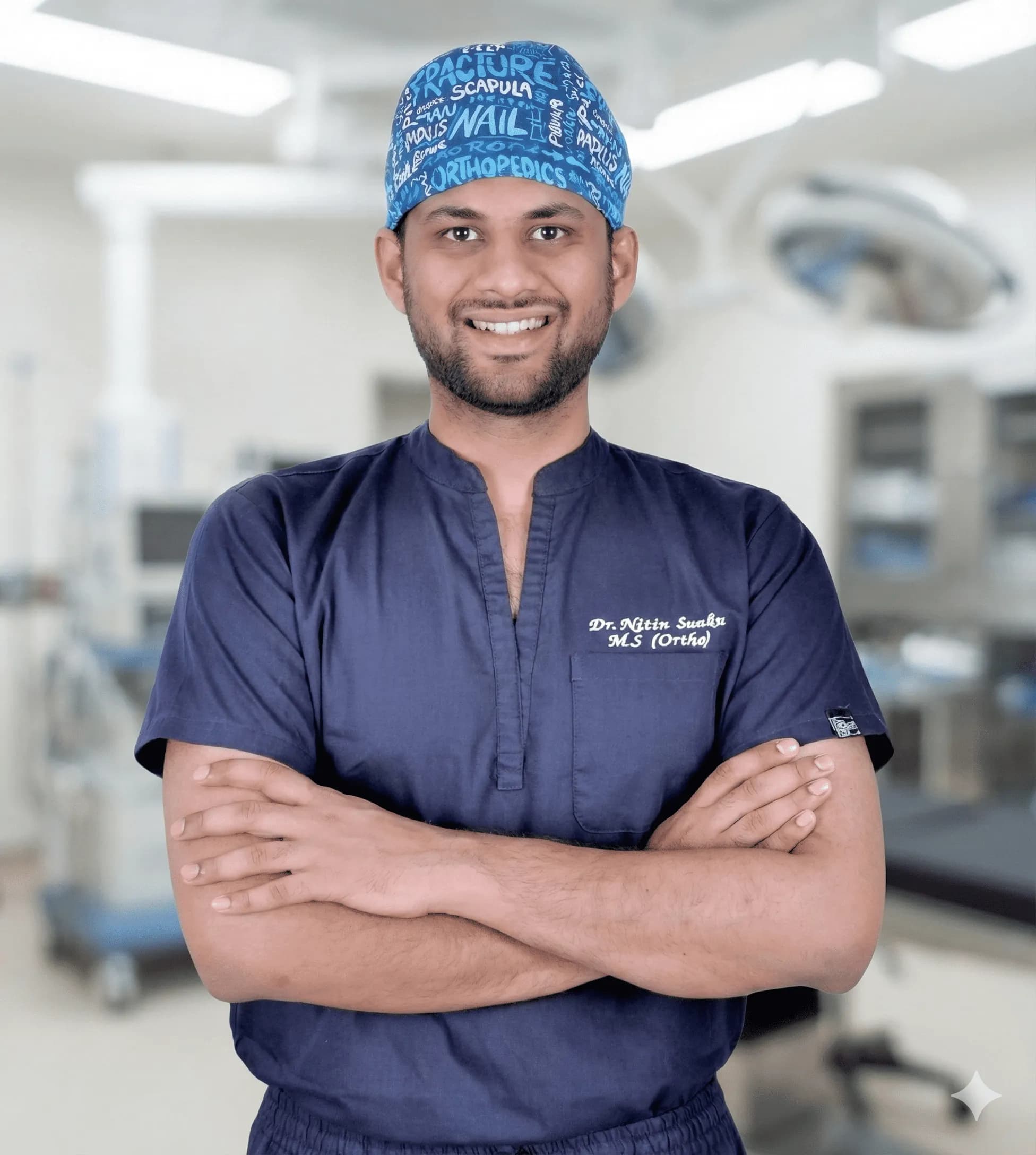
About the Author
Dr. Nitin N Sunku
MBBS, MS (Orthopedics), Fellowship in Arthroscopy & Sports Medicine
Dr. Nitin N Sunku is a Consultant Orthopedic & Sports Medicine Surgeon with over 10 years of focused practice in Bengaluru. He serves as the Team Doctor for Bengaluru FC and consults at Raghava Multispeciality Hospital (Attibele) and Health Nest Hospital (HSR Layout). His clinical interests include arthroscopy, ligament & meniscus care, regenerative orthopedic medicine, ultrasound-guided injections, and joint replacement.
Experiencing symptoms?
Don't let pain hold you back. Schedule a comprehensive evaluation with Dr. Nitin today.
Book Appointment

