This article is for general education and does not replace an in-person assessment, examination, or imaging. Everyone's injury pattern, medical history, and goals differ; use what you read here to prepare better questions for your doctor.
Dr. Nitin N Sunku is a consultant orthopedic and sports medicine surgeon. He sees patients at Raghava Multispeciality Hospital, Attibele, on Sarjapura–Attibele Road, and at Health Nest Hospital, HSR Layout, Bengaluru. If pain is rapidly worsening, you cannot bear weight, you develop numbness or weakness in a limb, or you have fever after an injury, seek urgent medical care. For non-emergency evaluation and individualised treatment options, book through the contact page.
Topics across this blog include knee ligament and meniscus problems, shoulder pain and instability, hip and knee arthritis, fracture recovery principles, spine symptoms when urgent causes have been excluded, running and tendon overuse issues, and what to expect from arthroscopy or joint replacement discussions. If you are comparing sources online, cross-check dates and always confirm advice with an in-person clinician.
Most orthopedic injuries in the Attibele-Electronic City corridor come off a bike on NH 44. What to do at the roadside, what not to do, when a limb needs casualty the same hour, and why the nearest hospital with X-ray and an orthopedic surgeon on call matters more than the biggest hospital in the city.
Hosur Road between Electronic City and Attibele carries an enormous volume of two-wheeler traffic, much of it at the start and end of the working day, on a surface that changes from six-lane highway to patched service road within a few hundred metres. The result is predictable: a large share of the fractures, dislocations and ligament injuries seen at the Attibele hospital arrive off a bike. Most are not life-threatening. Many are handled badly in the first hour in ways that make the injury worse, the treatment harder, or both. This is what to do instead.
First: the injuries that are not orthopedic
Before thinking about a limb, rule out the things that kill. A rider who was knocked out even briefly, who is confused, vomiting, has a severe headache, or has blood or clear fluid from the nose or ear needs a hospital with CT scanning and a neurosurgical opinion, not a fracture clinic. Chest pain with breathlessness after hitting the handlebar, or abdominal pain and a fast pulse, mean internal injury until proved otherwise. Neck pain after a crash means the neck is kept still until it has been assessed. In any of these situations call 108 and let the ambulance crew decide the destination. The limb can wait; these cannot.
The obviously broken limb
If the arm or leg is deformed, bent where there is no joint, or the person cannot move it or bear weight, treat it as a fracture. The rules are simple. Do not try to straighten it. Do not let a bystander pull on it. Do not move the person more than is needed to get them out of traffic. Support the limb in the position it is in: a folded jacket under a forearm, a rolled newspaper along a shin, anything that stops it moving. Cover any wound with the cleanest cloth available and press to stop bleeding; do not try to push bone back under the skin. If a foot or hand below the injury is cold, pale or numb, that is a circulation emergency and the person needs to be in a casualty within the hour.
An open fracture, where bone has come through the skin or there is a wound over the break, is time-critical in a different way. The risk is infection in the bone, and the clock on antibiotics and surgical cleaning starts at the moment of injury. That is an operation within hours, not days, and it needs a hospital with an operating theatre and an orthopedic surgeon on call. Our fracture and trauma care page covers what happens once you arrive.
The injury that looks minor and is not
The commonest mistake is the one that follows a low-speed fall: the rider gets up, is embarrassed, feels only bruised, and goes home. Several injuries hide behind that story. A scaphoid fracture in the wrist from landing on an outstretched hand hurts in the base of the thumb, often does not show on the first X-ray, and if missed goes on to a painful non-union. A clavicle fracture from landing on the shoulder is usually obvious, but an acromioclavicular joint injury from the same fall is not. A knee that twisted under the bike and swelled up over the next hour has usually bled into the joint, which means a ligament or meniscus injury, most often an ACL tear. An ankle that was bent under the footpeg may have a fracture rather than a sprain, and the two are treated completely differently.
The rule of thumb: if a joint swells within a few hours, if there is a specific point of bone tenderness, if the person cannot walk four steps, or if pain is not clearly improving by the next morning, get an X-ray. The Attibele hospital has X-ray in-house and a 24/7 casualty, so this is a single visit rather than a trip to a scan centre followed by a trip to a doctor.
Why the nearest hospital with an orthopedic surgeon beats the biggest hospital in the city
Families instinctively want the injured person taken to the most famous hospital they know, which from Attibele or Electronic City usually means an hour or more in traffic, often in the wrong direction. For a head, chest or abdominal injury that may be right, and the ambulance crew will make that call. For a limb injury it is usually wrong. A fracture needs an X-ray, a decision about whether it can be treated in plaster or needs fixing, pain relief, and a plan, and it needs those things soon rather than after a long journey with a broken bone jolting on every speed bump. A multispeciality hospital with casualty, X-ray, a plaster room, an operating theatre and an orthopedic surgeon who is actually there covers the large majority of what comes off Hosur Road, and the follow-up visits for cast checks and repeat X-rays are ten minutes away instead of a lost day each time.
What to bring, and what to say
If you are the one bringing an injured rider in, three things help. First, the story: how fast, what part of the body hit what, whether they were wearing a helmet, whether they were knocked out. Second, any medication they take and any allergies, particularly to painkillers or antibiotics. Third, insurance details or the employer's accident cover, because pre-authorisation for surgery starts faster with the paperwork in hand. Most two-wheeler accident injuries are covered under health insurance and many under the motor policy's personal accident cover; the hospital team helps with both. What the medical team does not need is a relative who has already decided from a photograph that the bone is "just cracked". Let the X-ray decide.
After the cast or the operation
Fracture healing is measured in weeks, and the temptation for a young rider is to get back on the bike as soon as the pain settles. A wrist in plaster does not grip a brake lever; a leg with a plate in it is not ready for the vibration of a bad road until the bone has united on X-ray. Follow-up X-rays at two, six and twelve weeks are not bureaucracy; they are how the surgeon confirms the fracture is healing in the right position before permitting load. Riding on a partly healed fracture is the fastest route to a second, more complicated operation. If the fracture involved a joint, the physiotherapy afterwards decides whether the joint moves fully again, and it is worth doing properly.
This article is general guidance. Any injury with deformity, a wound over a bone, numbness or coldness below the injury, or a head, neck, chest or abdominal component needs a casualty department immediately, not an appointment.
About the Author
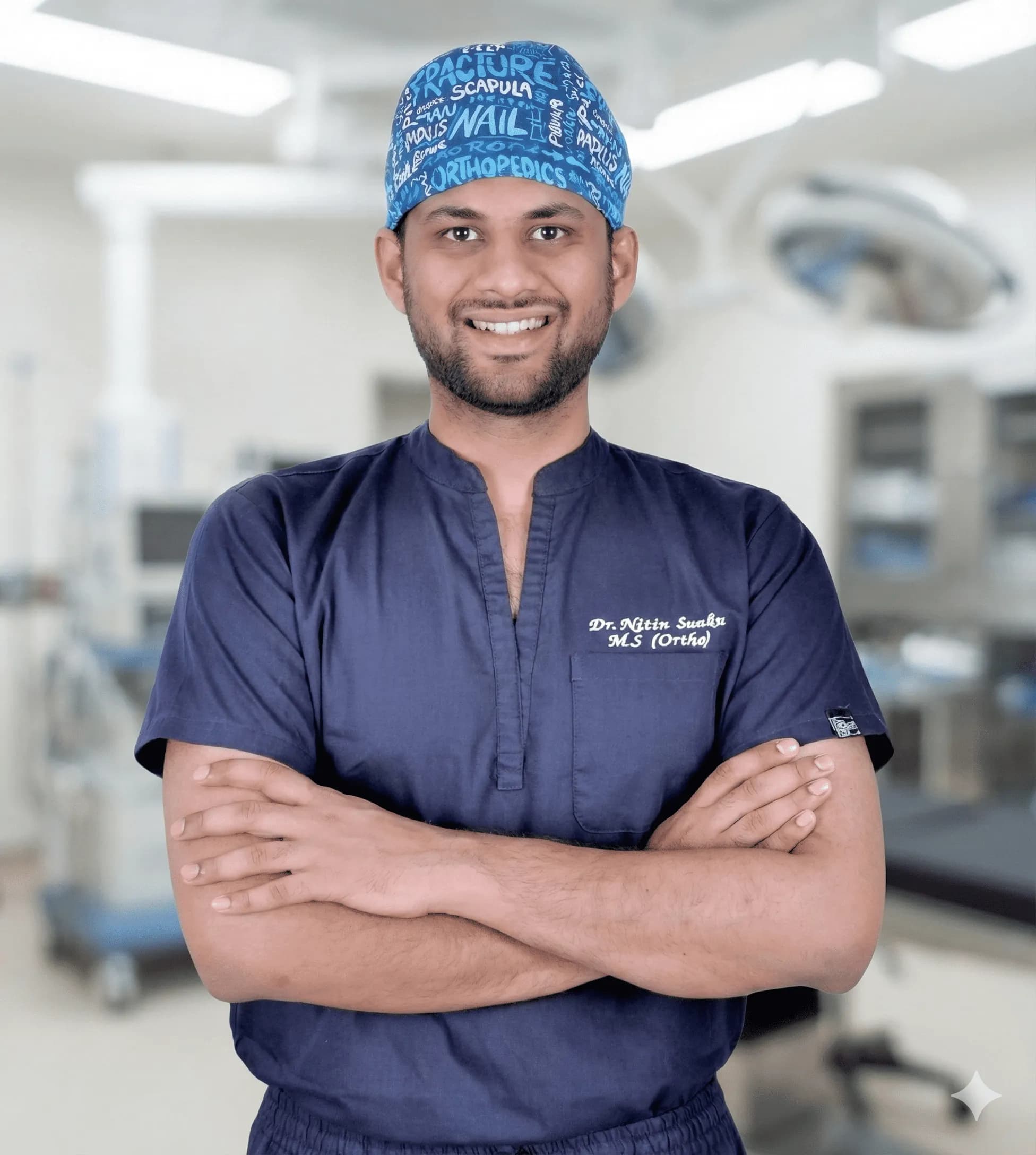
Dr. Nitin N Sunku
MBBS, MS (Orthopedics), Fellowship in Arthroscopy & Sports Medicine
Dr. Nitin N Sunku is a Consultant Orthopedic & Sports Medicine Surgeon with over 10 years of focused practice in Bengaluru. He serves as the Team Doctor for Bengaluru FC and consults at Raghava Multispeciality Hospital (Attibele) and Health Nest Hospital (HSR Layout). His clinical interests include arthroscopy, ligament & meniscus care, regenerative orthopedic medicine, ultrasound-guided injections, and joint replacement.
Experiencing symptoms?
Don't let pain hold you back. Schedule a comprehensive evaluation with Dr. Nitin today.
Book Appointment

