This article is for general education and does not replace an in-person assessment, examination, or imaging. Everyone's injury pattern, medical history, and goals differ; use what you read here to prepare better questions for your doctor.
Dr. Nitin N Sunku is a consultant orthopedic and sports medicine surgeon. He sees patients at Raghava Multispeciality Hospital, Attibele, on Sarjapura–Attibele Road, and at Health Nest Hospital, HSR Layout, Bengaluru. If pain is rapidly worsening, you cannot bear weight, you develop numbness or weakness in a limb, or you have fever after an injury, seek urgent medical care. For non-emergency evaluation and individualised treatment options, book through the contact page.
Topics across this blog include knee ligament and meniscus problems, shoulder pain and instability, hip and knee arthritis, fracture recovery principles, spine symptoms when urgent causes have been excluded, running and tendon overuse issues, and what to expect from arthroscopy or joint replacement discussions. If you are comparing sources online, cross-check dates and always confirm advice with an in-person clinician.
The industrial estates between Bommasandra, Jigani and Attibele generate a steady stream of hand, wrist, foot and back injuries. What the common injuries are, why hand injuries in particular must not wait, what the first hour on the shop floor should look like, and how insurance and employer cover fit in.
The belt of industrial estates that runs from Bommasandra through Jigani to the Attibele Industrial Area employs tens of thousands of people in manufacturing, engineering, pharmaceuticals and logistics, and it sits within fifteen minutes of the Attibele hospital. Industrial orthopedic injuries are a recognisable category with their own patterns and their own rules, and both workers and the supervisors who make decisions in the first minutes after an accident benefit from knowing them.
The injuries that come off the shop floor
The hand dominates. Crush injuries from presses and rollers, lacerations from sheet metal and machine edges, fingertip amputations from guillotines and conveyors, and fractures of the metacarpals and fingers from a hand caught between two objects make up the largest single group. Wrist fractures from a fall on a wet floor or from a height are next. The foot suffers when a load is dropped on it: metatarsal fractures, crush injuries, and the neglected toe fracture that becomes a painful non-union. Back injuries from manual lifting, mostly muscular but occasionally a disc, are the commonest reason for lost days without a visible wound. And two-wheeler accidents on the way to and from the shift, which we cover in what to do in the first hour after a two-wheeler accident on Hosur Road, produce the fractures that fill the rest of the list.
Why hand injuries cannot wait
A hand is the worker's livelihood, and the outcome of a hand injury is decided largely in the first few hours. A crush or laceration that has damaged a tendon, a nerve or a blood vessel needs to be recognised and repaired early; a tendon repaired within a day or two does well, one repaired after a week does much worse, and a nerve that is not repaired leaves permanent numbness or weakness. An open fracture of a finger or metacarpal, common in industrial settings, carries an infection risk that rises with every hour before surgical cleaning and antibiotics. A fingertip amputation may be replantable or reconstructable if the part is kept correctly and the patient arrives promptly. None of this is served by a dressing at the factory first-aid post and an appointment the following week. The rule is that any hand injury with a deep wound, deformity, numbness, inability to move a finger, or bone visible goes to a hospital casualty the same hour.
The first hour on the shop floor
Stop the machine and free the limb without pulling on it. Control bleeding with firm direct pressure through a clean cloth; do not apply a tourniquet unless bleeding is life-threatening and cannot be controlled by pressure, because an improperly applied tourniquet causes its own damage. Do not wash a deep wound with anything other than clean water and do not put any powder or ointment into it. If a part has been amputated, wrap it in clean gauze moistened with saline or clean water, put it in a sealed plastic bag, and put that bag in a container of ice water; do not put the part directly on ice and do not let it freeze. Splint a deformed limb in the position found. Note the time of injury, because the surgeon will want to know it. Then get the worker to a hospital with X-ray, an operating theatre and an orthopedic surgeon available, which from anywhere in the belt means the Attibele hospital's 24/7 casualty is within fifteen minutes. The fracture and trauma care page describes what happens on arrival.
The injury that gets ignored
The worker who does not want to lose a shift is the one whose injury is missed. A finger that was "jammed" and is still swollen and cannot straighten fully at a week may have a fracture into the joint or a tendon avulsion, and both are simple to treat early and difficult later. A wrist that was sprained in a fall and is still painful at the base of the thumb after ten days may be a scaphoid fracture, which if missed goes on to a painful non-union. A foot that a load was dropped on, that is bruised and can still be walked on, may have a fracture of the metatarsal base that needs a proper assessment. The practical rule for a supervisor: any injury that is still painful, swollen or not working normally after a few days gets an X-ray, and the shift is easier to replace than the hand.
Insurance, ESI and employer cover
Workers covered under the Employees' State Insurance scheme are generally entitled to treatment for employment injuries through the ESI system, and the first step for an ESI-covered worker is usually the employer's designated ESI dispensary or hospital, with referral onward for specialist care; the employer's HR or safety officer will know the procedure for the unit. Whether a particular hospital is empanelled for ESI, or for a company's group health insurance or workmen's compensation policy, is a question to ask the hospital directly with the policy details in hand, and the hospital team at Attibele assists with pre-authorisation paperwork for the insurers it works with. What should never happen is a delay in emergency treatment while the paperwork is sorted out; a hand injury is treated first and the cover established afterwards. The general position is on the insurance and cashless treatment page.
Getting back to work
Return to work after an industrial orthopedic injury is a medical decision, not an administrative one, and it is usually staged. A hand with a repaired tendon needs protected movement and then graded strengthening before it can grip a tool; a wrist fracture needs to be united on X-ray before it takes load; a back injury needs a graded return to lifting with attention to technique. Workers pushed back to full duty too early re-injure, and the second injury is worse. Employers who can offer modified duty during recovery get their skilled workers back sooner and in better condition. Physiotherapy after a hand injury in particular is not optional; it is the difference between a hand that works and one that does not.
For safety officers
The injuries described here are predictable and most are preventable. Machine guarding, lock-out procedures, safety footwear, and manual-handling training are the standard measures, and they work. What also helps is a relationship with a nearby hospital that knows the unit, so that when an injury happens the first call is to a casualty that is expecting industrial trauma, has X-ray and a theatre available, and can give a clear answer on the day about the injury and the expected time off. The Attibele hospital sits at the southern end of the belt and sees these injuries routinely.
This article is general guidance. Any hand injury with a deep wound, deformity, numbness, an unmovable finger, or an amputated part, and any injury with significant bleeding or a suspected fracture, needs a casualty department immediately.
About the Author
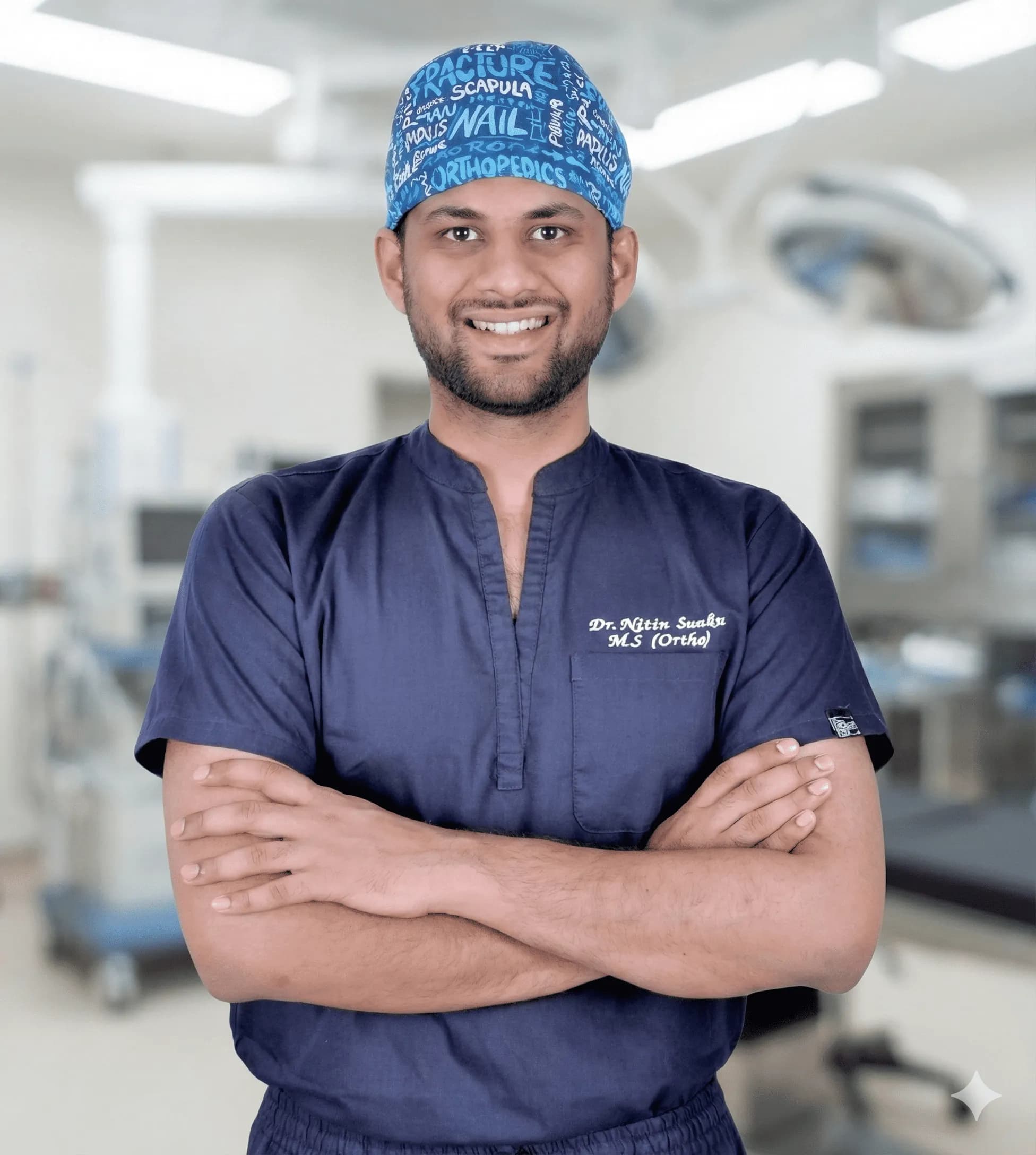
Dr. Nitin N Sunku
MBBS, MS (Orthopedics), Fellowship in Arthroscopy & Sports Medicine
Dr. Nitin N Sunku is a Consultant Orthopedic & Sports Medicine Surgeon with over 10 years of focused practice in Bengaluru. He serves as the Team Doctor for Bengaluru FC and consults at Raghava Multispeciality Hospital (Attibele) and Health Nest Hospital (HSR Layout). His clinical interests include arthroscopy, ligament & meniscus care, regenerative orthopedic medicine, ultrasound-guided injections, and joint replacement.
Experiencing symptoms?
Don't let pain hold you back. Schedule a comprehensive evaluation with Dr. Nitin today.
Book Appointment

