This article is for general education and does not replace an in-person assessment, examination, or imaging. Everyone's injury pattern, medical history, and goals differ; use what you read here to prepare better questions for your doctor.
Dr. Nitin N Sunku is a consultant orthopedic and sports medicine surgeon. He sees patients at Raghava Multispeciality Hospital, Attibele, on Sarjapura–Attibele Road, and at Health Nest Hospital, HSR Layout, Bengaluru. If pain is rapidly worsening, you cannot bear weight, you develop numbness or weakness in a limb, or you have fever after an injury, seek urgent medical care. For non-emergency evaluation and individualised treatment options, book through the contact page.
Topics across this blog include knee ligament and meniscus problems, shoulder pain and instability, hip and knee arthritis, fracture recovery principles, spine symptoms when urgent causes have been excluded, running and tendon overuse issues, and what to expect from arthroscopy or joint replacement discussions. If you are comparing sources online, cross-check dates and always confirm advice with an in-person clinician.
Sharp heel pain on the first few steps out of bed that eases once you get walking is one of the most recognisable patterns in orthopedics. It is usually plantar fasciitis, better described as plantar fasciopathy. Here is why the first step is the worst, what else it could be, why the heel spur on your X-ray is probably not the villain, and what actually helps.
Almost every week someone in clinic describes the same thing in nearly the same words. The first few steps out of bed feel like standing on a sharp stone. By the time they cross the room it has eased. Then they stand after a long meeting, or a drive across Bengaluru traffic, and the same jolt returns.
That pattern is so specific that the diagnosis is often clear from the history alone. It is also badly misunderstood, because the usual advice, rest and an X-ray, is close to the least useful response.
Quick answer: Sharp heel pain in the first few steps of the morning that eases after a few minutes of walking is most often plantar fasciitis. A better name is plantar fasciopathy, because what we find in the tissue is degenerative overload change in the plantar fascia rather than classic inflammation. The first step hurts because the fascia shortens and stiffens overnight while the foot rests in a toes-pointed position, then gets suddenly re-loaded with your full body weight the moment you stand. Once it warms up and lengthens over a few dozen steps the pain settles, which is why the symptom is worst first thing and after any long spell of sitting.
Why the First Step Is the Worst Step
The plantar fascia is a thick fibrous band running from the underside of the heel bone to the base of the toes. It is not a muscle but a tensioned structure that supports the arch and returns energy each time you push off.
Overnight the foot rests slightly toes-down, so the calf complex and the fascia both settle into a shortened length, and repair tissue at the sore attachment is laid down with no load telling it how to organise itself. You wake with a structure shorter, stiffer and less tolerant than the previous evening. Then you stand, and in one step that band goes from unloaded to carrying your whole body weight across already irritated tissue. Over the next few minutes of walking it lengthens and the pain fades. Sit still for an hour and the process repeats in miniature.
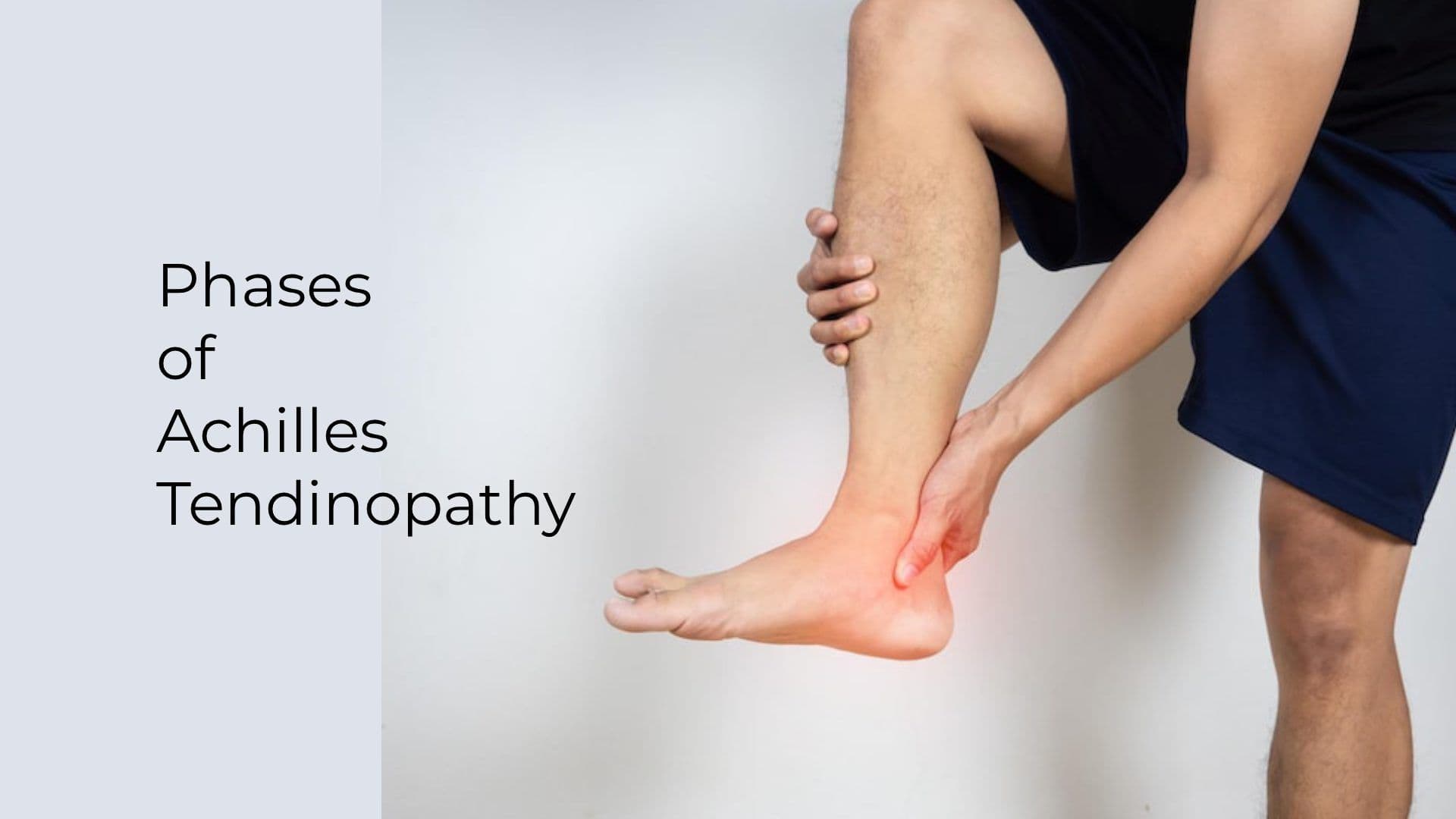
This start-up pattern is the signature of load-related tendon and fascia problems generally, and you will see the same behaviour in our guide to the phases of Achilles tendinopathy.
Fasciitis or Fasciopathy? Why the Name Matters
Fasciitis implies inflammation, and for decades that assumption pushed treatment towards anti-inflammatories and steroid injections. When plantar fascia tissue from long-standing cases was actually examined, the picture was different: disorganised collagen, increased ground substance, and very few inflammatory cells. It looked like tissue that had been overloaded and had failed to repair properly.
That distinction is not academic. Anti-inflammatory tablets may take the edge off without addressing the tissue problem, and rest alone tends to feel good and then fail, because an under-loaded fascia becomes even less tolerant. Graded, progressive loading is what changes the tissue. The same reasoning underpins modern management of tendon problems generally, covered in our overview of non-surgical care for tendinopathy.
The Typical Presentation
- Pain under the heel, usually towards the inner side, sometimes spreading into the arch.
- Worst on the first steps of the morning and after prolonged sitting.
- Eases within five to ten minutes of walking, then may return late in the day.
- Tender on one specific spot at the front-inner part of the heel bone.
- Worse barefoot on hard floors, better in a cushioned shoe.
- Usually one foot, and builds over weeks rather than in a single moment.
It usually follows a change: a new walking or running routine, a jump in standing hours, a switch to flat or worn-out footwear, or weight gain. Something asked the fascia to do more than it was conditioned for.
What Else Causes Morning Heel Pain
Plantar fasciopathy is by far the most common cause of under-heel pain in adults, but it is not the only one, and some alternatives matter.
| Condition | Where and when it hurts | Clues that point to it |
|---|---|---|
| Plantar fasciopathy | Under the heel, inner side. Worst on first steps, eases with walking | Point tenderness at the fascia origin, pain reproduced by pulling the toes upward, gradual onset |
| Heel fat pad atrophy | Directly under the centre of the heel, deep and bruise-like. Worse the longer you stay upright | More common with age or after repeated steroid injections. Tender centrally, not at the origin |
| Calcaneal stress fracture | Diffuse pain through the whole heel bone, often at rest and at night | Pain on squeezing the heel from both sides, a recent sharp rise in running or standing, worsens through activity rather than warming up |
| Insertional Achilles tendinopathy | Back of the heel rather than underneath, where the tendon meets bone | Tender and often thickened at the back, aggravated by stiff-backed shoes and uphill walking |
| Tarsal tunnel syndrome | Burning, tingling or electric pain in the sole and heel, sometimes worse at night | Nerve-type rather than mechanical pain, tapping behind the inner ankle bone may reproduce it |
| Sever's disease (children and teens) | Back and sides of the heel in an active 8 to 14 year old, worse after sport | Irritation of the growth plate at the back of the heel bone. Squeezing the sides hurts. Settles with load management as the plate matures |
| Inflammatory causes (spondyloarthropathy) | Heel pain, often in both heels, in a younger adult with prolonged morning stiffness elsewhere | A genuine red flag. Bilateral heel pain in a young adult with back stiffness lasting over 30 to 45 minutes, night pain, other joints involved or psoriasis warrants a rheumatology workup, not more insoles |
The heel bone is also a site where bone stress injuries get missed, particularly in recruits, new runners and people who suddenly increase standing hours. If the pain builds steadily through activity instead of easing, read our guide on recognising and treating a stress fracture before pushing through another week.
The Heel Spur Myth
Almost everyone X-rayed for heel pain is shown a small bony beak on the underside of the heel bone and told the spur is the cause. It is one of the most persistent misconceptions in musculoskeletal medicine.
- Plenty of people with spurs have no heel pain. Spurs turn up incidentally on films taken for unrelated reasons. If the spur caused pain, those feet would hurt.
- Plenty of people with classic plantar heel pain have no spur. Symptom and finding do not track together.
- The spur points the wrong way to be stabbing into soft tissue, forming along the line of pull near the fascia origin.
The reasonable interpretation is that a heel spur is a consequence of long-standing traction, a footprint of load history, not the pain generator. Removing it surgically is rarely the answer, and treating the spur instead of the tissue and the load that irritated it is how people end up years into a problem that was never addressed.
What Actually Helps, Ranked Honestly
Not everything on the standard list is equally worth your time. Roughly how I would prioritise:
1. Load management, not rest
Reduce the load provoking the fascia while keeping the foot working: cut standing and walking volume for a few weeks, break long standing spells into shorter ones, pause running and high-impact classes, and substitute cycling or swimming. Complete rest is counterproductive, because the fascia detrains quickly and hurts more when you return.
2. Stretching, including the stretch you do before your first step
Two stretches matter. Calf stretching, done with the knee straight and again with the knee bent, reduces tension transmitted to the heel. The second, which most people have never been shown, is the plantar fascia-specific stretch. Sitting down, cross the affected foot over the opposite knee, grasp the toes and pull them back towards the shin until you feel a firm stretch along the arch, using the other hand to confirm the fascia is taut like a cord. Hold about ten seconds, repeat about ten times.
Do this before your first step of the day, while still sitting on the edge of the bed, and again before standing after any long spell of sitting. This one habit changes the morning for many people within a couple of weeks, because you lengthen the tissue deliberately instead of letting body weight do it abruptly.
3. Footwear with cushioning and slight heel elevation
A cushioned sole with a modest heel-to-toe drop reduces tension through the fascia and softens impact under the heel. It is the best effort-to-benefit ratio available: a supportive cushioned trainer rather than thin flip-flops, flat sandals or hard formal shoes during a flare. Zero-drop and minimalist shoes are a poor choice in an acute episode.
4. Heel cups, arch supports and orthoses
A cushioned heel cup or off-the-shelf arch support helps many people by offloading the tender area, so start with an inexpensive prefabricated one. Custom orthoses have a role in specific foot shapes and after a fair trial of the simpler option, but they are not a required first step and do not reliably outperform good off-the-shelf ones here.
5. Progressive calf and intrinsic foot strengthening
This builds tissue capacity rather than just easing symptoms, and it is the part most often skipped. Heel raises progressed gradually, including the version with the toes propped on a rolled towel so the fascia is loaded under tension, plus work for the small foot muscles such as toe-spreading and short-foot exercises. Progress over months, not weeks. Some soreness during and after is fine; sharp pain lingering into the next morning means the dose was too high.
6. Body weight, stated plainly and without judgement
Body weight is a load variable for a weight-bearing structure in the same way training volume is, and it is one of the more consistently reported associations with plantar heel pain, particularly in people who stand for long hours. That is a mechanical observation, not a moral one, and nobody should be sent away with weight loss as their only advice. Where reduction is realistic alongside everything else here, it lowers what the fascia absorbs each step.
7. Night splints for stubborn cases
A night splint holds the ankle and toes gently stretched so the fascia cannot settle into its shortened length overnight. It suits people whose main complaint is morning pain and who have not improved after a couple of months of the above. Many find them uncomfortable to sleep in, which is why they fail, so they are worth trying rather than prescribing routinely.
Where the Evidence Is Weaker
Rolling the arch over a frozen bottle or spiky ball is harmless, but treat it as symptom relief rather than treatment. Anti-inflammatory tablets can carry you through a bad week and have their own risks with prolonged use. Shockwave therapy and injectables including platelet-rich plasma have been studied in resistant plantar heel pain with mixed and generally modest results, and are worth discussing only after a genuine loading programme has had several months. Dry needling and passive modalities have limited high-quality support, and none of these should replace load management and strengthening.
Where Ultrasound-Guided Injection Fits, and Its Honest Downside
A corticosteroid injection can give real short-term relief, and there are situations where that is legitimately useful: pain too severe to begin rehabilitation at all, or an unavoidable commitment on your feet. Ultrasound guidance matters, because it places the needle accurately at the fascia and keeps it out of the heel fat pad. Our page on ultrasound-guided orthopedic injections explains how image guidance changes accuracy.
The downside deserves stating clearly. Benefit is usually measured in weeks to a few months and converges with non-injected outcomes over time. Repeated steroid injections into the plantar fascia carry two specific risks: atrophy of the heel fat pad, which produces a different and often harder-to-treat heel pain, and rupture of the fascia, which can leave a flattened arch and a longer recovery than the original problem. An injection is best used to open a window for rehabilitation, not as a treatment in itself, and stacking injections into one heel is a decision to avoid.
The Honest Timeline
This is the part most people are not told, and not telling them causes real distress. Plantar fasciopathy is frequently a six to twelve month problem. Some settle faster, a minority take longer, and improvement is rarely linear: good weeks, a setback after a long day, then another step forward.
Good treatment does not shortcut biology. It shortens the arc, reduces setbacks, stops you doing the things that prolong it, and makes sure you are not spending twelve months treating the wrong diagnosis. Judge progress by whether first-step pain is less intense and shorter-lived month over month, not by whether it has vanished next week. Three months with no directional change is a reason to review the plan, not to try harder at the same one.
A Bengaluru Note: Hard Floors, Bare Feet and Long Standing Hours
- Hard tile and granite flooring. Most homes here have vitrified tile, granite or polished concrete with no give, so every step indoors is a high-impact step for the heel.
- Walking barefoot indoors. Leaving footwear at the door is normal here, but it means the hours you spend at home are the hours your heel is least protected. During a flare, a dedicated pair of cushioned indoor slippers kept just inside the door is one of the most effective and least demanding changes available.
- Long standing hours. Teachers, nurses, retail staff, security personnel and factory workers accumulate enormous heel load on hard floors without any exercise involved. Anti-fatigue matting, replacing footwear before it is fully worn out, and micro-breaks off the heel matter more than any stretch.
- Sudden step-count changes. A new fitness routine, trekking in sandals, or a longer commute on foot are common triggers. The fascia objects to sudden change more than to hard work.
When to See a Doctor Rather Than Self-Manage
A fair trial of the above is sensible for straightforward morning heel pain. Get it assessed properly if:
- Pain has not begun improving after six to eight weeks of genuine load management and stretching.
- Pain is present at rest or wakes you at night.
- Both heels hurt, particularly in a younger adult with morning stiffness elsewhere.
- There is numbness, tingling or burning in the sole rather than mechanical pain.
- The pain began suddenly with a snap or pop, or after a fall from height.
- The heel is swollen, red or warm, or you have fever.
- You have diabetes, a suppressed immune system, or known inflammatory arthritis.
- It is a child or teenager whose heel pain is limiting sport.
- You are an athlete needing this sorted around a season or event. Our sports injury clinic in Bengaluru sees many of these.
What a Consultation Actually Involves
The examination does most of the work. The history establishes the pain pattern, what changed before it started, footwear, occupation, training load and any systemic symptoms. The examination localises the tender point, tests whether pulling the toes upward reproduces the pain, checks calf flexibility and heel-raise capacity, squeezes the heel to screen for a bone stress injury, examines the Achilles insertion, tests for nerve involvement behind the inner ankle, and watches you stand and walk.
Imaging is ordered when it will change the plan, not as a reflex. An X-ray mainly looks for other bone pathology rather than hunting for a spur, since finding one does not alter treatment. Ultrasound shows fascia thickening and is useful in unclear cases and for guiding an injection. MRI is reserved for suspected calcaneal stress fracture or fascia rupture, nerve entrapment, or heel pain behaving unexpectedly. If an inflammatory cause is suspected, blood tests and a rheumatology opinion beat more foot treatment.
You should leave with a named diagnosis, a loading and stretching programme with numbers attached, footwear advice, a realistic timeline, and a clear statement of what would trigger the next step. If the heel pain is part of a broader foot problem, our foot and ankle pain clinic page explains how treatment is staged.
One Question Everyone Asks: Can I Keep Running?
Running usually needs to be reduced or paused during the worst phase and reintroduced gradually once first-step pain has settled meaningfully. Pain that worsens through a run rather than warming up suggests a bone stress injury and needs assessment first. Runners whose pain sits along the inner shin instead of the heel should read about shin splints after running, a related overload problem managed differently.
Dr. Nitin N Sunku, MBBS, MS Orthopedics (Gold Medalist), Fellowship in Arthroscopy & Sports Medicine.
Team Doctor, Bengaluru FC. Visiting Consultant, Narayana Hrudayalaya & Manipal Hospital, Bengaluru. Consulting at Attibele and HSR Layout.
Dr. Nitin regularly assesses adults and athletes with plantar heel pain, Achilles problems and foot overuse injuries.
Book appointment online or call +91-9449031003
About the Author
Dr. Nitin N Sunku
MBBS, MS (Orthopedics), Fellowship in Arthroscopy & Sports Medicine
Dr. Nitin N Sunku is a Consultant Orthopedic & Sports Medicine Surgeon with over 10 years of focused practice in Bengaluru. He serves as the Team Doctor for Bengaluru FC and consults at Raghava Multispeciality Hospital (Attibele) and Health Nest Hospital (HSR Layout). His clinical interests include arthroscopy, ligament & meniscus care, regenerative orthopedic medicine, ultrasound-guided injections, and joint replacement.
Experiencing symptoms?
Don't let pain hold you back. Schedule a comprehensive evaluation with Dr. Nitin today.
Book Appointment