This article is for general education and does not replace an in-person assessment, examination, or imaging. Everyone's injury pattern, medical history, and goals differ; use what you read here to prepare better questions for your doctor.
Dr. Nitin N Sunku is a consultant orthopedic and sports medicine surgeon. He sees patients at Raghava Multispeciality Hospital, Attibele, on Sarjapura–Attibele Road, and at Health Nest Hospital, HSR Layout, Bengaluru. If pain is rapidly worsening, you cannot bear weight, you develop numbness or weakness in a limb, or you have fever after an injury, seek urgent medical care. For non-emergency evaluation and individualised treatment options, book through the contact page.
Topics across this blog include knee ligament and meniscus problems, shoulder pain and instability, hip and knee arthritis, fracture recovery principles, spine symptoms when urgent causes have been excluded, running and tendon overuse issues, and what to expect from arthroscopy or joint replacement discussions. If you are comparing sources online, cross-check dates and always confirm advice with an in-person clinician.
Shoulder arthroscopy in India explained by an orthopedic surgeon — conditions treated, honest cost ranges, recovery timeline and how to choose a surgeon.
Over the last 25 years, shoulder arthroscopy surgery in India has quietly transformed how we treat painful, stiff and unstable shoulders. What used to require a long open incision, weeks in hospital and months of stiffness can now often be done through three or four 5–6 mm portals, with patients going home the same day or the next morning. For most rotator cuff tears, labral injuries, impingement and frozen shoulders that have failed conservative care, keyhole surgery is now the global standard.
That said, surgery is never the first answer. In Dr. Nitin's Bengaluru practice at Raghava Multispeciality Hospital (Attibele) and Health Nest Hospital (HSR Layout), many patients who were told they need arthroscopy actually do very well with a structured 6–12 week programme of physiotherapy, activity modification, and sometimes a targeted injection. Arthroscopy is powerful, but it earns its place only after honest conservative care has been tried and failed, or when the diagnosis itself (a full-thickness tear in a young patient, a recurrent dislocator, a locked shoulder with a loose body) makes early surgery the smarter path.
What shoulder arthroscopy actually is
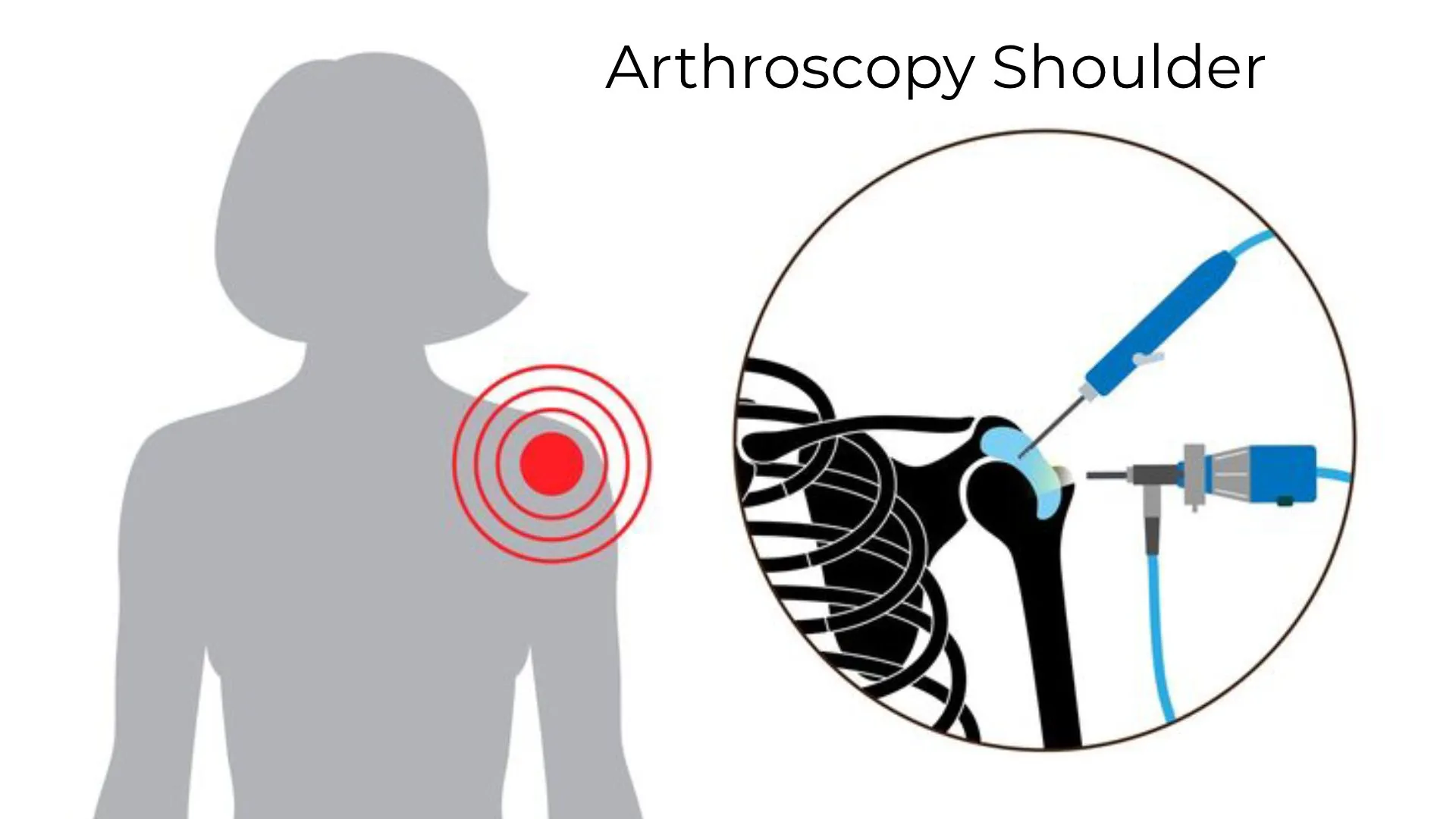
Arthroscopy literally means "looking inside a joint." A pencil-thin high-definition camera is introduced through a 5–6 mm portal, and the shoulder is filled with sterile saline so the joint opens up like an underwater cavern on the monitor. Through one or two additional portals, miniature instruments — shavers, radiofrequency probes, suture passers and small anchors — allow precise repair of tendons, labrum and capsule with very little damage to the overlying deltoid muscle. The magnification is actually better than open surgery, which is why arthroscopic repairs of small and medium rotator cuff tears now match or beat open results in most studies.
Conditions treated by shoulder arthroscopy
Rotator cuff tears (partial or full thickness)
The commonest indication. Partial tears that haven't responded to physio and full-thickness tears in active patients are repaired by re-attaching the tendon to bone with small suture anchors. The detailed approach is covered in the existing Rotator Cuff Injury and Rotator Cuff Surgery Cost in India guides on the site.
Subacromial impingement
When the rotator cuff is being pinched under a bony spur, an arthroscopic subacromial decompression shaves the undersurface of the acromion and removes the inflamed bursa, giving the tendon room to glide.
SLAP tears (superior labrum)
Common in overhead athletes and after falls. SLAP repair arthroscopy reattaches the torn superior labrum with anchors; in older patients with degenerative SLAP lesions, a biceps tenodesis often gives better results than repair.
Bankart lesions / recurrent dislocation
When the shoulder dislocates repeatedly, the front labrum is usually torn off the socket. Arthroscopic Bankart repair restores stability with 3–4 anchors and has excellent long-term results in the right patient.
Frozen shoulder (capsular release)
For frozen shoulders that have not budged after 4–6 months of physio, hydrodilatation and injections, an arthroscopic capsular release can restore motion in a single sitting. Most patients should still start with the non-surgical pathway outlined in the existing Frozen Shoulder Treatment Without Surgery in India article.
AC joint pathology / distal clavicle resection
Painful AC joint arthritis that has failed injections can be treated by shaving 5–8 mm off the end of the clavicle arthroscopically — a small operation with a quick recovery.
Loose bodies and synovitis
Cartilage or bone fragments floating in the joint cause catching and locking. They are removed under direct vision, and inflamed synovium is debrided in the same sitting.
Biceps tendon problems
Partial tears, instability and inflammation of the long head of biceps are often addressed during the same arthroscopy — either by tenotomy or tenodesis, depending on age and demands.
Advantages over open shoulder surgery
- Three or four 5–6 mm scars instead of one 8–12 cm incision
- Far less damage to the deltoid muscle — this matters enormously for long-term function
- Lower infection risk because the joint is constantly flushed with sterile saline
- Day-care or single-night admission is realistic for most procedures
- Faster early recovery, less narcotic painkiller use, earlier physiotherapy
- Equivalent or better long-term outcomes for small and medium rotator cuff tears, instability and impingement
- Better visualisation of the entire joint — we frequently find and treat secondary problems that would be missed through an open approach
When arthroscopy isn't enough
Honesty matters here. Massive irreparable rotator cuff tears with significant muscle atrophy, advanced cuff-tear arthropathy, severe glenohumeral arthritis and large complex fracture-dislocations are usually better served by open surgery or shoulder replacement. If you fall in this group, the existing Shoulder Replacement Surgery India article walks through your options. The worst outcome in shoulder surgery is forcing an arthroscopic solution onto a problem that needs a bigger operation.
Shoulder arthroscopy cost in India
Real-world, all-inclusive ranges across Bengaluru and most tier-1 Indian cities in 2026:
- Diagnostic shoulder arthroscopy: ₹1,20,000 – ₹2,50,000
- Subacromial decompression / bursectomy: ₹1,50,000 – ₹3,00,000
- Rotator cuff repair (single tendon): ₹1,80,000 – ₹3,50,000
- SLAP repair: ₹2,00,000 – ₹3,50,000
- Bankart repair (instability): ₹2,00,000 – ₹3,80,000
- Arthroscopic capsular release (frozen shoulder): ₹1,50,000 – ₹3,00,000
These are indicative ranges only. Your final estimate depends on the exact procedure, implants used, hospital category and room type, and any combined procedures done in the same sitting.
What drives cost up or down
- Number of suture anchors used — a small partial tear may need one anchor; a larger U-shaped tear may need four or five
- Anchor brand and material — PEEK, all-suture and biocomposite anchors have different price points
- Hospital category — corporate chains charge more than mid-size multispeciality hospitals for the same surgery
- Room category — sharing, single deluxe and suite categories can shift the bill by ₹15,000–₹60,000
- Additional procedures — a concurrent biceps tenodesis, distal clavicle excision or capsular release adds implants and time
- Comorbidities — diabetes, cardiac history or sleep apnoea may require extra workup and ICU standby
Recovery after shoulder arthroscopy
This is where realistic expectations matter most. The skin heals in 10 days; the tendon takes months.
- Day 0–1: home the same day or the next morning, arm in a sling, ice packs, oral painkillers
- Week 1–6: sling continuously, passive range of motion, gentle pendulum exercises, no active lifting of the arm
- Week 6–12: sling weaned off, active range of motion, light strengthening begins
- Months 3–6: progressive strengthening, return to most office work, light gym, swimming
- Months 6–9: full return to overhead sport, heavy lifting and contact sport once strength is symmetrical
Recovery varies enormously by procedure. An arthroscopic capsular release for frozen shoulder may have you driving in 2 weeks; a large rotator cuff repair will keep you in a sling for 6 weeks and out of overhead sport for 6–9 months. Skipping the early phase to "feel better faster" is the single biggest cause of re-tears.
Risks and realistic outcomes
In well-selected patients with a skilled surgeon and a committed physio programme, 85–90% report good to excellent outcomes at 1 year — meaningful pain relief, return to sleep, return to work and most recreational activity. Specific risks include post-operative stiffness (the most common nuisance), infection (well under 1% in modern arthroscopy), rare nerve injury, re-tear of the repaired tendon (especially in smokers, diabetics and large tears), and persistent pain in roughly 5–10%. These numbers should be discussed openly before you consent.
Insurance and what to ask the hospital
Most Indian health insurance policies cover shoulder arthroscopy when it is medically indicated and supported by an MRI report — cosmetic or purely diagnostic procedures may face queries. Before admission, ask for a written itemised estimate that lists the surgeon's fee, anaesthesia, OT charges, implant count and brand, room category, and a post-op physiotherapy plan. If a hospital is reluctant to give you anchor counts in writing, that is a yellow flag worth following up on. For non-surgical alternatives that may be worth trying first, see the existing Shoulder Pain Injections guide.
How to choose a shoulder arthroscopy surgeon
- Dedicated arthroscopy and sports-medicine fellowship training — not just general orthopedics
- High annual case volume in shoulder arthroscopy specifically (not just knees)
- Willingness to discuss and exhaust non-surgical options first
- Routine use of MRI and good intra-operative imaging
- A clear, written estimate with anchor count and implant brand
- A defined post-operative physiotherapy protocol — not "we'll figure it out after surgery"
- Comfort treating both the simple impingement and the complex revision case
The existing Arthroscopy Shoulder overview post on this site has more detail on what to expect in the operating room itself.
Book a shoulder consultation in Attibele or HSR Layout
If you have been told you may need keyhole shoulder surgery and want a balanced second opinion before committing, you can reach the clinics directly. Raghava Multispeciality Hospital, Attibele: +91-9980031006. Health Nest Hospital, HSR Layout: +91-9449031003. Please carry your MRI films, recent X-rays and any previous physiotherapy notes to the consultation.
Frequently Asked Questions
How long is shoulder arthroscopy recovery time?
It depends on what was done. A diagnostic scope or capsular release may have you back to office work in 1–2 weeks. A rotator cuff repair needs a sling for 6 weeks, light activity at 3 months, and 6–9 months for full overhead sport.
Is shoulder arthroscopy a day-care procedure?
For most diagnostic and simple procedures, yes — you go home the same day. Rotator cuff repairs and instability surgeries are typically a single overnight admission so that pain and the regional block can be monitored.
How painful is it after surgery?
The first 48–72 hours are the most uncomfortable, but a long-acting nerve block placed before surgery takes care of most of it. Oral painkillers handle the rest, and most patients are off narcotics by the end of the first week.
When can I drive after shoulder arthroscopy?
After a capsular release or simple debridement, usually 2–3 weeks. After a rotator cuff or labral repair, you should not drive while in the sling — typically 6 weeks for the operated side, sooner if it is your non-dominant arm.
Will insurance cover my shoulder arthroscopy?
Most Indian health policies cover it when there is MRI evidence of a tear or pathology and conservative treatment has failed. Pre-authorisation through the hospital's TPA desk is straightforward in most cases.
Arthroscopy versus open shoulder surgery — which is better?
For the great majority of modern indications — impingement, small to medium rotator cuff tears, instability, SLAP tears, frozen shoulder — arthroscopy is at least as good and usually better. Massive tears, severe arthritis and complex fractures may still need an open or replacement procedure.
When can I return to sport?
Light non-contact activity (jogging, stationary cycling) at 6–8 weeks. Gym strengthening at 3 months. Overhead sport, contact sport and heavy lifting typically at 6–9 months, once strength is symmetrical and the surgeon clears you.
About the Author
Dr. Nitin N Sunku
MBBS, MS (Orthopedics), Fellowship in Arthroscopy & Sports Medicine
Dr. Nitin N Sunku is a Consultant Orthopedic & Sports Medicine Surgeon with over 10 years of focused practice in Bengaluru. He serves as the Team Doctor for Bengaluru FC and consults at Raghava Multispeciality Hospital (Attibele) and Health Nest Hospital (HSR Layout). His clinical interests include arthroscopy, ligament & meniscus care, regenerative orthopedic medicine, ultrasound-guided injections, and joint replacement.
Experiencing symptoms?
Don't let pain hold you back. Schedule a comprehensive evaluation with Dr. Nitin today.
Book Appointment