This article is for general education and does not replace an in-person assessment, examination, or imaging. Everyone's injury pattern, medical history, and goals differ; use what you read here to prepare better questions for your doctor.
Dr. Nitin N Sunku is a consultant orthopedic and sports medicine surgeon. He sees patients at Raghava Multispeciality Hospital, Attibele, on Sarjapura–Attibele Road, and at Health Nest Hospital, HSR Layout, Bengaluru. If pain is rapidly worsening, you cannot bear weight, you develop numbness or weakness in a limb, or you have fever after an injury, seek urgent medical care. For non-emergency evaluation and individualised treatment options, book through the contact page.
Topics across this blog include knee ligament and meniscus problems, shoulder pain and instability, hip and knee arthritis, fracture recovery principles, spine symptoms when urgent causes have been excluded, running and tendon overuse issues, and what to expect from arthroscopy or joint replacement discussions. If you are comparing sources online, cross-check dates and always confirm advice with an in-person clinician.
Does red light therapy (photobiomodulation) actually help an ACL tear? An evidence-based look at mechanism, timing, dosing, and how it fits into structured ACL rehabilitation in Bengaluru.
If you have recently torn your ACL, you are probably searching for anything that can help you heal faster, hurt less, and get back to sport or daily life without unnecessary delay. One name keeps coming up in sports medicine circles and online forums alike: red light therapy. But does it actually work for an ACL tear, or is it just the latest wellness trend dressed up in clinical language?
As an orthopaedic surgeon based in Bengaluru who manages ACL injuries every week, the honest answer is: red light therapy (also called photobiomodulation, PBM, or low-level laser therapy, LLLT) does have a growing body of evidence behind it. It is not a replacement for surgery or structured physiotherapy. Used correctly and at the right stage of recovery, it can be a genuinely useful adjunct that helps manage pain, reduce swelling, and support tissue repair.
What Is an ACL Tear and Why Is Recovery So Challenging?
The anterior cruciate ligament (ACL) is one of four key ligaments in the knee. It prevents the tibia from sliding forward relative to the femur and plays a major role in rotational stability — which is why ACL injuries are so common in sports that involve sudden direction changes such as football, basketball, badminton, and kabaddi.
When the ACL tears, several problems occur at once: bleeding inside the joint, loss of ligament structural integrity, cellular energy depletion, and a runaway inflammatory cascade. What makes ACL recovery uniquely difficult is that ligament tissue has very poor blood supply. Without adequate blood flow, the cells that repair the ligament cannot get the oxygen, glucose, and growth factors they need. This is why a complete ACL tear rarely heals on its own and typically requires arthroscopic reconstruction followed by 6 to 12 months of structured rehabilitation.
What Is Red Light Therapy (Photobiomodulation)?
Red light therapy uses specific wavelengths of red and near-infrared (NIR) light, typically between 630 and 880 nanometres, to stimulate biological activity inside cells. Unlike ultraviolet light (which damages DNA) or infrared heat (which only warms surface tissue), red and NIR light penetrate several centimetres into the skin and reach muscle, tendon, and ligament tissue underneath.
The primary target is the mitochondria. When the light hits a photoreceptor protein called cytochrome c oxidase, it triggers a cascade of beneficial changes: more ATP production, reduced oxidative stress, modulated inflammation, and increased release of growth factors that drive healing.
Key Wavelengths Used in Practice
- Red light (630–670 nm): reaches superficial tissue, strong anti-inflammatory effect, promotes collagen synthesis.
- Near-infrared (800–1064 nm): penetrates deeper, ideal for reaching joint structures and ligament tissue.
- Combination devices using both wavelengths simultaneously are now the most common in clinical and home settings.
How Red Light Therapy Helps an ACL Tear
1. Boosting cellular energy (ATP)
Photobiomodulation stimulates the mitochondria to produce more ATP. This surge of cellular energy accelerates cell proliferation, migration, and tissue remodelling — all essential steps in ligament healing.
2. Regulating inflammation
Inflammation after an ACL tear is necessary in the first few days, but harmful when prolonged. Red light therapy reduces pro-inflammatory signalling (TNF-alpha, IL-6) while increasing anti-inflammatory cytokines (IL-10), helping a controlled and effective response rather than one that runs out of control.
3. Stimulating collagen production
Red light therapy stimulates fibroblasts to deposit more organised collagen fibres rather than disorganised scar tissue. This matters because disorganised scar is weaker and more prone to re-injury.
4. Improving local blood flow
PBM stimulates the release of nitric oxide, dilating blood vessels, and promotes angiogenesis — the formation of new capillaries. Both effects improve the supply of oxygen and nutrients to the injured site.
5. Drug-free pain management
Red light therapy blocks certain pain signals by modulating ion channels and stimulates endorphin release. For patients who want to reduce reliance on NSAIDs or opioids during recovery, this can be a meaningful benefit.
What Does the Research Actually Show?
The strongest data comes from studies on general ligament and tendon healing, cartilage protection, and post-surgical pain reduction. ACL-specific evidence is growing but is not yet as large as the evidence for, say, low back pain or plantar fasciitis. Published studies using wavelengths around 804–850 nm consistently report lower pain scores, reduced swelling at three months post-injury, and less need for opioid analgesics in treated groups.
A 2022 study in Physiological Research examined LLLT for post-surgical knee contracture and found significant improvements in joint mobility and tissue flexibility. Ongoing clinical trials are specifically looking at photobiomodulation as a post-ACL reconstruction adjunct. The emerging consensus is that red light therapy is a credible adjunct with a sound mechanism and a reasonable evidence base — not a cure, but no longer something to dismiss.
When and How to Use Red Light Therapy During ACL Recovery
Phase 1: Acute phase (Days 1–14 after injury or surgery)
Swelling, pain, and haemarthrosis peak in this window. Red light therapy can help modulate inflammation and reduce pain — but if you have had surgery, get explicit clearance from your surgeon before applying any device near fresh incisions.
Phase 2: Subacute and early rehabilitation (Weeks 2–6)
The most productive window. Apply red light therapy before rehab sessions to improve tissue pliability and reduce pain enough to allow more effective exercise, and after sessions to limit post-exercise soreness.
Phase 3: Progressive strengthening and return to sport (Months 2–9)
During harder phases — quadriceps strengthening, neuromuscular training, plyometrics, sport-specific drills — PBM supports collagen maturation and helps keep inflammation from becoming an obstacle to training.
Practical session guidelines
- Session length: 10 to 20 minutes per session.
- Frequency: 3 to 5 sessions per week during active rehabilitation.
- Distance: a few centimetres from skin surface (follow manufacturer guidance).
- Wavelength: prioritise devices with both red (630–670 nm) and NIR (800–850 nm) for knee and ligament injuries.
- Do not apply directly over active infection, malignancy, or fresh surgical wounds without medical clearance.
Combining Red Light Therapy With Other ACL Strategies
Red light therapy works best as part of a comprehensive plan. It complements structured physiotherapy by reducing the pain and stiffness that limit engagement with rehab. There is preliminary evidence suggesting that combining PRP injections with red light therapy may offer additive benefits — PRP delivers concentrated growth factors while PBM enhances cellular uptake of those signals. For patients undergoing ACL reconstruction surgery, PBM can play a useful role both pre-operatively (improving tissue quality) and throughout post-operative rehab.
Is Red Light Therapy Safe?
Photobiomodulation has an excellent safety profile. It is non-ionising, non-thermal at therapeutic doses, and non-invasive. Do not apply red light over known cancer sites, over the eyes without protective goggles, over a foetus during pregnancy, or over fresh surgical wounds without clearance. If you are on photosensitising medications, consult your doctor first.
The main practical limitations are these: PBM does not replace the structural work of physiotherapy and exercise, it cannot regenerate a completely torn ligament without surgical reconstruction, the quality of consumer devices varies enormously, and the optimal ACL-specific protocol is still being refined.
ACL Care in Bengaluru: What to Expect
If you are recovering from an ACL tear in Bengaluru and want to use red light therapy as part of your plan, do not start it without guidance from your treating orthopaedic surgeon. The phase of your recovery, the severity of your tear, and whether you have had surgery all matter.
Dr. Nitin N Sunku consults at Raghava Multispeciality Hospital, Attibele and Health Nest Hospital, HSR Layout, taking a conservative-first, evidence-based approach. To understand whether your knee injury is an ACL tear, or to get a second opinion on your current management plan, you can book an appointment online.
Quick Reference
Benefits: increases ATP production; regulates inflammation; stimulates organised collagen deposition; promotes angiogenesis; drug-free pain relief; reduces post-exercise soreness during intensive rehab.
Limitations: not a substitute for ACL reconstruction in complete tears; requires a clinically validated device with appropriate wavelengths and power output; must be timed correctly within rehabilitation; ACL-specific protocol research is still maturing.
Frequently Asked Questions
Can red light therapy heal a completely torn ACL without surgery?
No. A complete ACL rupture cannot regenerate the original fibres on its own. For complete tears, arthroscopic ACL reconstruction remains the standard of care. Red light therapy serves as an adjunct, not a replacement.
When can I start red light therapy after ACL surgery?
Usually from week two or three post-operatively, once the incision has closed and there is no sign of infection — but always with surgeon clearance. Never apply directly over a fresh surgical wound or staples.
Is red light therapy safe to use at home for ACL recovery?
Yes, if you choose a device with clinically validated wavelengths (630–670 nm red and 800–850 nm NIR) and adequate power output, follow the manufacturer's distance/duration guidance, wear eye protection, and use it as part of a plan supervised by your surgeon and physiotherapist.
How many sessions before I see results?
Most patients report noticeable pain reduction and reduced swelling within 2–3 weeks of consistent use (3–5 sessions/week). Tissue-level benefits like improved collagen organisation are cumulative over months.
Can red light therapy help without surgery?
For partial ACL tears managed conservatively, or for swelling and pain after any acute knee injury, PBM can help modulate inflammation and reduce discomfort. A proper diagnosis comes first — do not self-treat a knee injury without knowing what you are dealing with.
Educational content only. Always consult a qualified orthopaedic surgeon before adding any adjunct therapy to your ACL rehabilitation plan.
About the Author
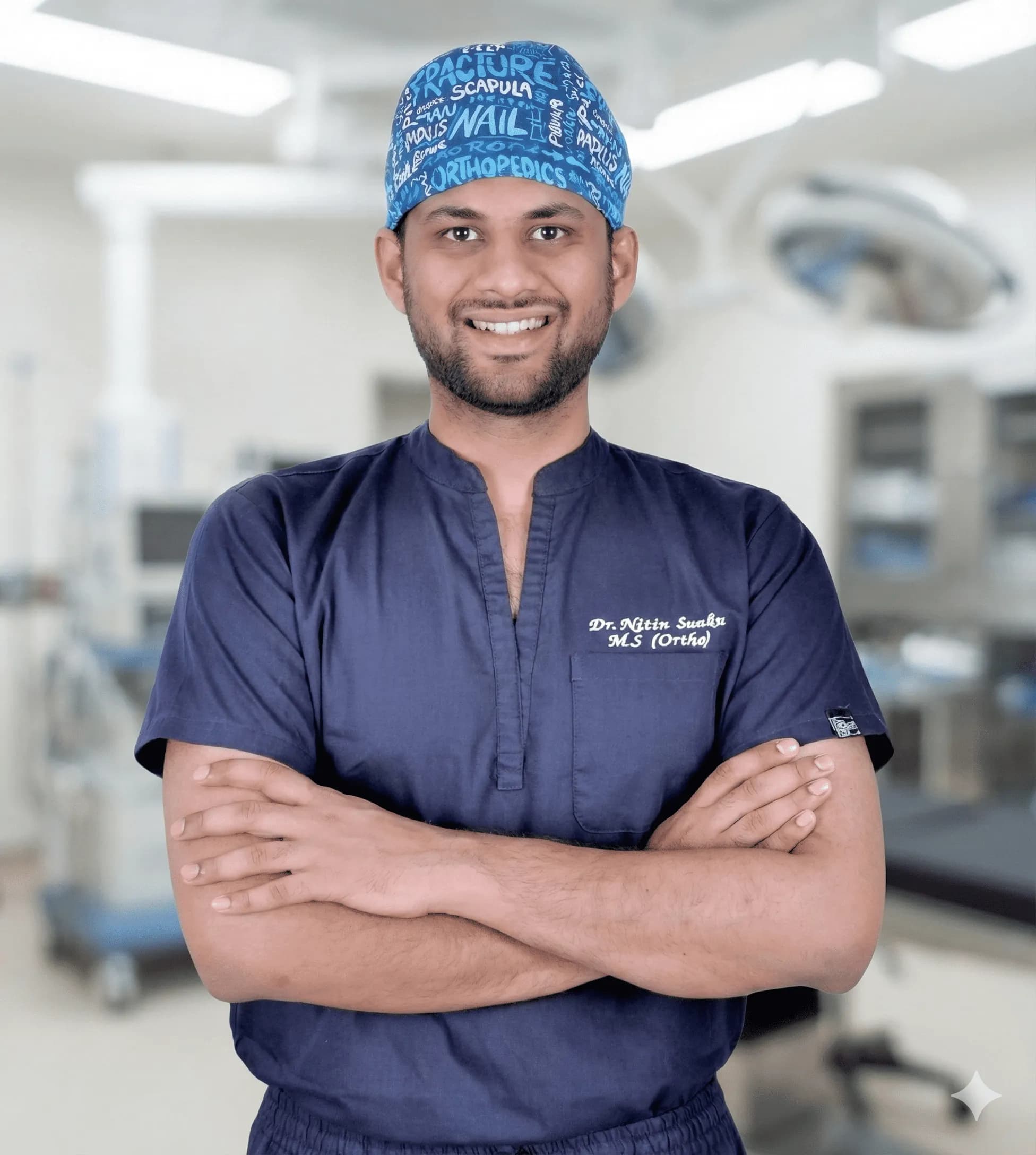
Dr. Nitin N Sunku
MBBS, MS (Orthopedics), Fellowship in Arthroscopy & Sports Medicine
Dr. Nitin N Sunku is a Consultant Orthopedic & Sports Medicine Surgeon with over 10 years of focused practice in Bengaluru. He serves as the Team Doctor for Bengaluru FC and consults at Raghava Multispeciality Hospital (Attibele) and Health Nest Hospital (HSR Layout). His clinical interests include arthroscopy, ligament & meniscus care, regenerative orthopedic medicine, ultrasound-guided injections, and joint replacement.
Experiencing symptoms?
Don't let pain hold you back. Schedule a comprehensive evaluation with Dr. Nitin today.
Book Appointment