This article is for general education and does not replace an in-person assessment, examination, or imaging. Everyone's injury pattern, medical history, and goals differ; use what you read here to prepare better questions for your doctor.
Dr. Nitin N Sunku is a consultant orthopedic and sports medicine surgeon. He sees patients at Raghava Multispeciality Hospital, Attibele, on Sarjapura–Attibele Road, and at Health Nest Hospital, HSR Layout, Bengaluru. If pain is rapidly worsening, you cannot bear weight, you develop numbness or weakness in a limb, or you have fever after an injury, seek urgent medical care. For non-emergency evaluation and individualised treatment options, book through the contact page.
Topics across this blog include knee ligament and meniscus problems, shoulder pain and instability, hip and knee arthritis, fracture recovery principles, spine symptoms when urgent causes have been excluded, running and tendon overuse issues, and what to expect from arthroscopy or joint replacement discussions. If you are comparing sources online, cross-check dates and always confirm advice with an in-person clinician.
A Bengaluru spine surgeon's honest guide to lumbar disc herniation surgery in India — types, costs, recovery, and when surgery is actually needed.
Your MRI report says "L4–L5 disc herniation" or "L5–S1 prolapse with nerve root compression," and the surgeon you consulted has mentioned an operation. It is a frightening moment — the spine feels like a part of the body you do not want anyone cutting near. Before you agree to anything, it helps to understand what lumbar disc herniation surgery in India actually involves, when it is genuinely required, and when you can still safely wait.
Here is the honest baseline: roughly 80–90% of lumbar disc herniations settle down without surgery, often within 6 to 12 weeks of structured conservative care. That is also how Dr. Nitin N Sunku approaches every new patient who walks into his Attibele or HSR Layout clinic with an MRI in hand — physiotherapy, activity modification, and time first. But a real minority of patients genuinely need surgery, either because of a neurological red flag or because the pain has not responded after a fair trial. This guide is for that decision point.
What lumbar disc herniation surgery actually is
A lumbar disc herniation happens when the soft inner core of a spinal disc pushes through its outer ring and presses on a nerve root. Surgery does not replace the disc in most cases. What the surgeon actually does is remove or trim only the herniated fragment that is pinching the nerve — this is called a discectomy. The rest of the disc stays in place and continues to do its job. The aim is decompression of the nerve, which is what gives leg pain its dramatic relief.
Types of lumbar disc herniation surgery available in India
Not every spine surgery is the same operation. The technique depends on the size and position of the herniation, your anatomy, and the surgeon's training.
Open microdiscectomy
Still considered the gold standard worldwide. A small incision (around 2–3 cm) is made, and an operating microscope is used to magnify the nerve and the disc fragment. Tissue disruption is minimal compared with older "open back surgery," and most patients walk the same day. Reliable, well-studied, and available at almost every tertiary hospital in India.
Tubular microdiscectomy
A minimally invasive variant where a series of dilators creates a working channel through the back muscles instead of cutting them. The disc fragment is removed through this tube. Slightly less muscle trauma, slightly faster soft-tissue recovery, but the actual nerve work is identical to a microdiscectomy.
Full-endoscopic discectomy (TESSYS / transforaminal endoscopic surgery)
The smallest incision available — usually a single 7–8 mm port. A high-definition endoscope is passed through the natural opening on the side of the spine to reach the disc. It can often be done under sedation rather than general anaesthesia, which suits older patients and those with medical comorbidities. Not every herniation is anatomically suitable for an endoscopic approach, so this requires careful case selection.
Lumbar fusion
Fusion is not a first-line treatment for a simple disc herniation. It is considered only when there is genuine spinal instability, a recurrent herniation at the same level after a previous discectomy, or significant degenerative changes alongside the herniation. If a surgeon recommends fusion for a straightforward first-time herniation, a second opinion is reasonable.
Artificial disc replacement
In carefully selected single-level cases — usually a younger patient with a damaged disc but well-preserved facet joints — the entire disc can be replaced with an artificial implant that preserves motion. The indications are narrow, and not everyone is a candidate.
When is lumbar disc herniation surgery genuinely needed?
Surgery moves from "optional" to "recommended" or "urgent" in these situations:
- Cauda equina syndrome — loss of bladder or bowel control, saddle-area numbness, or sudden severe weakness in both legs. This is a surgical emergency, ideally operated within 24–48 hours.
- Progressive motor weakness — a foot drop, a quadriceps that is getting weaker week by week, or any neurological deficit that is worsening rather than stable.
- Severe disabling pain that has not responded to 6–12 weeks of properly delivered conservative care (physiotherapy, medication, image-guided injections where indicated).
- Recurrent attacks — multiple episodes a year that keep interrupting work, sleep, and family life.
- A sequestered (free) disc fragment on MRI with persistent symptoms that match the affected nerve root.
When you can still avoid surgery
Many patients with frightening-looking MRIs actually do very well with patience and the right rehabilitation. You are usually safe to keep waiting if:
- Your leg pain is gradually improving, even if slowly.
- You have no objective weakness on examination.
- There are no red-flag symptoms (no bladder, bowel, or saddle changes).
- You are still within the first 12 weeks since the symptoms started.
- You are willing to commit to structured physiotherapy and activity modification.
The companion pillars Sciatica Treatment Without Surgery in India and the post on Herniated Disc Pain go into the non-surgical pathway in detail and are worth reading before you commit to an operation.
Lumbar disc herniation surgery cost in India
Costs vary widely by city, hospital tier, implant choice, and length of stay. The figures below are indicative market ranges in 2026 for private hospitals in Tier-1 Indian cities, including surgeon fees, anaesthesia, hospital stay, and standard implants where applicable.
- Open microdiscectomy: ₹1,50,000 – ₹3,00,000
- Tubular microdiscectomy: ₹2,00,000 – ₹3,50,000
- Endoscopic discectomy (TESSYS): ₹2,50,000 – ₹4,50,000
- Lumbar fusion (single level): ₹3,50,000 – ₹6,50,000
- Artificial disc replacement: ₹4,00,000 – ₹8,00,000
Most cashless health insurance policies cover lumbar disc surgery as an inpatient procedure once the medical necessity is documented. Always insist on an itemised written estimate before admission. The full breakdown of what drives spine surgery costs in India is covered in the dedicated Spine Surgery Cost in India pillar.
What recovery actually looks like
- Week 0–2: Walking on the same day or the next day. Short, frequent walks. No bending, lifting, or twisting. Pain medication tapered down through this period.
- Week 2–6: Most desk-based professionals are back at work, often part-time first. Driving short distances usually allowed by week 3–4. Light physiotherapy begins.
- Week 6–12: Progressive loading — core strengthening, posterior chain work, controlled gym activity. Heavier physical jobs return in this window.
- Months 3–6: Full activity for most patients. Long-term maintenance: core and glute strength, posture, ergonomics, weight control.
Endoscopic and tubular approaches tend to give a slightly faster soft-tissue recovery in the first 2–3 weeks. By three months, results between open microdiscectomy and minimally invasive techniques are usually comparable in well-selected patients.
Risks and honest expectations
No spine surgeon should sell you a guarantee. Realistic numbers, based on published evidence: around 85–90% of patients get meaningful, durable relief of their leg pain after a well-indicated discectomy. Back pain relief is less predictable — surgery is for the leg pain. Recurrence at the same level happens in roughly 5–10% of cases. Other risks include dural tear (small CSF leak, usually repairable on the table), infection (under 1% in good centres), and transient nerve irritation that settles over weeks.
How to choose the right surgeon and hospital
- Ask how many lumbar disc cases the surgeon does each year — volume matters.
- The surgeon should be willing to discuss non-surgical options first and not push straight to surgery.
- Intra-operative imaging (C-arm) should be standard.
- You should leave the consultation with a written, itemised estimate — no verbal-only quotes.
- Beware of any surgeon who recommends fusion for a first-time, single-level disc herniation without clear instability on imaging.
Book a spine consultation in Bangalore
Dr. Nitin N Sunku consults at two locations in Bangalore and reviews every spine case with a conservative-first approach. Bring your most recent MRI (ideally within the last 6 months) and a list of treatments you have already tried.
Raghava Multispeciality Hospital, Attibele — +91-9980031006
Health Nest Hospital, HSR Layout — +91-9449031003
Frequently Asked Questions
Is surgery necessary for every lumbar disc herniation?
No. Around 80–90% of lumbar disc herniations settle with conservative care within 6–12 weeks. Surgery is reserved for red-flag situations, progressive weakness, or severe pain that has not responded to a proper non-surgical trial.
Microdiscectomy or endoscopic discectomy — which is better?
Both are excellent in the right hands. Microdiscectomy is the time-tested gold standard with the widest evidence base. Endoscopic surgery offers a smaller incision and faster early recovery but is technically demanding and not suitable for every anatomical pattern. The right choice depends on the herniation, not the marketing.
How long is the total recovery after lumbar disc surgery?
Most patients walk the same day, return to desk work within 2–6 weeks, and resume full activity by 3 months. Heavy manual work and high-impact sports usually need 3–6 months.
What is the success rate of lumbar disc herniation surgery?
For well-selected patients, around 85–90% report good to excellent relief of their leg pain. Back pain relief is less predictable because surgery primarily decompresses the nerve, not the disc itself.
When can I return to work after a discectomy?
Desk-based workers are often back within 2–4 weeks, sometimes sooner with endoscopic surgery. Manual jobs that involve lifting, bending, or long driving typically need 6–12 weeks.
Will the disc heal back to normal after surgery?
No — the disc does not regrow. The herniated fragment is removed and the remaining disc continues to function, usually quite well. The nerve, which was being compressed, is what actually recovers.
Can a disc herniation happen again at the same level?
Yes, in roughly 5–10% of cases. The risk is reduced by maintaining core strength, avoiding heavy lifting with poor technique, controlling weight, and not returning to high-impact activity too early.
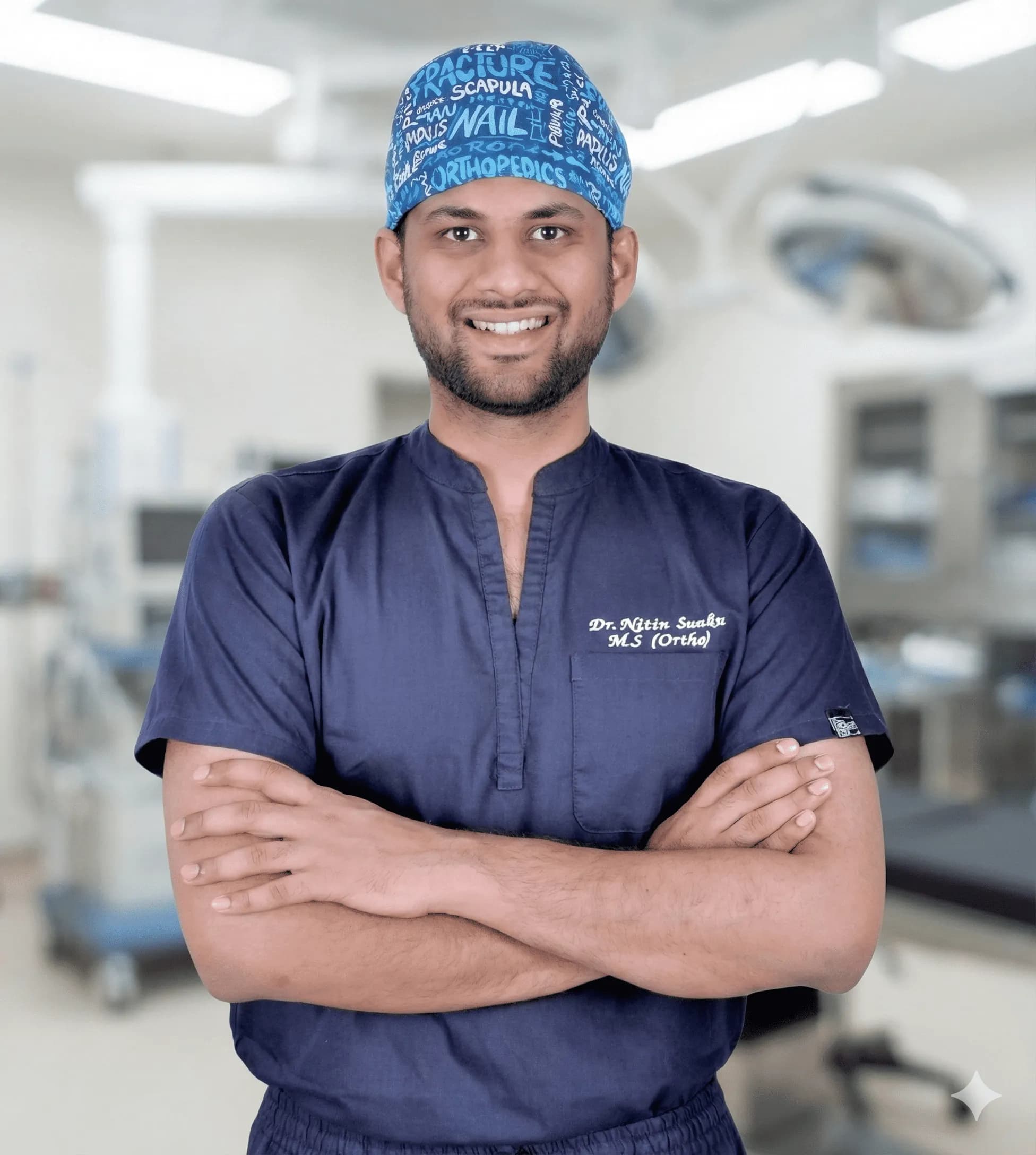
About the Author
Dr. Nitin N Sunku
MBBS, MS (Orthopedics), Fellowship in Arthroscopy & Sports Medicine
Dr. Nitin N Sunku is a Consultant Orthopedic & Sports Medicine Surgeon with over 10 years of focused practice in Bengaluru. He serves as the Team Doctor for Bengaluru FC and consults at Raghava Multispeciality Hospital (Attibele) and Health Nest Hospital (HSR Layout). His clinical interests include arthroscopy, ligament & meniscus care, regenerative orthopedic medicine, ultrasound-guided injections, and joint replacement.
Experiencing symptoms?
Don't let pain hold you back. Schedule a comprehensive evaluation with Dr. Nitin today.
Book Appointment

