This article is for general education and does not replace an in-person assessment, examination, or imaging. Everyone's injury pattern, medical history, and goals differ; use what you read here to prepare better questions for your doctor.
Dr. Nitin N Sunku is a consultant orthopedic and sports medicine surgeon. He sees patients at Raghava Multispeciality Hospital, Attibele, on Sarjapura–Attibele Road, and at Health Nest Hospital, HSR Layout, Bengaluru. If pain is rapidly worsening, you cannot bear weight, you develop numbness or weakness in a limb, or you have fever after an injury, seek urgent medical care. For non-emergency evaluation and individualised treatment options, book through the contact page.
Topics across this blog include knee ligament and meniscus problems, shoulder pain and instability, hip and knee arthritis, fracture recovery principles, spine symptoms when urgent causes have been excluded, running and tendon overuse issues, and what to expect from arthroscopy or joint replacement discussions. If you are comparing sources online, cross-check dates and always confirm advice with an in-person clinician.
Endoscopic spine surgery in India explained by a Bangalore spine surgeon — types, costs, recovery, candidacy, and honest limitations. Read before you decide.
Few areas of orthopedic surgery have evolved as rapidly in the last decade as endoscopic spine surgery india has. What used to require a 5–7 cm incision, significant muscle stripping, and a week in hospital can now — in the right patient — be done through a 7–10 mm keyhole, often under local or spinal anaesthesia, with the patient walking out the same evening. It is, genuinely, one of the most exciting developments in modern spine care.
But endoscopic spine surgery is not magic, and it is not the right answer for every patient. In Dr. Nitin's practice across Attibele and HSR Layout in Bengaluru, the conversation almost always begins the same way: a patient walks in having read about "keyhole" or "laser" spine surgery online and assumes that is automatically the best choice. The job is to be honest. For a single-level disc herniation in a 38-year-old IT professional, endoscopic surgery can be transformative. For a 65-year-old with multi-level stenosis and instability, it may not be the right tool at all. Most patients who come in with back or leg pain don't need surgery in the first place — physiotherapy, weight management, and time resolve a surprising number of disc problems, as discussed in the posts on Sciatica Treatment Without Surgery in India and Herniated Disc Pain. Surgery is reserved for those who genuinely need it.
What endoscopic spine surgery actually is
Endoscopic spine surgery is a technique in which the surgeon makes a 7–10 mm incision and passes a high-definition endoscope — a thin tube with a camera and light at its tip — through either the natural foramen on the side of the spine or the interlaminar window at the back. The actual surgical work — removing a disc fragment, decompressing a nerve, widening a narrowed canal — is performed with miniature instruments that pass alongside the camera, while the surgeon watches a live, magnified video feed on a screen. Saline is continuously irrigated through the endoscope to keep the field clear. Because the instruments work between muscle fibres rather than cutting through them, the disruption to normal anatomy is dramatically less than in open surgery.
Types of endoscopic spine surgery
Transforaminal endoscopic discectomy (TESSYS)
The TESSYS (Transforaminal Endoscopic Surgical System) technique approaches the disc through the natural foramen on the side of the spine. The patient often lies on their side or front, frequently under sedation and local anaesthesia, and can talk to the surgeon during the procedure. This is the workhorse for lateral and foraminal disc herniations in the lumbar spine.
Interlaminar endoscopic discectomy
For disc herniations located more centrally or at the L5–S1 level — where the iliac crest can block the transforaminal route — the endoscope is passed through the back, between the laminae. This is the closest endoscopic equivalent to a traditional microdiscectomy.
Biportal endoscopic spine surgery (BESS / UBE)
Biportal Endoscopic Spine Surgery, also called Unilateral Biportal Endoscopy (UBE), uses two small incisions instead of one — one for the camera, one for the working instruments. This gives the surgeon greater freedom of movement and allows more complex decompressions. BESS is growing rapidly in India and is particularly useful for stenosis and bilateral decompression through a single side.
Endoscopic lumbar decompression
For patients with lumbar canal stenosis — the narrowing of the spinal canal that causes neurogenic claudication — endoscopic decompression widens the canal while preserving the bony architecture and ligaments that maintain stability. This is especially attractive in older patients who want to avoid open surgery.
Endoscopic foraminotomy
When a nerve root is pinched as it exits the spine through the foramen, an endoscopic foraminotomy enlarges that opening and releases the nerve. This is highly targeted and preserves the facet joint, which matters for long-term spinal stability.
Conditions endoscopic spine surgery treats
- Lumbar disc herniation — the most common indication, especially single-level disease
- Foraminal stenosis with radiculopathy — nerve root compression at the exit point
- Cervical disc herniation — in carefully selected cases, posterior endoscopic foraminotomy
- Lateral recess stenosis — narrowing where the nerve root begins its descent
- Synovial cysts at the facet joint — can be excised endoscopically with minimal facet damage
- Sequestered disc fragments — loose disc pieces that have migrated up or down from the disc space
Advantages of endoscopic spine surgery
Smallest incision (7–10 mm)
A scar barely larger than a pen tip, with minimal cosmetic concern and a reduced risk of wound infection.
Minimal muscle and ligament disruption
The paraspinal muscles are spread, not cut. This translates to less post-operative back pain and better long-term spinal mechanics.
Often performed under spinal or local anaesthesia
Many endoscopic discectomies are done with the patient awake and lightly sedated. This is a real advantage for patients with cardiac or pulmonary risk who don't tolerate general anaesthesia well.
Faster early recovery and return to work
Most desk-job patients return to work in 10–14 days, compared with 3–6 weeks after open surgery.
Day-care or 1-night admission possible
A significant proportion of endoscopic discectomies are discharged the same day or the next morning, which reduces hospital costs and exposure to hospital-acquired infection.
Better suited for older patients with comorbidities
The smaller physiological insult and avoidance of general anaesthesia make endoscopic surgery a safer option for diabetic, hypertensive, or cardiac patients in their 60s and 70s.
Limitations and disadvantages
Steep learning curve for the surgeon
Endoscopic spine surgery is technically demanding. The early cases of any endoscopic surgeon take significantly longer than their open equivalents, and outcomes correlate strongly with case volume. This is the single most important variable in your result.
Not suitable for every disc location
Highly migrated fragments, severe central disc extrusions, and certain calcified discs are harder to address endoscopically. Honest pre-operative MRI review matters.
Equipment cost is higher
The endoscope, camera, light source, and disposables are expensive. This is one reason the procedure costs more than equivalent open surgery in India.
Longer operating time early in adoption
Even in experienced hands, complex endoscopic decompressions can take longer than the open equivalent.
Limited utility for fusion-level instability
If you have spondylolisthesis with significant slip, or multi-level degenerative instability, you likely need a fusion — and that is not what endoscopic surgery is designed for. See the detailed Spine Surgery Cost in India guide for what fusion involves.
Not all hospitals have the endoscopic stack
The equipment is a significant capital investment, so not every hospital offers it. Choose your hospital as carefully as you choose your surgeon.
Endoscopic vs open microdiscectomy: which is better?
Honest answer: open microdiscectomy remains the time-tested gold standard with the widest evidence base — decades of data, predictable outcomes, and surgeons trained in it everywhere. Endoscopic surgery offers a smaller incision, faster early recovery, less muscle damage, and is often preferred by patients who want to be back at work in two weeks. But it requires a surgeon with substantial endoscopic case volume to deliver those advantages reliably. The published literature shows that at the 3-month mark, well-selected patients have similar outcomes either way. The difference is mostly in the first six weeks — and in the experience of your surgeon. For more detail on the disc herniation surgical decision overall, the Lumbar Disc Herniation Surgery in India post walks through the full algorithm.
Endoscopic spine surgery cost in India
- Single-level endoscopic discectomy (TESSYS): ₹2,50,000 – ₹4,50,000
- Biportal endoscopic spine surgery (BESS): ₹3,00,000 – ₹5,00,000
- Endoscopic lumbar decompression: ₹3,00,000 – ₹5,50,000
- Endoscopic foraminotomy: ₹2,80,000 – ₹4,80,000
Endoscopic surgery is typically 20–40% more expensive than the equivalent open procedure, driven by disposables, the endoscopic stack, and longer OT time. The good news is that most major insurance policies in India now cover endoscopic spine surgery under cashless arrangements — pre-authorisation is usually straightforward when the MRI and clinical notes clearly justify it.
Recovery after endoscopic spine surgery
- Day 0–1: Most patients walk within 2–4 hours of surgery and are discharged the same evening or next morning.
- Week 1–2: Light walking, gentle daily activities. No lifting beyond 2–3 kg. Stitches off around day 10.
- Week 2–4: Most desk-job patients return to work. Driving short distances is usually fine after week 2.
- Week 4–6: Begin structured spine rehabilitation — core strengthening, hamstring flexibility, posture work.
- Month 3–6: Full return to gym, sport, and physical work, depending on the procedure performed.
Who is a good candidate?
- Single-level disc herniation with leg pain dominant over back pain
- No significant spinal instability or spondylolisthesis
- No multi-level degenerative disease requiring fusion
- MRI confirms a clearly defined, accessible target lesion
- Symptoms have not responded to 6–12 weeks of conservative care
- Neurological deficit, severe pain, or progressive weakness
How to choose a surgeon for endoscopic spine surgery in India
- Dedicated endoscopic spine training — a formal fellowship, not just a weekend course
- High case volume — ideally more than 50 endoscopic spine cases per year
- Willingness to discuss non-surgical options first — a surgeon who only offers surgery is the wrong surgeon
- Intra-operative imaging available — C-arm fluoroscopy at minimum, ideally O-arm or navigation
- Written cost estimate — no "final bill will be different" surprises
- Honest conversation about realistic outcomes — including what could go wrong
Book a spine consultation in Attibele or HSR Layout
If you have leg or back pain that hasn't resolved with rest and physiotherapy, or if your MRI shows a disc herniation and you're weighing your options, Dr. Nitin would be glad to review your case. Consultations are available at Raghava Multispeciality Hospital, Attibele (call +91-9980031006) and Health Nest Hospital, HSR Layout (call +91-9449031003). Please bring any prior MRI films and reports along. Many patients leave the first visit reassured that they don't need surgery at all — and when surgery is needed, you'll get a clear, honest plan.
Frequently Asked Questions
Is endoscopic spine surgery safe?
In experienced hands, yes. Complication rates — infection, dural tear, recurrent herniation — are comparable to or lower than open microdiscectomy. The single biggest safety variable is surgeon experience.
How long is the recovery after endoscopic spine surgery?
Most patients are home the same day or the next morning, walking within hours, and back at desk work in 10–14 days. Full recovery and return to heavy activity takes 3–6 months depending on the procedure.
Will I have a lot of pain after surgery?
Surprisingly little. Because the muscles are spread rather than cut, post-operative back pain is much less than after open surgery. Most patients manage on oral painkillers for 5–7 days.
Is it day-care or does it need hospital admission?
A simple single-level endoscopic discectomy is often done as day-care or with one overnight stay. More complex decompressions and BESS procedures usually need 1–2 nights in hospital.
Can endoscopic surgery be done for cervical (neck) discs?
In carefully selected cases, yes — posterior endoscopic cervical foraminotomy is an excellent option for lateral cervical disc herniations causing arm pain. Central cervical discs are still better managed with anterior cervical discectomy and fusion.
Endoscopic spine surgery vs microdiscectomy — which should I choose?
If you have a single-level disc herniation, a good MRI target, and access to a high-volume endoscopic surgeon, endoscopic offers faster early recovery and less muscle damage. If your surgeon is more experienced in microdiscectomy, that's the better choice for you. The surgeon's skill matters more than the technique.
Does insurance cover endoscopic spine surgery in India?
Yes, most major Indian insurance policies cover endoscopic spine surgery under cashless arrangements, provided the MRI and clinical notes clearly justify surgical intervention. Pre-authorisation is usually straightforward.
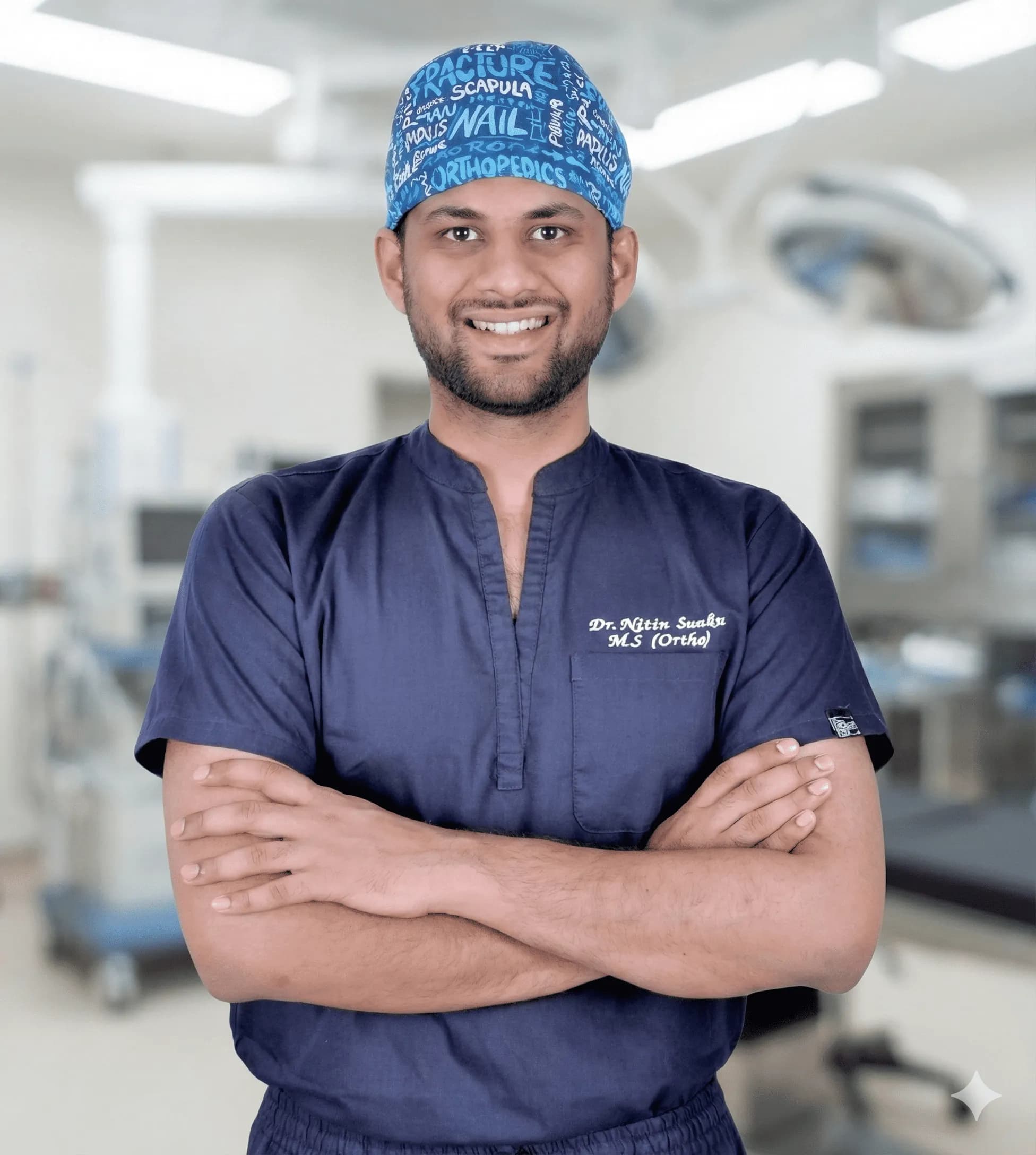
About the Author
Dr. Nitin N Sunku
MBBS, MS (Orthopedics), Fellowship in Arthroscopy & Sports Medicine
Dr. Nitin N Sunku is a Consultant Orthopedic & Sports Medicine Surgeon with over 10 years of focused practice in Bengaluru. He serves as the Team Doctor for Bengaluru FC and consults at Raghava Multispeciality Hospital (Attibele) and Health Nest Hospital (HSR Layout). His clinical interests include arthroscopy, ligament & meniscus care, regenerative orthopedic medicine, ultrasound-guided injections, and joint replacement.
Experiencing symptoms?
Don't let pain hold you back. Schedule a comprehensive evaluation with Dr. Nitin today.
Book Appointment

