This article is for general education and does not replace an in-person assessment, examination, or imaging. Everyone's injury pattern, medical history, and goals differ; use what you read here to prepare better questions for your doctor.
Dr. Nitin N Sunku is a consultant orthopedic and sports medicine surgeon. He sees patients at Raghava Multispeciality Hospital, Attibele, on Sarjapura–Attibele Road, and at Health Nest Hospital, HSR Layout, Bengaluru. If pain is rapidly worsening, you cannot bear weight, you develop numbness or weakness in a limb, or you have fever after an injury, seek urgent medical care. For non-emergency evaluation and individualised treatment options, book through the contact page.
Topics across this blog include knee ligament and meniscus problems, shoulder pain and instability, hip and knee arthritis, fracture recovery principles, spine symptoms when urgent causes have been excluded, running and tendon overuse issues, and what to expect from arthroscopy or joint replacement discussions. If you are comparing sources online, cross-check dates and always confirm advice with an in-person clinician.
Cervical disc replacement in India explained by a Bengaluru spine surgeon — ACDR vs ACDF fusion, who qualifies, devices, real costs, and honest recovery.
Your MRI report mentions a cervical disc herniation at C5–C6 or C6–C7. Your arm hurts, maybe two fingers feel numb, and the surgeon you saw last week suggested a fusion — ACDF. Then a friend or a YouTube video mentioned cervical disc replacement india, and now you're wondering whether the artificial disc is a better option, whether it's available here, and whether you actually need surgery at all. These are the right questions to ask, and you should ask them before anyone touches your neck.
Here is the part most patients are not told clearly: the majority of cervical disc herniations settle down with 6–12 weeks of physiotherapy, posture correction, a short course of medication and, occasionally, a nerve root injection. Surgery — whether ACDF or artificial disc replacement — is for the smaller group whose arm pain, weakness or numbness does not improve, or whose MRI shows significant spinal cord compression. Dr. Nitin N Sunku's practice in Bengaluru is conservative-first: non-surgical options are exhausted before discussing implants. If surgery is genuinely needed, this guide walks you through what cervical disc replacement is, when it's the right choice, when ACDF is still the better answer, and what it costs in India today.
What cervical disc replacement actually is
Cervical disc replacement — also called ACDR (Anterior Cervical Disc Replacement) or artificial cervical disc surgery — involves removing the damaged disc through a small incision at the front of the neck and inserting a mobile implant in its place. Unlike ACDF, which locks two vertebrae together with bone and a plate, the artificial disc preserves motion at that level. The pinched nerve gets decompressed in exactly the same way; what changes is what fills the empty disc space afterwards.
Cervical disc replacement vs ACDF (fusion)
This is the central decision. Both operations relieve arm pain. They differ in what happens to your neck mechanics for the next 20 years.
ACDF (Anterior Cervical Discectomy and Fusion)
ACDF has been performed for over 60 years and is still the time-tested gold standard for most cervical disc problems. The disc is removed, a cage or bone graft is placed, and a small titanium plate locks the level together until it heals into one solid bone block.
- Pros: proven long-term data, lower implant cost, works in almost any neck (kyphosis, instability, poor bone, multi-level), insurance approval is straightforward.
- Cons: the fused level no longer moves, which puts more load on the discs immediately above and below — the well-known phenomenon of adjacent-segment disease, which can occasionally need further surgery 10–15 years later.
Cervical disc replacement / ACDR
ACDR replaces the disc with a moving implant. The level continues to bend and rotate, which biomechanically should reduce stress on neighbouring discs.
- Pros: preserved neck motion, faster return to activity for many patients, growing evidence at 7–10 years that adjacent-segment disease is less common than after fusion, no need for a hard collar in most cases.
- Cons: stricter patient selection, higher implant cost, more insurance scrutiny in India, a small risk of heterotopic ossification (bone forming around the implant) that can stiffen the level anyway.
When is cervical disc replacement appropriate?
ACDR is not a universal upgrade over ACDF — it is the right operation for a specific anatomy. You are usually a candidate if you meet most of these:
- Single-level or two-level cervical disc disease between C3 and C7
- Preserved facet joint health on CT or MRI
- No significant cervical kyphosis (reversed curve) or instability
- Good bone quality and a normal BMI
- Age generally under 65
- No previous neck surgery at that level
- Failed 6–12 weeks of structured conservative care — physiotherapy, activity modification, posture work, and where appropriate a nerve root injection
When is ACDR NOT a good choice?
Honest patient selection is what separates a good outcome from a difficult one. ACDR should usually be avoided when any of these are present:
- Multi-level disease involving three or more discs
- Significant facet joint arthritis (the implant cannot fix arthritic joints behind the disc)
- Cervical instability or spondylolisthesis
- Osteoporosis or poor bone quality — the implant needs bone to anchor into
- Severe cervical kyphosis — a motion-preserving device cannot restore a lost curve
- Prior fusion at the same or adjacent level
- Severe ligamentous instability of the neck
If any of these apply, ACDF is the more honest answer. A surgeon who recommends ACDR despite these findings is selling the implant, not solving the problem.
Devices available in India
Several FDA-approved artificial discs are available through Indian distributors. The implant brand matters less than the surgeon's experience with that specific device:
- Mobi-C (Zimmer Biomet) — widely used, FDA-approved for one and two-level use
- Prestige LP (Medtronic) — titanium ceramic, long track record
- M6-C (Spinal Kinetics / Orthofix) — polymer core that mimics a natural disc
- Prodisc-C (Centinel Spine) — one of the original cervical disc designs
Ask which device your surgeon implants most often, and how many cases per year. Volume on the specific device matters more than the brochure.
Cervical disc replacement cost in India
Costs in Bengaluru and other Indian metros in 2026 are broadly:
- Single-level ACDR (e.g. C5 C6 disc replacement): ₹3,50,000 – ₹6,00,000
- Two-level ACDR: ₹5,00,000 – ₹8,00,000
- Hybrid construct (ACDR + ACDF at adjacent level): ₹5,50,000 – ₹8,50,000
The single biggest variable is the implant itself — the device can account for 40–55% of the total. Insurance scrutiny is notably higher for ACDR than for ACDF; many policies will reimburse only up to the equivalent ACDF amount and ask the patient to pay the implant difference. Get a written estimate that separates surgeon, hospital, anaesthesia and implant costs — the same advice the Spine Surgery Cost in India guide on this site lays out.
Recovery after cervical disc replacement
- Day 0–1: surgery takes 60–120 minutes; most patients are sitting up the same evening and discharged within 24–48 hours. A soft collar is optional, not mandatory.
- Week 1–2: light walking, normal household activity, gentle neck movement actively encouraged — movement is the whole point of the implant.
- Week 2–4: return to desk work and driving for most patients.
- Week 4–6: light gym, cycling, swimming under physiotherapist guidance.
- Month 3–6: full return to sport and heavy activity. Neck range of motion at 6 months is usually equal to or slightly better than before surgery.
Risks and realistic outcomes
Realistic numbers: 85–90% of correctly selected patients get good to excellent arm pain relief. Neck pain improves in most but not all — if your dominant problem is axial neck pain rather than arm pain, no spine operation has a 90% success rate, and you should be cautious about anyone promising one. Specific risks include heterotopic ossification around the implant (which can gradually fuse the level anyway in a small percentage), device migration (rare with modern implants), adjacent-segment disease (less common than after ACDF but not zero), infection, and persistent neck stiffness. These mirror the honest risk discussions in the Lumbar Disc Herniation Surgery in India and Endoscopic Spine Surgery India articles.
How to choose a surgeon for ACDR in India
- Ask about the surgeon's personal volume in ACDR specifically, not just ACDF — the two are different operations
- Confirm formal training and proctoring on the specific device being recommended
- The surgeon should be willing to spend most of the first consultation discussing non-surgical options — see the Sciatica Treatment Without Surgery in India guide for the cervical equivalent of that approach
- Intra-operative imaging (fluoroscopy or O-arm) should be standard
- A written, itemised estimate, in advance
- A clear answer to: "Why ACDR and not ACDF for me?"
Book a cervical spine consultation in Attibele or HSR Layout
Dr. Nitin N Sunku consults at Raghava Multispeciality Hospital, Attibele (+91-9980031006) and Health Nest, HSR Layout (+91-9449031003). Please bring your latest cervical MRI (films and report), any previous X-rays or CT, a list of current medications, and notes on what conservative treatment you have already tried and for how long. Most cervical disc patients seen here do not need surgery — and the ones who do deserve a clear, unhurried discussion of ACDR versus ACDF before any decision is made.
Frequently Asked Questions
What is the difference between ACDR and ACDF?
ACDF removes the disc and fuses two vertebrae into one solid bone block, locking that level. ACDR removes the disc and replaces it with an artificial implant that continues to move. Both decompress the nerve equally well; the difference is whether the level keeps moving or not.
How long is recovery after cervical disc replacement in India?
Most patients are back to desk work within 2–4 weeks, driving by week 3 once neck rotation is comfortable, and back to gym, swimming or yoga between 6 and 12 weeks. Heavy contact sports wait 3–6 months.
How long does an artificial cervical disc last?
Modern devices have published follow-up data out to 10–15 years with very low revision rates. They are designed to last decades, though long-term real-world data beyond 20 years is still being collected.
Can I have two-level cervical disc replacement?
Yes — two-level ACDR is FDA-approved and routinely performed in India in suitable candidates. Three or more levels is generally better managed with ACDF or a hybrid construct.
Does insurance in India cover cervical disc replacement?
Most Indian insurers cover the procedure but with greater scrutiny than ACDF. Many will reimburse up to the equivalent ACDF amount and ask the patient to pay the implant difference. Pre-authorisation with detailed MRI justification is strongly recommended.
When can I drive after cervical disc replacement?
Usually 2–3 weeks, once you can turn your head comfortably both ways and are off strong pain medication. Highway driving and long journeys are typically fine from week 4.
How do I know if I need surgery or just more physiotherapy?
If your arm pain, numbness or weakness is improving week-on-week with 6–12 weeks of structured physiotherapy, posture correction and medication, you almost certainly do not need surgery. Surgery is for progressive weakness, intractable arm pain that has plateaued despite conservative care, or MRI evidence of significant spinal cord compression.
About the Author
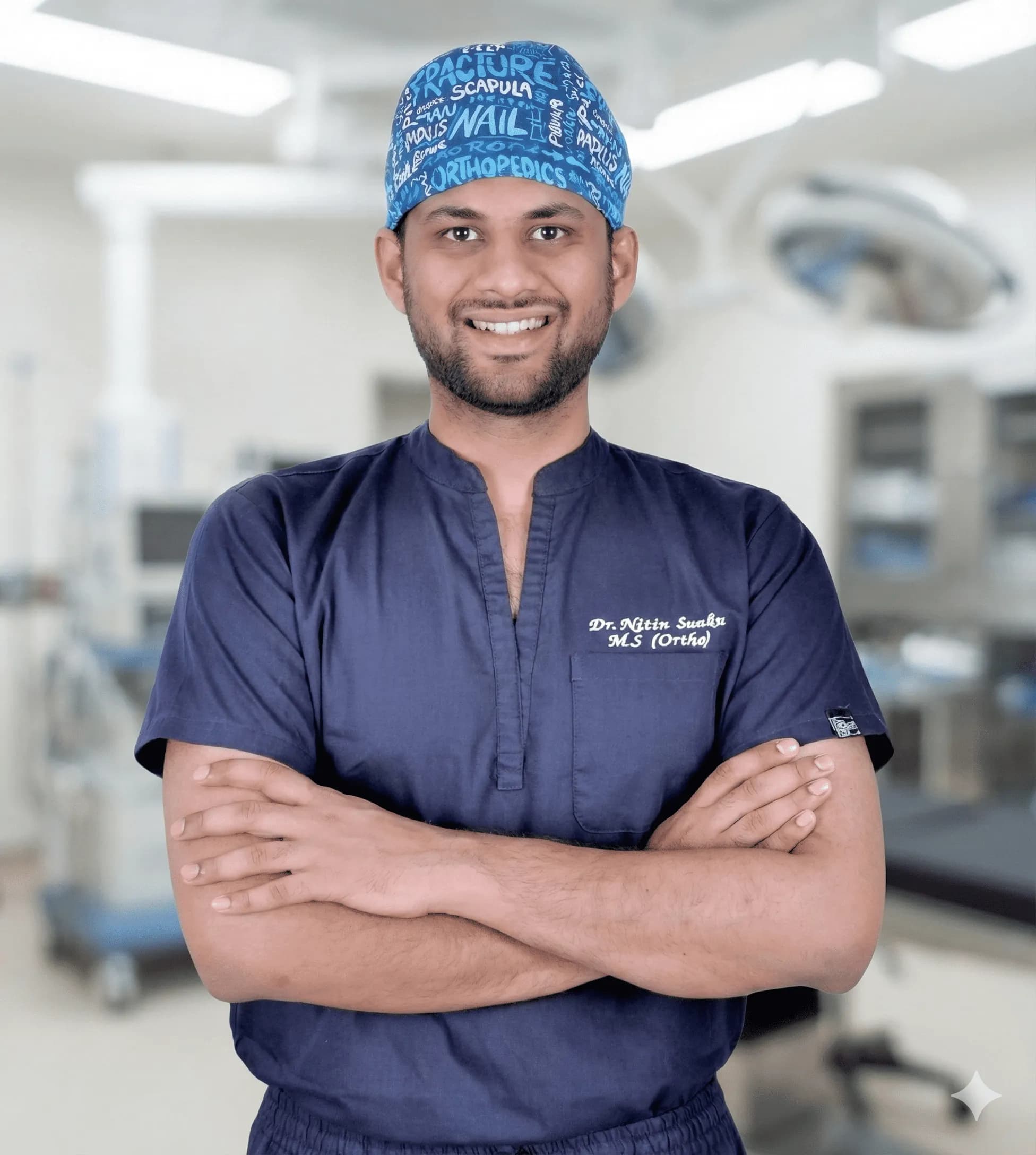
Dr. Nitin N Sunku
MBBS, MS (Orthopedics), Fellowship in Arthroscopy & Sports Medicine
Dr. Nitin N Sunku is a Consultant Orthopedic & Sports Medicine Surgeon with over 10 years of focused practice in Bengaluru. He serves as the Team Doctor for Bengaluru FC and consults at Raghava Multispeciality Hospital (Attibele) and Health Nest Hospital (HSR Layout). His clinical interests include arthroscopy, ligament & meniscus care, regenerative orthopedic medicine, ultrasound-guided injections, and joint replacement.
Experiencing symptoms?
Don't let pain hold you back. Schedule a comprehensive evaluation with Dr. Nitin today.
Book Appointment

