This article is for general education and does not replace an in-person assessment, examination, or imaging. Everyone's injury pattern, medical history, and goals differ; use what you read here to prepare better questions for your doctor.
Dr. Nitin N Sunku is a consultant orthopedic and sports medicine surgeon. He sees patients at Raghava Multispeciality Hospital, Attibele, on Sarjapura–Attibele Road, and at Health Nest Hospital, HSR Layout, Bengaluru. If pain is rapidly worsening, you cannot bear weight, you develop numbness or weakness in a limb, or you have fever after an injury, seek urgent medical care. For non-emergency evaluation and individualised treatment options, book through the contact page.
Topics across this blog include knee ligament and meniscus problems, shoulder pain and instability, hip and knee arthritis, fracture recovery principles, spine symptoms when urgent causes have been excluded, running and tendon overuse issues, and what to expect from arthroscopy or joint replacement discussions. If you are comparing sources online, cross-check dates and always confirm advice with an in-person clinician.
A week-by-week home physiotherapy plan after hip replacement — precautions, exercises, common mistakes, and when to call your orthopedic surgeon.
A successful hip replacement is only half the journey. The other half — the half that decides whether you walk smoothly without a limp, climb stairs confidently, and return to the life you love — happens during the weeks and months after surgery. The right hip replacement physiotherapy exercises in India, done consistently at home, are what convert a technically perfect surgery into a genuinely excellent functional outcome.
At Dr. Nitin N Sunku's practice in Attibele and HSR Layout, patients are given a structured rehabilitation roadmap before they even leave the hospital. The principle is simple: simple exercises done every single day beat complex routines done sporadically. If you are 1–6 weeks post hip replacement, or you are helping a family member through recovery, this guide walks you through exactly what to do, when to do it, and what to avoid.
Why physiotherapy after hip replacement matters
Surgery removes the damaged joint surfaces and replaces them with a new implant, but it does not restore the muscles that have weakened from years of arthritic pain. Physiotherapy after hip replacement does five critical things: it re-activates the gluteal and quadriceps muscles that have switched off, prevents scar tissue from limiting your new joint's range, restores a normal walking pattern (gait retraining), rebuilds balance and proprioception, and — most importantly in the first 6–12 weeks — reduces the risk of dislocation, particularly for patients who had a posterior approach surgery.
Hip precautions you must follow for the first 6 weeks
Before any exercise, learn the precautions. These are non-negotiable for posterior-approach hip replacements during the early healing window:
- No hip flexion past 90° — do not bring your knee higher than your hip when sitting or lying.
- No crossing legs at the knee or ankle, in any position.
- No internal rotation of the operated leg — keep toes pointing forward or slightly out, never turned in.
- Use a wedge or abduction pillow between your knees when sleeping on your side.
- Use a raised toilet seat for at least 6 weeks to avoid deep hip flexion.
- Do not bend forward at the waist to reach your feet, pick up objects, or put on socks — use a reacher or sock aid.
Note: patients who had an anterior approach hip replacement have different and generally fewer precautions. Always confirm with your operating surgeon which set of rules applies to you.
Hip replacement physiotherapy exercises: a day-by-day plan
Day 0–2 (in hospital)
Recovery begins within hours of surgery. The focus is circulation, lung function, and waking up the muscles around the new joint.
- Ankle pumps — every hour while awake.
- Isometric quadriceps sets — tighten the thigh muscle, hold 5 seconds.
- Gluteal sets — squeeze the buttocks, hold 5 seconds.
- Deep breathing exercises with a spirometer.
- Standing and a few supervised steps with a walker, usually by Day 1.
Week 1–2 (early home phase)
You are home, using a walker, and the goal is gentle movement multiple times a day.
- Heel slides — slide the heel toward the buttock, staying within 90° of hip flexion.
- Hip abduction lying down — slide the operated leg out to the side and back.
- Mini squats holding the kitchen counter for support.
- Marching in place while holding the walker.
- Sit-to-stand practice from a firm, raised chair.
Week 3–6 (intermediate phase)
Most patients transition from walker to a single cane in this window. Exercises become more upright and load-bearing.
- Standing hip abduction with support.
- Standing hip extension at a wall.
- Stationary cycling — seat raised high so the hip never flexes beyond 90°; never use a low seat.
- Step-ups on a low (10 cm) step.
- Single-leg balance holding a support, 10–20 seconds.
Week 6–12 (progressive loading)
After the 6-week follow-up and your surgeon's clearance, precautions are usually relaxed and strengthening intensifies.
- Bridges — lying on the back, lift the hips off the bed.
- Clamshells within precautions.
- Resistance band hip abduction and extension.
- Treadmill walking at a gentle gradient.
- Swimming and pool walking, once the wound is fully healed.
- Stationary cycling with normal pedal stroke.
Months 3–6 (return to life)
You should feel close to normal by now. The focus shifts to long-term joint health and confidence.
- Gym-based glute strengthening — hip thrusts, supported lunges, leg press within range.
- Balance and proprioception drills on a soft mat or wobble board.
- Brisk outdoor walking, 30–45 minutes a day.
- Light golf, recreational doubles tennis, gentle yoga — with your surgeon's explicit clearance.
Detailed how-to for the 6 most important exercises
1. Ankle pumps
Position: lying or sitting with legs straight. Movement: pump the foot up and down at the ankle. Reps: 20 repetitions every waking hour for the first week. Why: these prevent deep vein thrombosis (DVT), the most dangerous post-surgical complication. Mistake to avoid: doing them only twice a day — they must be hourly.
2. Gluteal sets and quad sets
Position: lying flat in bed. Movement: tighten the buttock muscles (gluteal set) or press the back of the knee into the bed (quad set), hold for 5 seconds, release. Reps: 10 holds, 3 sets, three times a day. Mistake to avoid: holding your breath — breathe normally throughout.
3. Heel slides
Position: lying on the back, legs straight. Movement: slowly slide the heel of the operated leg toward the buttock, then slide it back. Reps: 10 repetitions, 3 sets, twice a day. Mistake to avoid: bending the hip past 90° — stop when the thigh begins to rise.
4. Standing hip abduction
Position: standing tall, holding a sturdy chair or counter. Movement: lift the operated leg straight out to the side, keeping the toes pointing forward, then lower slowly. Reps: 10 repetitions, 2–3 sets, twice a day. Why: this is the single most important exercise for preventing a Trendelenburg limp. Mistake to avoid: leaning to the opposite side — keep the torso upright.
5. Sit-to-stand
Position: seated on a firm, raised chair, feet flat. Movement: stand up using leg strength, not by pulling on furniture; sit back down with control. Reps: 10 repetitions, 2 sets, twice a day. Mistake to avoid: flopping into the chair on the way down — control the descent.
6. Bridges (after week 6, with surgeon clearance)
Position: lying on your back, knees bent, feet flat. Movement: squeeze the glutes and lift the hips off the bed into a straight line from shoulder to knee, hold 3 seconds, lower slowly. Reps: 10 repetitions, 2–3 sets, daily. Mistake to avoid: arching the lower back instead of squeezing the glutes.
Common mistakes that slow recovery
- Skipping daily exercises because you feel tired or sore — consistency matters more than intensity.
- Doing too much too soon — pushing through pain in week 2 sets recovery back, not forward.
- Ignoring pain that lasts more than 24 hours after an activity — this is a clear signal that you overdid it.
- Forgetting precautions in week 3, when most patients feel surprisingly good and become careless — this is when many dislocations happen.
- Sleeping in a bad position without the wedge pillow, or sleeping on the operated side too early.
- Sitting in low sofas or car seats that force the hip past 90°.
Signs you should stop and call your surgeon
- Persistent or worsening hip pain that is different from normal post-surgical soreness.
- Fever above 100.4°F (38°C) or chills.
- Redness, warmth, or drainage from the surgical wound.
- Calf swelling, tenderness, or pain — possible DVT.
- Sudden inability to bear weight on the operated leg.
- A sensation of popping, clunking, or the leg feeling "out of place" — possible dislocation, an emergency.
Hip replacement physiotherapy in India: typical session cost
Home physiotherapy visits in Bengaluru typically cost ₹500–₹1,500 per session depending on the therapist's experience and travel distance. Clinic-based packages work out cheaper per session when bought as a 10- or 20-visit bundle. Many Indian health insurance policies will partly reimburse post-operative rehabilitation when it is documented as part of the surgical care plan — ask your insurer in advance. For a complete view of the surgical investment, see the pillar guide on Hip Replacement Surgery Cost in India. If you are still weighing whether surgery is the right call, the article on Natural Alternatives to Hip Replacement covers the non-surgical options worth trying first.
Get a personalised rehab plan in Attibele or HSR Layout
Dr. Nitin N Sunku's team coordinates closely with trusted physiotherapists in South Bengaluru and reviews every patient's rehabilitation progress at the standard 2-week, 6-week, and 3-month follow-ups. If a milestone is not being met, the plan is adjusted — rehab is never one-size-fits-all.
- Raghava Multispeciality Hospital, Attibele — +91-9980031006
- Health Nest Hospital, HSR Layout — +91-9449031003
Frequently Asked Questions
How long do I need physiotherapy after hip replacement?
Most patients benefit from supervised physiotherapy for 6–12 weeks, followed by an independent home exercise program for another 3–6 months. Strength and gait usually continue improving for up to a year after surgery.
Can I walk without a walker?
Most patients progress from walker to a single cane around weeks 3–4, and to unaided walking around weeks 6–8. Your surgeon will confirm the timing based on your gait and X-ray findings.
When can I climb stairs?
Stair climbing usually starts with the "good leg up, operated leg down" rule under physiotherapy supervision in week 2. Normal alternating-foot stairs typically return by week 6–8.
Can I do yoga after hip replacement?
Gentle, modified yoga is generally safe from around the 3-month mark, but deep hip flexion poses, cross-legged sitting (padmasana), and extreme rotations should be avoided long term. Always confirm specific poses with your surgeon.
How many times a day should I exercise?
The structured exercise routine should be done twice a day during the first 6 weeks, in sessions of around 20–30 minutes. Ankle pumps and short walks should be much more frequent — hourly while awake in the first two weeks.
When can I drive?
For a right hip replacement, driving is usually permitted around 6 weeks, once you can sit comfortably and react quickly. For a left hip replacement with an automatic car, it can be slightly earlier. Never drive while on strong pain medication.
What if I have pain during exercise?
Mild discomfort or stretching sensation during exercise is normal. Sharp pain, pain that lingers more than 24 hours, or pain that worsens day by day is not — stop the exercise and contact your surgeon's team for review.
This article is general post-operative guidance. Individual rehabilitation plans vary, particularly between posterior and anterior surgical approaches, and your operating surgeon's instructions always take precedence over any online resource.
About the Author
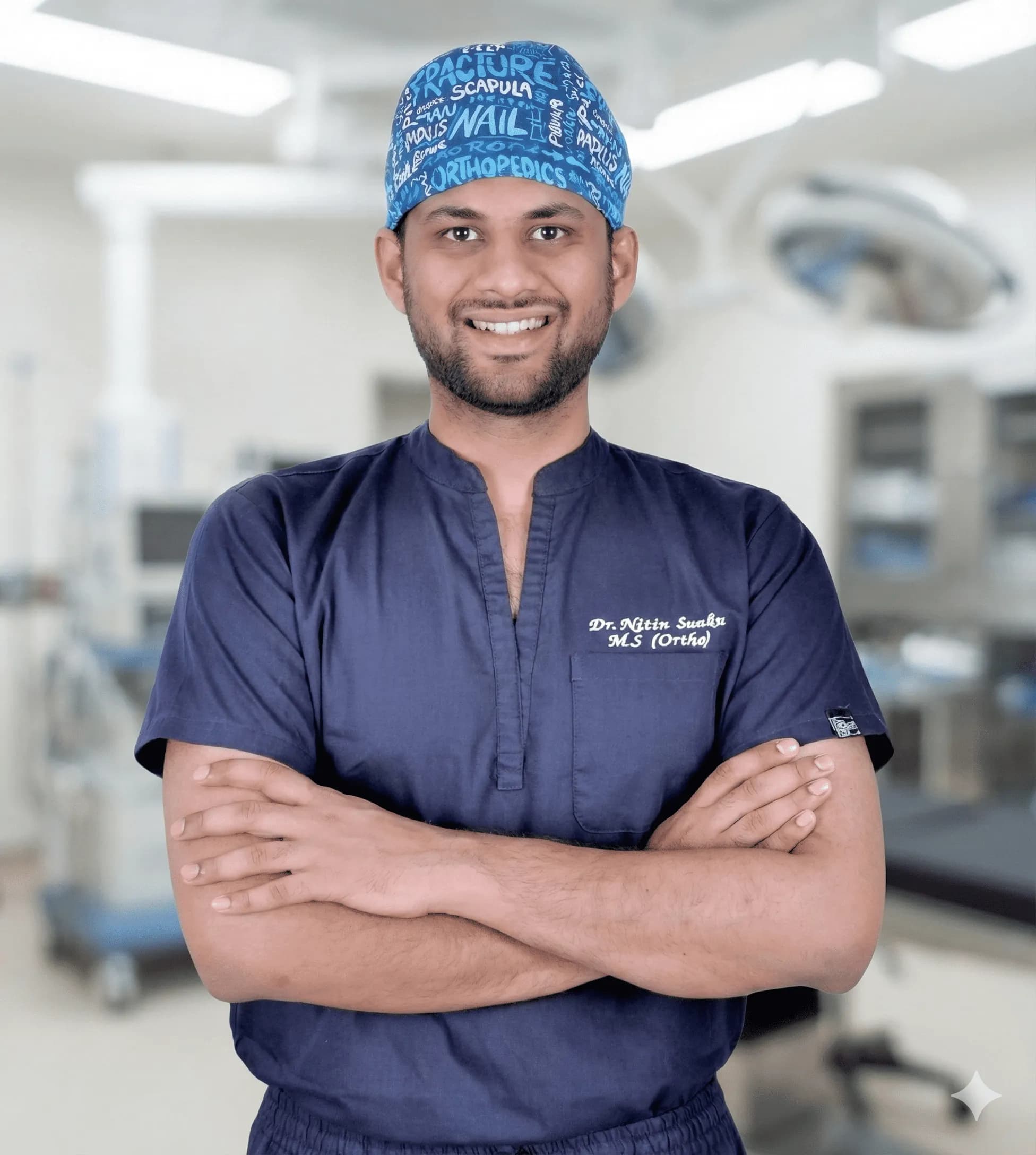
Dr. Nitin N Sunku
MBBS, MS (Orthopedics), Fellowship in Arthroscopy & Sports Medicine
Dr. Nitin N Sunku is a Consultant Orthopedic & Sports Medicine Surgeon with over 10 years of focused practice in Bengaluru. He serves as the Team Doctor for Bengaluru FC and consults at Raghava Multispeciality Hospital (Attibele) and Health Nest Hospital (HSR Layout). His clinical interests include arthroscopy, ligament & meniscus care, regenerative orthopedic medicine, ultrasound-guided injections, and joint replacement.
Experiencing symptoms?
Don't let pain hold you back. Schedule a comprehensive evaluation with Dr. Nitin today.
Book Appointment
